Stablecoin Arbitrage: USDT/USDC Spreads, Depegs and Quote-Currency Gaps Between Exchanges Thursday November 19th, 2026 – Posted in: Arbitrage Software, cryptoarbitrage software
Stablecoin Arbitrage: USDT/USDC Spreads, Depegs and Quote-Currency Gaps Between Exchanges
USDT and USDC are both meant to be worth one dollar, yet on exchanges they rarely trade at exactly 1.0000 against each other, and in a crisis the gap can reach several percent. This guide explains where stablecoin price differences come from, how to measure them in basis points, why a BTC/USDT versus BTC/USDC “spread” is often not an arbitrage at all, what a real snapshot of seven exchanges looks like, and how fees, transfers, freezes and depeg risk decide whether a stablecoin trade makes money.
- Stablecoin arbitrage: the short answer
- Why a stablecoin is not exactly one dollar
- Five types of stablecoin arbitrage
- The math in basis points: a worked USDC/USDT example
- Quote-currency gaps: the scanner trap
- Real snapshot: USDC/USDT on seven exchanges
- Depegs: what happened in 2022 and 2023
- Trading a depeg: a bet on redemption, not arbitrage
- Costs and frictions that eat the spread
- Inventory: holding both stablecoins on both venues
- How bots and scanners should handle stablecoins
- Step by step: checking a stablecoin opportunity
- Risks and limitations
- FAQ
Stablecoin arbitrage: the short answer
Short answer: stablecoin arbitrage means profiting from price differences between dollar stablecoins such as USDT and USDC, or between the same stablecoin on different exchanges, networks or fiat markets. In calm markets these differences are tiny, usually a fraction of a basis point to a few basis points (1 basis point = 0.01%), so the trade only works with very low fees, large size and inventory already placed on both venues. The bigger gaps appear during depegs, but then the trade stops being arbitrage and becomes a bet that the coin will be redeemed at one dollar. The most common practical use of stablecoin knowledge is defensive: making sure that a BTC/USDT versus BTC/USDC price difference is not mistaken for an arbitrage opportunity.
Stablecoins are the quote currency of most crypto trading. Almost every cross-exchange crypto arbitrage trade either uses a stablecoin as its cash leg or compares prices quoted in two different stablecoins. That makes the small, usually ignored differences between them important in two ways: they can be traded directly, and they silently distort every other spread you measure.
The first two cards are measured values from our snapshot of public exchange order books on 19 November 2026 (see below). They change constantly and are not a forecast.
Why a stablecoin is not exactly one dollar
A fiat-backed stablecoin holds its value because large, verified customers can create (mint) new tokens by sending dollars to the issuer and can redeem tokens for dollars. If the market price drops to 0.995, such a customer can buy tokens cheaply and redeem them at 1.00; if it rises to 1.005, they can mint at 1.00 and sell. This primary-market arbitrage keeps the price close to the peg, but it is not perfect, and the reasons it is imperfect are exactly the reasons secondary-market gaps exist:
- Access is limited. Minting and redemption are available only to onboarded institutional customers, with minimum sizes and sometimes fees. Retail traders and most trading firms can only trade the token on exchanges.
- Banking hours and settlement. Dollars move through banks that close at weekends and on holidays. When the fiat rail is closed, the pressure that pulls the price back to 1.00 weakens.
- Different demand on different exchanges. On venues where most pairs are quoted in USDT, demand for USDT is structurally higher; where USDC pairs dominate, the reverse happens. Persistent premiums of a few basis points follow.
- Market makers’ inventory. Between issuer and exchange stand market makers who hold inventory of both coins. When their inventory is one-sided they shift their quotes, which moves the pair by a few basis points for hours or days.
- Perceived issuer risk. The market prices the quality of reserves, transparency and regulatory status. When confidence in one issuer drops, its coin trades at a discount to the others, sometimes sharply.
- Regulatory availability. Some exchanges restricted non-compliant stablecoins for users in certain regions, for example in the European Economic Area under the MiCA rules in 2024 and 2025. Restricted supply and one-way flows can leave regional prices out of line.
Five types of stablecoin arbitrage
“Stablecoin arbitrage” covers several different trades with very different risk. Mixing them up is the most common reason why an opportunity that looked risk-free turns out not to be.
| Type | What you trade | Typical gap | Main risk |
|---|---|---|---|
| 1. Cross-exchange stable pair | Buy USDC/USDT on exchange A, sell it on exchange B | 0 to a few bp in calm markets | Fees larger than the gap; inventory and transfer cost |
| 2. Quote-currency gap | BTC/USDT on one book versus BTC/USDC on another (or the same exchange) | Mostly equal to the USDC/USDT rate itself | Phantom spread: no profit after converting quotes |
| 3. Stablecoin vs fiat | USDT/USD or USDC/USD versus 1.00, or against regional fiat pairs | Several bp; larger in local fiat markets | Fiat withdrawal limits, banking delays, capital controls |
| 4. Mint and redeem | Buy below 1.00 on an exchange, redeem with the issuer (or the reverse) | A few bp normally, large in stress | Access only for onboarded institutions; redemption delays |
| 5. Depeg trade | Buy a stablecoin trading well below 1.00, wait for recovery | 1% to 15% or more | The peg does not recover: this is a directional bet |
A sixth variant runs on decentralized exchanges: stablecoin pools on AMMs drift when large holders swap out of one coin, and arbitrage bots rebalance them. The mechanics, gas and MEV costs of that version are covered in our guide to CEX-DEX arbitrage and AMM price impact. This article focuses on centralized exchanges.
The math in basis points: a worked USDC/USDT example
Stablecoin gaps are so small that percentages become awkward; traders use basis points. The gross gap between two venues is the bid on the selling venue minus the ask on the buying venue, divided by the ask:
gap_bp = (bid_B – ask_A) / ask_A x 10,000
Suppose USDC/USDT is offered at 1.0009 on exchange A and bid at 1.0016 on exchange B. That is a gap of 7 basis points, already large for a calm market. Now trade 100,000 USDC through it:
| Step | Calculation | Result (USDT) |
|---|---|---|
| Buy 100,000 USDC on A at 1.0009 | 100,000 x 1.0009 | -100,090.00 |
| Sell 100,000 USDC on B at 1.0016 | 100,000 x 1.0016 | +100,160.00 |
| Gross profit | 7 bp of 100,090 | +70.00 |
| Taker fee on A, 1 bp | 100,090 x 0.0001 | -10.01 |
| Taker fee on B, 1 bp | 100,160 x 0.0001 | -10.02 |
| Rebalancing transfer, amortized | two withdrawals on cheap networks, about 2 USDT | -2.00 |
| Net profit | +47.97 (about 4.8 bp) |
The same trade with standard taker fees of 10 bp per side would lose about 130 USDT. Fees are therefore not a detail in stablecoin arbitrage; they decide whether the strategy exists at all. Many exchanges run zero-fee or reduced-fee promotions on stable pairs, and maker orders are often cheaper than taker orders. Our article on maker and taker fees in crypto arbitrage explains how to rest one leg as a maker order and what that costs in fill risk.
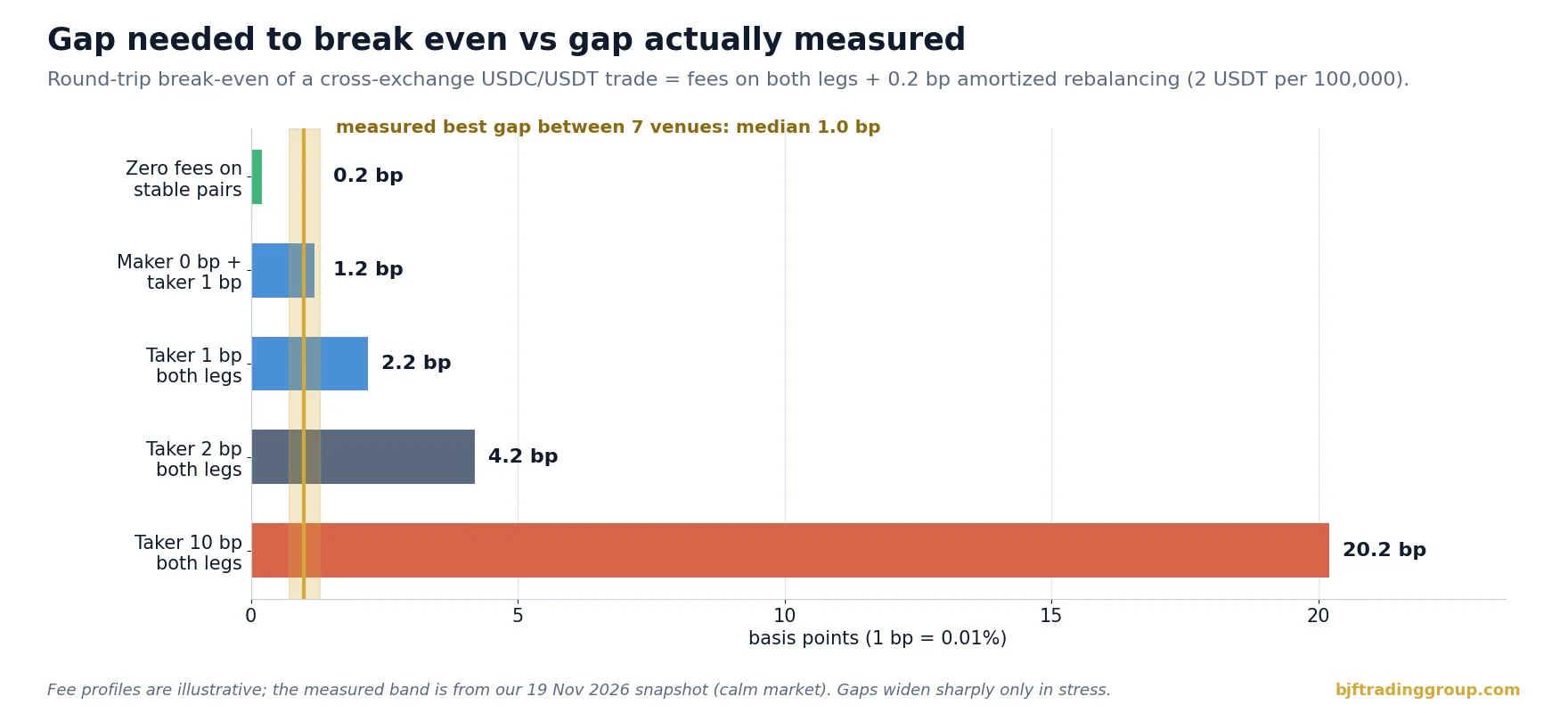
The chart makes the main point visible: in calm markets the gaps between major exchanges are usually smaller than the fees of any account that does not trade stable pairs at zero or near-zero cost. Direct stablecoin arbitrage is a business for accounts with very low fees, large balances and fast execution, not a strategy that works on standard retail terms.
Quote-currency gaps: the scanner trap
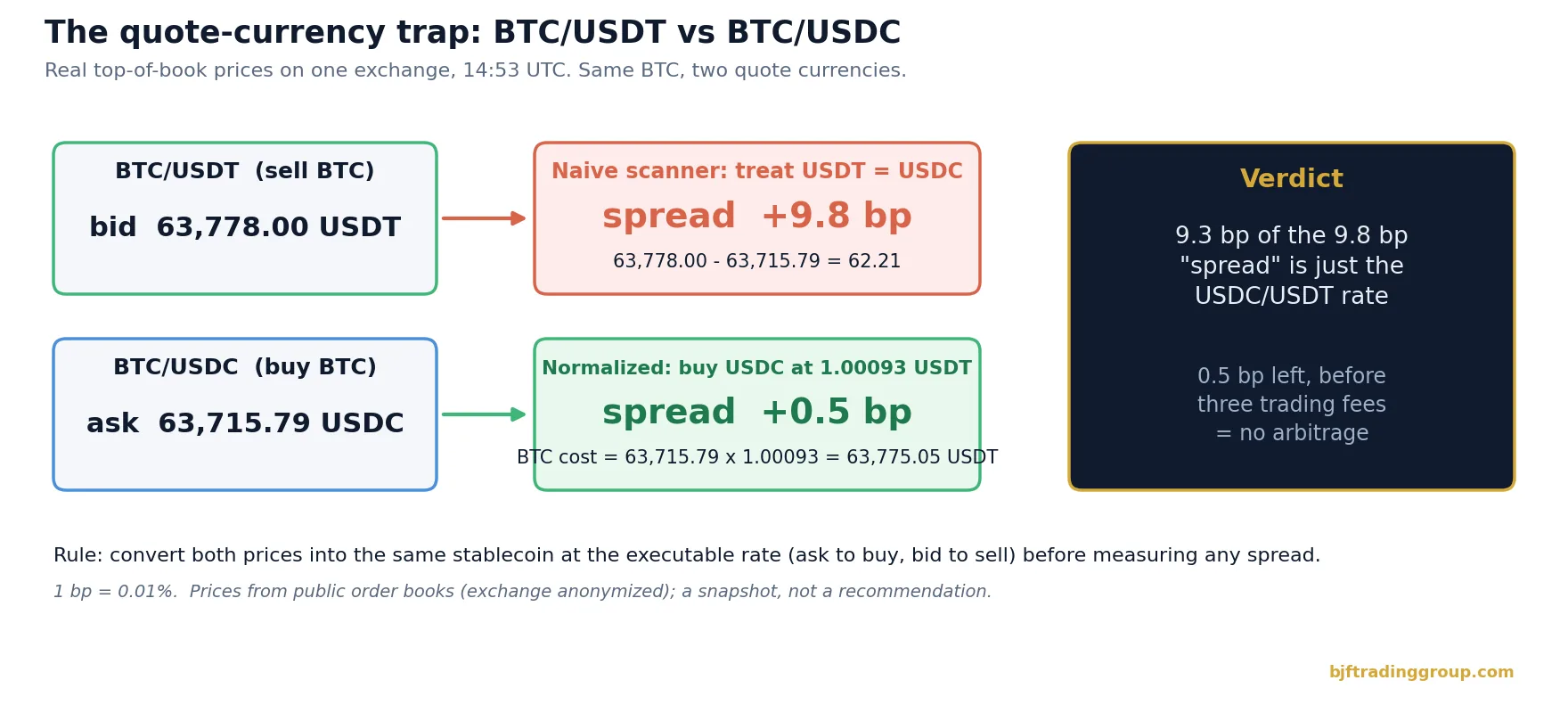
The most frequent stablecoin “opportunity” is not a stablecoin trade at all. A scanner that compares BTC/USDT on one book with BTC/USDC on another, and treats both quotes as dollars, will report a permanent spread whenever USDC and USDT are not at exactly 1:1. In our snapshot the difference between the two BTC books was about 7 to 11 basis points, every time, on every exchange that lists both. Here is the same comparison done correctly, with real prices taken at 14:53:57 UTC on one exchange:
| Step | Price used | Value |
|---|---|---|
| Sell BTC on the BTC/USDT book | bid | 63,778.00 USDT |
| Buy BTC on the BTC/USDC book | ask | 63,715.79 USDC |
| Naive spread, treating USDC as USDT | (bid – ask) / ask | 9.8 bp |
| Buy the USDC you need on the USDC/USDT book | ask | 1.00093 USDT per USDC |
| Real cost of 1 BTC in USDT | 63,715.79 x 1.00093 | 63,775.05 USDT |
| Normalized spread | (63,778.00 – 63,775.05) / 63,775.05 | 0.5 bp |
| After three taker fees of 1 bp each | 0.5 – 3.0 | -2.5 bp |
The naive comparison shows a spread of 9.8 bp; the normalized one shows 0.5 bp before three trading fees (buy USDC, buy BTC, sell BTC). The “opportunity” was simply the USDC/USDT rate. This is the same consistency that a triangular arbitrage loop checks: BTC/USDT, BTC/USDC and USDC/USDT form a triangle, and market makers keep it closed to within a fraction of a basis point on liquid exchanges.
The same trap exists between a USD-quoted book (BTC/USD on a fiat exchange) and a USDT-quoted book. With USDT trading below one dollar, as it did in our snapshot, BTC/USDT looks systematically more expensive than BTC/USD, and the difference again is not free money.
Real snapshot: USDC/USDT on seven exchanges
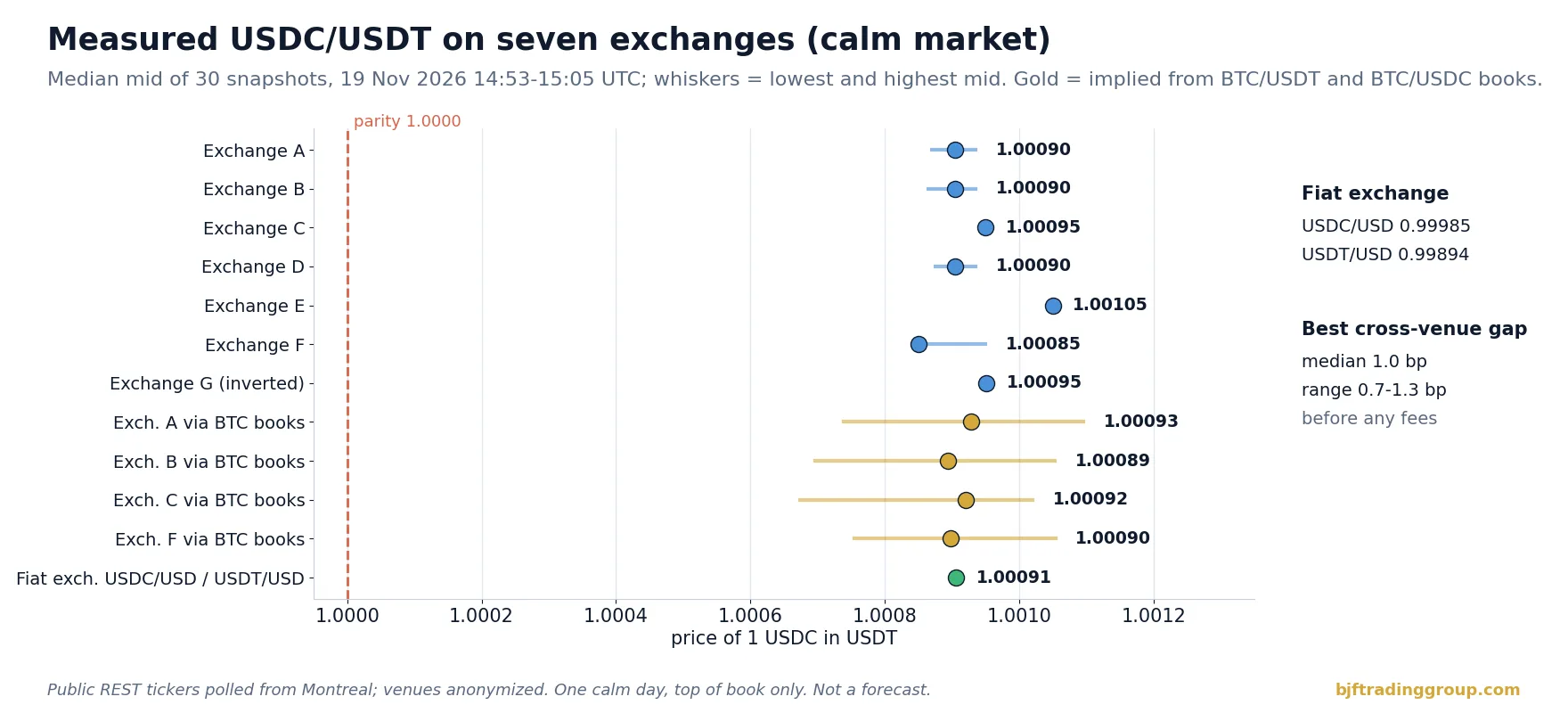
To show what stablecoin gaps look like in practice, we sampled the public top-of-book prices of USDC/USDT on several large exchanges from our server in Montreal: 30 snapshots, one about every 23 seconds, on 19 November 2026 between 14:53 and 15:05 UTC, a calm market day. We also recorded USDC/USD and USDT/USD on a fiat exchange and the BTC books quoted in USDT and USDC. Exchange names are replaced by letters, because the point is the structure, not a ranking of venues.
| Venue | Median bid | Median ask | Median mid | Bid-ask, bp |
|---|---|---|---|---|
| Exchange A | 1.00090 | 1.00091 | 1.00090 | 0.1 |
| Exchange B | 1.00090 | 1.00091 | 1.00090 | 0.1 |
| Exchange C | 1.00090 | 1.00100 | 1.00095 | 1.0 |
| Exchange D | 1.00090 | 1.00091 | 1.00090 | 0.1 |
| Exchange E | 1.00100 | 1.00110 | 1.00105 | 1.0 |
| Exchange F | 1.00080 | 1.00090 | 1.00085 | 1.0 |
| Exchange G (USDT/USDC book, inverted) | 1.00090 | 1.00100 | 1.00095 | 1.0 |
| Fiat exchange: USDC/USD | mid 0.99985 | – | – | |
| Fiat exchange: USDT/USD | mid 0.99894 | – | – | |
What the numbers say:
- USDC traded at a premium to USDT everywhere. Median mids ranged from 1.00085 to 1.00105 USDT per USDC, about 8 to 10 bp above parity. On the fiat exchange USDC was at 0.99985 USD and USDT at 0.99894 USD, which implies 1.00091, the same level.
- The venues agree to within about 2 bp. The spread between the cheapest and the most expensive median mid was 2.0 bp. Tick size matters: books quoted in steps of 0.0001 show a 1 bp bid-ask spread, books with 0.00001 steps show 0.1 bp.
- The best executable cross-venue gap was small but persistent. Buying at the best ask on one exchange and selling at the best bid on another gave a median of 1.0 bp (range 0.7 to 1.3 bp), most often buying on exchange A and selling on exchange E. That is less than the cost of two taker fees of 1 bp each, so it was not tradable on such terms.
- BTC books confirm the rate. The ratio of BTC/USDT to BTC/USDC prices implied 1.00089 to 1.00093 USDT per USDC, matching the direct pair. The wider whiskers come from BTC moving between our sequential requests, not from real triangle gaps.
Method: public REST ticker and level-1 endpoints, polled sequentially, so prices on different venues are a few hundred milliseconds apart. Mid = (bid + ask) / 2. A snapshot of one calm day shows the structure of the market, not typical profits.
Depegs: what happened in 2022 and 2023
The large stablecoin gaps that attract attention come from depegs: periods in which the market doubts that a coin can be redeemed at one dollar. Three episodes show the range of outcomes.
| Episode | Cause | Low | Outcome |
|---|---|---|---|
| TerraUSD (UST), May 2022 | Algorithmic design without full reserves; a run on the coin | Below 0.10 | Never recovered. Holders lost almost everything. |
| USDT, May 2022 | Contagion fear after UST, heavy redemptions | About 0.95 on some venues, briefly | Recovered within days as redemptions were paid. |
| USDC, March 2023 | Part of the reserves held at a failed US bank | About 0.87 to 0.88 on some venues | Recovered to about 1.00 within three days after depositors were protected. |
| DAI, March 2023 | Large share of collateral in USDC | About 0.90 | Recovered together with USDC. |
Two features matter for traders. First, during a depeg the spread between exchanges widens too: some venues pause withdrawals or trading of the affected coin, order books thin out, and the price on one venue can be several percent away from another for minutes. Second, the outcome is binary. Those who bought USDC at 0.88 in March 2023 earned about 13%; those who bought UST at 0.90 in May 2022 lost most of their money. Before the event, both looked like “a stablecoin below its peg”.
Trading a depeg: a bet on redemption, not arbitrage
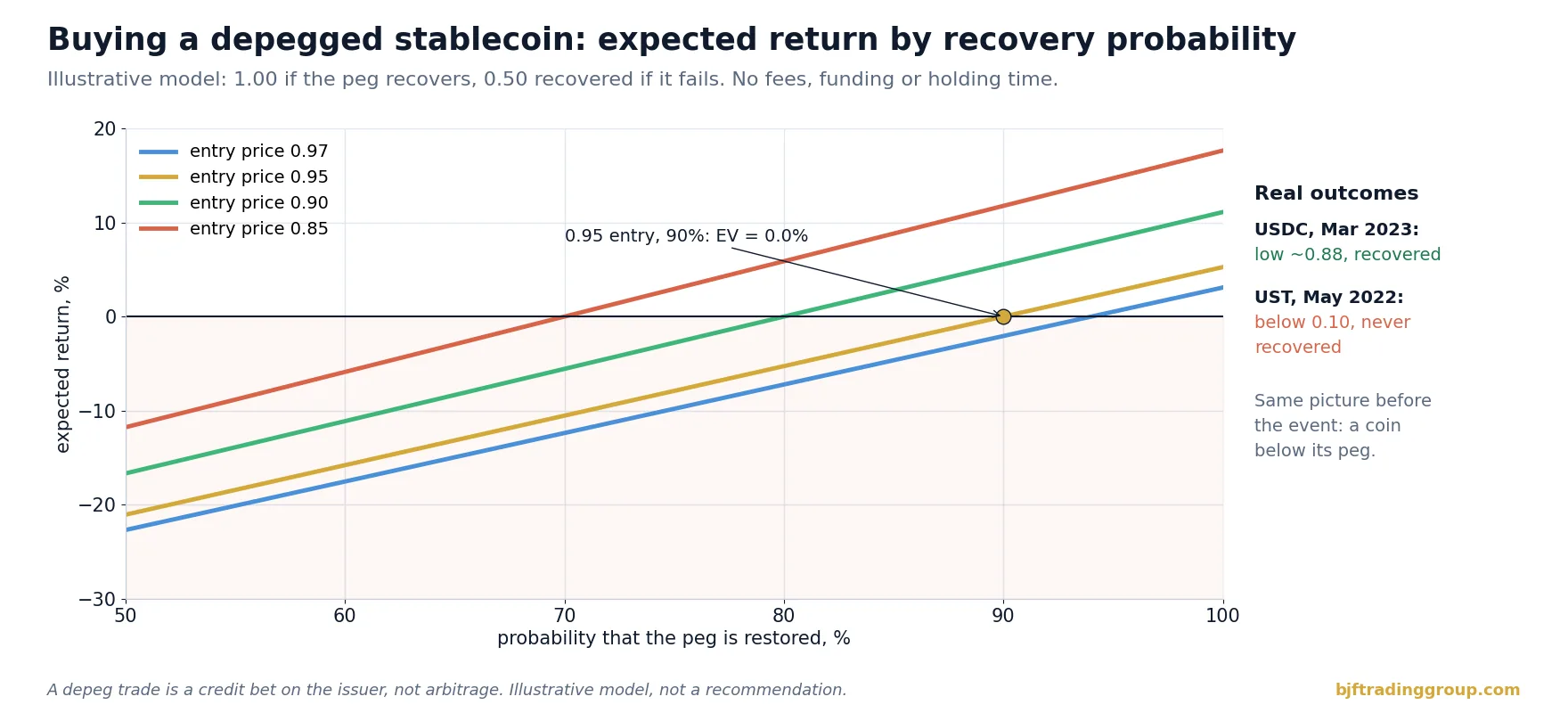
Buying a stablecoin at a discount is profitable only if it is eventually redeemable at (or near) one dollar, and you can hold it until then. That makes it a credit trade on the issuer and its reserves. The expected value depends on two numbers you can only estimate: the probability that the peg is restored and the value you recover if it is not.
EV per 1 USD paid = [ p x 1.00 + (1 – p) x R ] / price – 1
At a price of 0.95, a recovery probability of 90% and a recovery value R of 0.50 if the peg fails, the expected value is (0.90 + 0.05) / 0.95 – 1 = 0.0%: the discount only pays for the risk. At 97% probability it is +3.7%; at 80% it is -5.3%. Small changes in a probability nobody can measure precisely swing the result from attractive to a loss, which is why depeg trading belongs to risk capital, not to an arbitrage book.
Practical points if you still trade depegs:
- Size the position as if a total loss were possible; never fund it with margin.
- Know what backs the coin: fiat reserves and attestations, crypto collateral, or an algorithm. Algorithmic coins without full reserves have failed completely.
- Check whether you personally can redeem with the issuer. If not, you depend on the market price recovering.
- Expect withdrawals of the affected coin to be paused on some exchanges, which can trap inventory exactly when you want to move it.
Costs and frictions that eat the spread
With gross gaps measured in single basis points, every cost line matters. A complete stablecoin trade can include:
| Cost | Typical size | How to reduce it |
|---|---|---|
| Trading fee per leg | 0 to 10 bp, often lower on stable pairs | Zero-fee stable pairs, VIP tiers, maker orders |
| Bid-ask spread | About 0.1 to 1 bp on major venues | Trade liquid pairs; avoid thin regional books |
| Withdrawal fee | From cents to several dollars depending on the network | Choose cheap networks both venues support; batch transfers |
| Transfer time | Seconds to tens of minutes, plus exchange processing | Pre-positioned inventory instead of transfer per trade |
| Conversion leg | One extra fee and spread when the quote currencies differ | Compare same-quote books; include the leg in the threshold |
| Fiat on/off ramp | Bank fees, limits, days of settlement | Avoid fiat legs for short-term trades |
Network choice deserves special attention. USDT and USDC exist on many blockchains, but not every exchange supports every network for deposits and withdrawals, and the fee for the same coin can differ by a factor of a hundred between networks. Bridged versions of a token are not always accepted where the native version is. Our guide to withdrawal fees, networks and transfer times walks through how to choose a route and how much a transfer really costs.
Two frictions are specific to stablecoins. Issuers of the major fiat-backed coins can freeze tokens at specific addresses, usually at the request of law enforcement. And exchanges sometimes delist or restrict a stablecoin for regulatory reasons, which can strand balances or force a conversion at a poor rate.
Inventory: holding both stablecoins on both venues
A stablecoin gap of a few basis points disappears in seconds, and a blockchain transfer takes minutes. Profitable stablecoin arbitrage therefore works like any other inventory-based cross-exchange strategy: you hold both coins on both exchanges, buy on one and sell on the other at the same moment, and rebalance in batches when the inventory drifts.
The capital tied up in this inventory has an opportunity cost: the same balances could earn the funding rate in a funding rate arbitrage position or interest elsewhere. Count that cost in the annual return, together with the counterparty risk of keeping funds on exchanges.
How bots and scanners should handle stablecoins
Whether you trade stablecoins directly or not, any arbitrage software that compares prices across exchanges must handle quote currencies correctly. A checklist for configuring a bot or reading a scanner:
- Same-quote comparison by default. Compare BTC/USDT with BTC/USDT and BTC/USDC with BTC/USDC. Cross-quote comparisons need an explicit conversion leg.
- Live conversion rate. Never assume 1 USDT = 1 USDC = 1 USD. Use the executable bid or ask of the stable pair at the moment of the signal.
- Thresholds in basis points after all fees. Set the entry threshold above the sum of fees, spread and amortized transfer cost of every leg, including the conversion.
- Depeg guard. Pause trading, or at least cross-quote trading, when a stablecoin moves more than a set number of basis points from its normal range, or when withdrawals of it are suspended.
- Network awareness. Keep a table of which networks each exchange supports for each stablecoin, with current withdrawal fees, before planning any rebalancing.
To see which coins currently differ in price between exchanges, the free crypto arbitrage scanner is a quick starting point; when you check a cross-exchange difference it shows, confirm that both prices use the same quote currency before acting on it. For live trading, SharpTrader runs arbitrage strategies across crypto exchanges with thresholds you set per instrument.
Step by step: checking a stablecoin opportunity
1
2
3
4
5
6
7
Risks and limitations
- Issuer and reserve risk. A stablecoin is a claim on an issuer. Reserves, attestations and regulation differ between coins, and a failure can make the token worth far less than one dollar.
- Exchange risk. Inventory held on exchanges is exposed to insolvency, hacks, withdrawal suspensions and account restrictions.
- Freezes and delistings. Tokens can be frozen by the issuer at specific addresses, and exchanges can restrict a coin in some regions.
- Thin margins. With gaps of a few basis points, one mispriced fee, a slow leg or a single bad fill can wipe out the profit of many trades.
- Snapshot limitations. Our measurement covers one calm day and top-of-book prices only; it does not show depth, intraday extremes or crisis behaviour.
- Legal and tax rules. Stablecoin availability, fiat transfers and the tax treatment of conversions differ by country. Trade only on venues and products that are legal and available to you; this article is not financial advice.
Measure first, then automate
BJF Trading Group builds arbitrage and high-frequency trading software for crypto and forex markets. Start by watching real price differences between exchanges with the free scanner, check them with the cost model in this article, and automate only what still pays after every fee.
Free arbitrage scanner + short email course
Get the free scanner link and a few short, practical emails from Boris: what a price gap really means after costs, how to test a strategy before risking real money, and which tools fit your market. No hype.
FAQ
Is stablecoin arbitrage profitable?
It can be for traders with very low or zero fees on stable pairs, inventory on several exchanges and fast execution, because calm-market gaps are usually only a fraction of a basis point to a few basis points. On standard fee tiers the fees are usually larger than the gap. Large gaps appear mainly during depegs, when the trade carries real risk of loss.
Why is USDC/USDT not exactly 1.0000?
Because the two coins have different issuers, reserves, regulatory status and demand on each exchange, and only onboarded institutions can mint and redeem them directly. Market makers keep the rate close to 1.00, but persistent differences of several basis points are normal.
Is BTC/USDT versus BTC/USDC a real arbitrage opportunity?
Usually not. The price difference between the two books mostly reflects the USDC/USDT exchange rate. Convert one price into the other currency at the live executable rate and subtract the conversion fee; in our snapshot this removed almost the whole apparent spread.
What is a stablecoin depeg?
A depeg is a period in which a stablecoin trades significantly away from its target value, usually below one dollar, because the market doubts that it can be redeemed in full. Examples include USDC falling to about 0.88 in March 2023, which recovered, and TerraUSD collapsing in May 2022, which did not.
Is buying a depegged stablecoin risk-free arbitrage?
No. It is a bet that the coin will be redeemable at or near one dollar. If the peg is restored the profit can be large; if it is not, the loss can be most of the position. The expected value depends on probabilities that cannot be measured precisely.
Which network should I use to move USDT or USDC between exchanges?
The cheapest network that both exchanges support for deposits and withdrawals of that specific token, with acceptable confirmation times. Check the exchange’s current network list and fee before each transfer, and make sure the destination accepts the native or bridged version you are sending.
Can a scanner find stablecoin arbitrage automatically?
A scanner can show where prices of the same pair differ between exchanges. Whether a difference is tradable depends on fees, depth, transfer routes and whether both prices use the same quote currency, so every signal still needs a cost check before trading.
