LockCL2 vs Phantom Drift for Gold: Which Lock Arbitrage Strategy to Run on XAUUSD Thursday November 12th, 2026 – Posted in: Arbitrage Software, Forex trading
BJF TRADING GROUP · GOLD ARBITRAGE
LockCL2 vs Phantom Drift: Which Lock Strategy to Run on Gold
Both strategies make their money the same way: a fast price feed tells them when to unlock a hedged position on XAUUSD before the broker’s quote catches up. What separates them is what the broker sees. LockCL2 trades the lock openly and often. Phantom Drift hides the same lock inside an RSI averaging trade that looks like an ordinary technical trader. This guide compares the two side by side, with live public monitoring, and helps you choose the one that fits your broker, your capital and your patience.

In this guide
- The short answer
- Why gold is where both strategies earn
- How LockCL2 trades gold
- How Phantom Drift trades gold
- Side by side: 12 differences that matter
- Live monitoring: what the accounts show
- Phantom Drift + Hybrid Masking (free for Phantom Drift owners)
- Which one to choose
- Starting settings for XAUUSD
- Risks to plan for
- FAQ
The short answer
LockCL2 is the lock-arbitrage engine itself: two broker accounts hold opposite positions on gold, and a fast feed decides when to close one side. It trades many times a day, holds positions briefly and earns from volume. Choose it when your brokers tolerate arbitrage flow and you want the highest throughput. Phantom Drift runs the same LockCL2 engine, but only after an RSI entry and an averaging sequence have built a position that looks like normal technical trading. It works in fewer, longer cycles and needs more margin. Choose it when your broker or prop firm actively hunts arbitrage and account longevity matters more than trade count.
Watch: LockCL2 vs Phantom Drift in 4 minutes
Why gold is where both strategies earn
Lock arbitrage needs one thing above all: moments when a slow broker’s quote lags a faster market by more than the spread. Gold produces those moments more often and in larger size than any major currency pair. A single XAUUSD move of several dollars can happen within a second, many brokers treat gold as a secondary instrument with fewer liquidity providers and slower quote refresh, and a one-dollar gap on 1.00 lot is worth 100 USD. On EURUSD the same strategy waits much longer for a gap that pays.
That is why both of our live test groups trade a basket of currency pairs at 0.10 lot but gold at 1.00 lot, and why gold dominates the results: almost all of the latest closed trades in the LockCL2 monitoring are XAUUSD, and on the long-running Phantom Drift account tracked by FX Blue, 95.8% of all trades are gold. Our gold arbitrage guide covers the gold pricing landscape in depth; this article focuses on the choice between the two lock strategies.
How LockCL2 trades gold
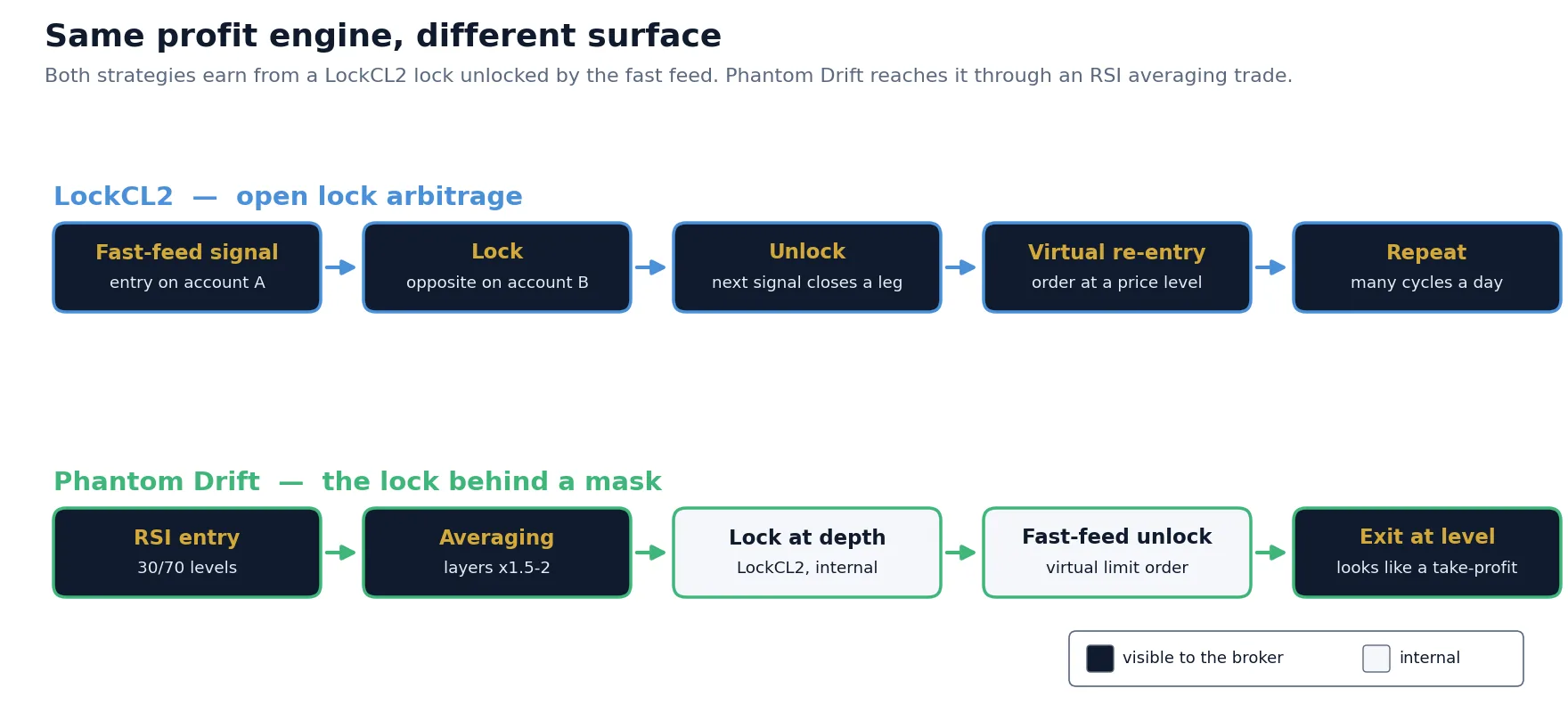
LockCL2 is the core lock strategy in SharpTrader and the base for several others. It works with two accounts at two brokers and a fast reference feed.
1
2
3
4
5
The result is a pair of accounts whose results mirror each other: when one account is down, the other is up, and the group equity is far smoother than either account alone. Profit comes from the size of winning closes rather than from a high win rate, which is why lock arbitrage typically shows a profit factor around 1.2 with a win rate just above 50%. The full family (Lock, LockCL1, LockCL2, LockCL3, BrightDuo, BrightTrio Plus) is explained on our lock arbitrage page.
How Phantom Drift trades gold
Phantom Drift was built for brokers that learned to detect direct arbitrage by its order timing, its very short holds and its unusually high win rate. It keeps the LockCL2 profit engine and changes everything the broker can measure.
1
2
3
4
5
6
Holding times move from seconds to minutes and hours, entries correlate with RSI rather than with feed updates, and the win rate looks plausible. The price of that disguise is capital: the averaging layers plus the hedge need considerably more margin per cycle than a single lock. More detail on the design is on our Phantom Drift page.
Side by side: 12 differences that matter
| LockCL2 | Phantom Drift | |
|---|---|---|
| Profit engine | Lock arbitrage from a fast feed | The same LockCL2 lock arbitrage |
| Visible entry trigger | Fast-feed arbitrage signal | RSI oversold / overbought |
| What the broker sees | Frequent two-account lock activity | An RSI trader averaging into positions |
| Trade frequency | High: 819 trades in 13 trading days on our live pair | Fewer, longer cycles; each cycle can include several averaging orders |
| Holding time | Short | Minutes to hours |
| Typical win rate | Just above 50% | About 60% (60.4% on our FX Blue account) |
| Typical profit factor | About 1.2 | 1.22 on our FX Blue account |
| Margin per cycle | Two opposite positions | Averaging layers plus the hedge: significantly more |
| Where the risk sits | Deep drawdown on one leg while the group is flat | Averaging depth if gold trends hard against the sequence |
| Broker detection resistance | Good (virtual re-entry removes timing correlation) | Highest (no feed-timed entries, normal holds, normal win rate) |
| Prop firms | Usually against the rules | Designed for firms that allow averaging; not for firms that ban it |
| Included in | SharpTrader Lite and Pro | Separate strategy; Hybrid Masking free for owners |
Frequencies, win rates and profit factors are from our public live accounts described below; your figures will depend on broker, feed speed, lot size and settings.
Live monitoring: what the accounts show
We publish real accounts instead of backtests. LockCL2 runs on two live USD accounts at two brokers, connected with read-only access to Strategy X-Ray, a new account-statistics service. Phantom Drift is tracked on a real account at FX Blue. The widget and the chart below update automatically, so you see current figures rather than the snapshot we quote.
LockCL2 on gold: the live pair
| LockCL2, Oct 23 – Nov 10, 2026 | Net profit | Gain | Max drawdown | Trades |
|---|---|---|---|---|
| Account 1 | $21,452.36 | +218.90% | 17.59% | 413 |
| Account 2 | $16,321.88 | +170.73% | 65.10% | 406 |
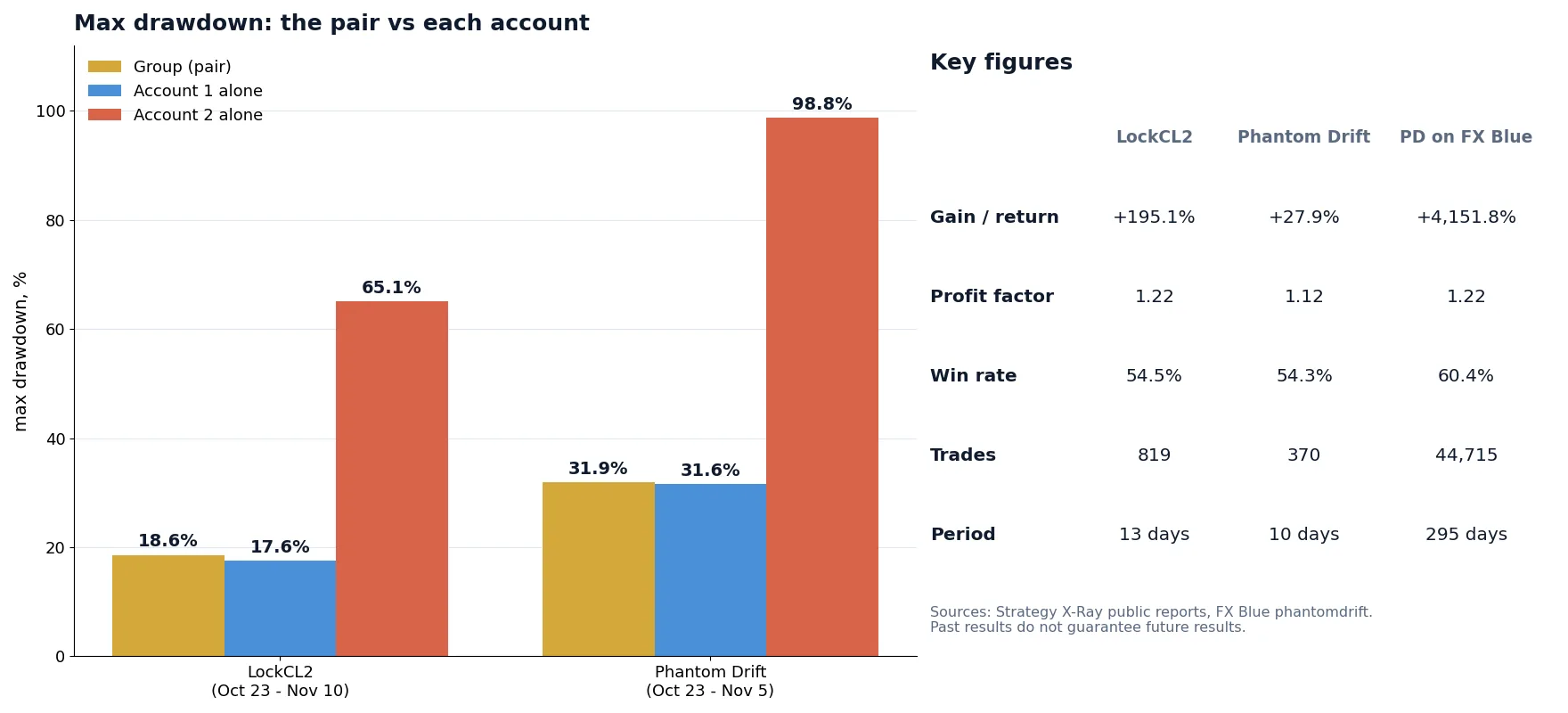
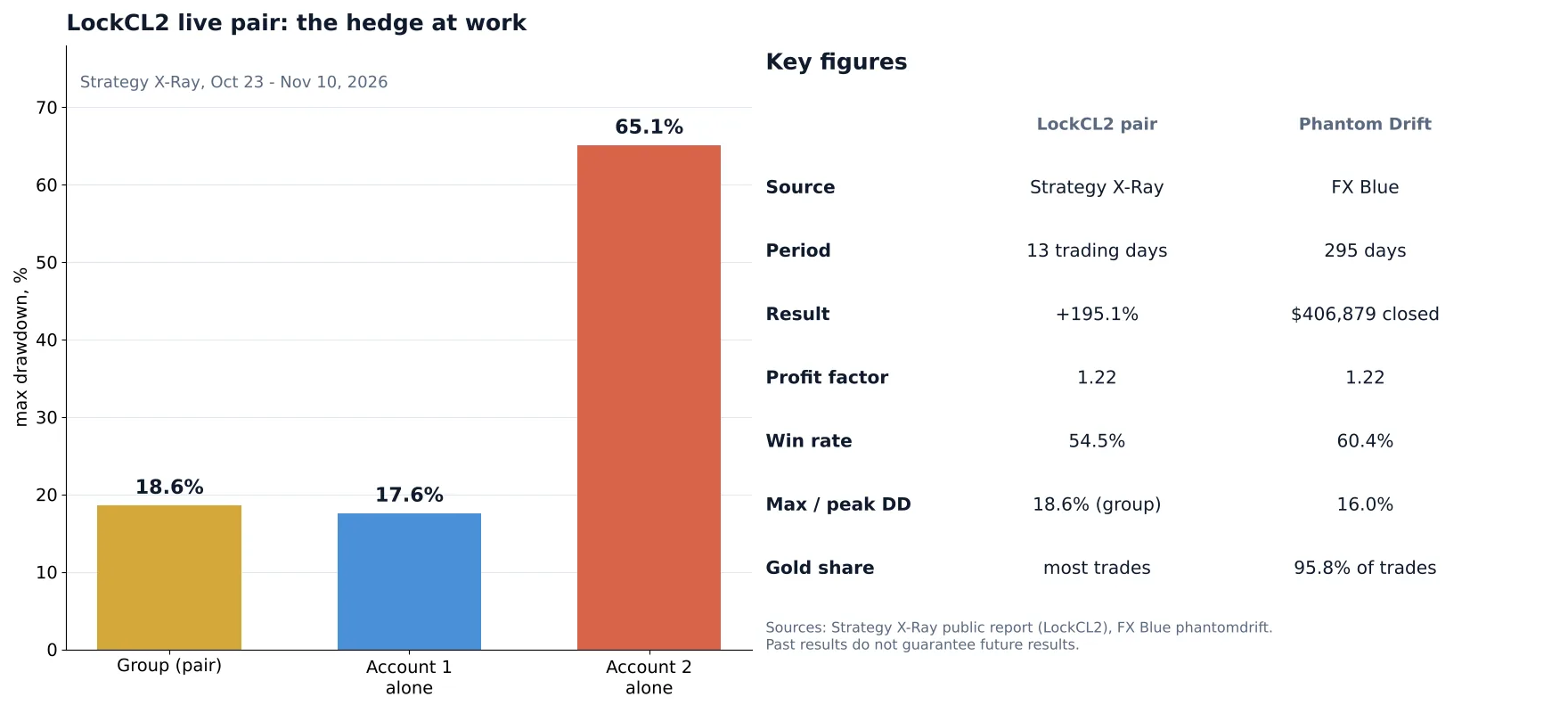
| Group | $37,774.24 | +195.11% | 18.60% ($6,939.82) | 819 |
Over 13 trading days the pair nearly tripled its combined deposit, with a profit factor of 1.22 and a win rate of 54.5%. The number to understand is the drawdown. The group drew down $6,939.82; measured account by account the drawdowns add up to $16,385.48, and Account 2 alone touched 65.10%. That is how a lock behaves: while gold runs, one leg shows a large loss and the other an almost equal gain. At the snapshot both accounts held an XAUUSD lock at 1.00 lot each, with a combined floating result of about +$917. Each account must be funded to survive its own leg, even though the pair as a whole is hedged. Lot sizes in this test (1.00 lot on gold) are deliberately aggressive for the deposit.
Phantom Drift on gold: the FX Blue account
For Phantom Drift we show a long history rather than a short test: a strategy that holds positions for minutes to hours needs many market regimes to be judged fairly. Our public FX Blue account phantomdrift is a real account that ran Phantom Drift for 295 days, from June 2025 into spring 2026, almost entirely on gold.
FX Blue reports a total return of +4,151.8% for this history. Returns of this size come from compounding with aggressive position sizing and are not a forecast; the same account also had a worst single day of −$15,377.75. Full statistics, monthly breakdown and trade list are public on FX Blue.
Phantom Drift + Hybrid Masking (free for Phantom Drift owners)
Phantom Drift hides how the arbitrage enters and exits. Hybrid Masking goes one step further and changes what the whole account looks like. It is a separate SharpTrader strategy that adds genuine trend and pullback trades on other timeframes: an EMA trend filter on H1 and M30, Fibonacci pullback entries on M5 and M15, and randomized entry time, trade size, stop loss, take profit and trailing. On the broker’s side the account stops looking like a single averaging system and reads as a diversified trader with several styles.
- Different trade shapes. Trend and pullback trades with varied size and holding times dilute the averaging pattern.
- No mechanical regularity. Randomized SL, TP, size and timing remove the repeated numbers risk systems cluster on.
- Measured, not assumed. In our broker-style review of 55,777 trades on the Phantom Drift account combined with Hybrid Masking, the account scored a low toxicity of 18 out of 100. The method is described in How Phantom Drift and Hybrid Masking appear to broker risk systems.
Which one to choose
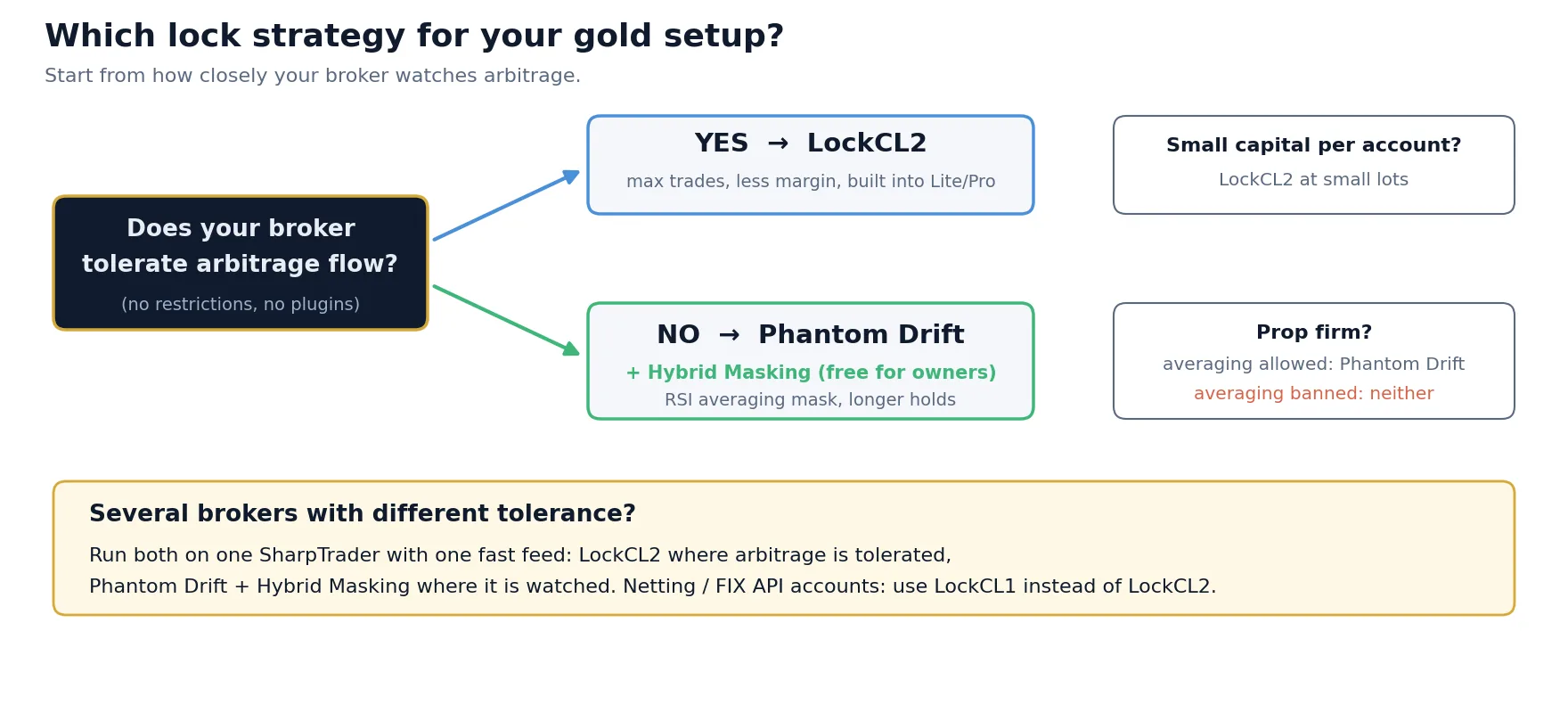
| Your situation | Our recommendation |
|---|---|
| Two brokers that tolerate arbitrage, you want maximum trades on gold | LockCL2 |
| Broker with anti-arbitrage plugins, accounts restricted before | Phantom Drift + Hybrid Masking |
| Prop firm that allows averaging but bans arbitrage | Phantom Drift with hard stop and equity control; check the firm’s rules first |
| Prop firm that bans averaging or martingale | Neither; consider non-arbitrage strategies |
| Smaller capital per account | LockCL2 at small lot size; Phantom Drift needs margin for its layers |
| Netting or FIX API accounts | LockCL1 instead of LockCL2 |
| Several brokers with different tolerance | Both: LockCL2 where arbitrage is tolerated, Phantom Drift where it is watched |
Running both is a common setup. A lock pair at a tolerant broker earns from volume; Phantom Drift with Hybrid Masking keeps a stricter broker account alive for months. Both share the same fast feed, the same SharpTrader installation and the same gold expertise.
Starting settings for XAUUSD
These are starting points from our own live tests and documentation, not optimized values. Calibrate every parameter for your broker pair and feed, ideally in SharpTrader Optimizer on real ticks.
| Parameter | LockCL2 on gold | Phantom Drift on gold |
|---|---|---|
| Fast feed advantage | 50 to 100 ms over the slow broker at minimum | Same |
| Impulse entry (Min move) | 50 points on XAUUSD (25 on FX) in our live test | Same engine, same logic |
| Reverse factor % | 20% on XAUUSD only in our live test | Optional |
| RSI | Not used | Period 14, levels 30/70 to start |
| Averaging | Not used | 3 to 5 layers, multiplier 1.5 to 2, sized so the full ladder fits the account |
| Lot size | Start well below the 1.00 lot of our test accounts | Start at the minimum lot; scale only after live verification |
| Protection | Fund each account for its own leg’s drawdown | Hard stop and equity control on every account |
The new entry and exit parameters used in these tests (Min move, Reverse factor, adaptive exits) are explained in our LockCL2 and Phantom Drift live test, with the exact settings and a head-to-head comparison.
Risks to plan for
- Single-leg drawdown. A lock is hedged as a pair, not per account. On a strong gold move one LockCL2 account can be deep in drawdown while the pair is flat.
- Averaging depth. Phantom Drift’s ladder can outgrow an account in a sustained gold trend. Size layers to the account and use the equity stop.
- Broker conditions change. Spreads on gold widen at rollover and on news; execution and feed speed vary by broker and VPS.
- Two brokers, two balances. Profit accumulates on one account and losses on the other; rebalancing funds between brokers is part of running a lock.
- Rules. Read your broker’s and prop firm’s terms. Masking changes what a risk system sees, not what the contract allows.
Run gold lock arbitrage with SharpTrader
LockCL2 is built into SharpTrader Lite and Pro. Until December 31, 2026 every license is −55%, and two ready-made packs cover this article: the Lock Pack (SharpTrader Lite with LockCL2, plus LockCL1 and LockCL3 free) and the Stealth Pack (SharpTrader Lite, Phantom Drift, Hybrid Masking free and the DominionForce gold bot free). Every order includes 2 lifetime licenses, a free fast feed and lifetime support.
Stealth Pack: Phantom Drift + Hybrid MaskingLock Pack: LockCL2 + CL1 + CL3All Black Friday packs
Free arbitrage scanner + short email course
Get the free scanner link and a few short, practical emails from Boris: what a price gap really means after costs, how to test a strategy before risking real money, and which tools fit your market. No hype.
FAQ
What is the difference between LockCL2 and Phantom Drift?
Both earn from the same lock arbitrage engine on two broker accounts with a fast feed. LockCL2 trades the lock directly and often; Phantom Drift reaches the lock through an RSI entry and an averaging sequence, so the broker sees a technical trader with normal holding times and win rate.
Which is better for gold, LockCL2 or Phantom Drift?
Neither is better in general. LockCL2 gives more trades and needs less margin, so it suits brokers that tolerate arbitrage. Phantom Drift gives the strongest protection against broker detection, so it suits brokers and prop firms that watch for arbitrage, at the cost of more capital per cycle.
Why do both strategies trade mostly XAUUSD?
Gold moves in larger and faster steps than major currency pairs, and many brokers quote it with slower refresh. That creates more and larger gaps between the fast feed and the slow broker, which is exactly what lock arbitrage captures.
Is Hybrid Masking really free?
Yes. Hybrid Masking is a $495 module, and we activate it at no charge for every Phantom Drift owner. It adds trend and pullback trades with randomized parameters so the account looks like a diversified trader.
Can I use Phantom Drift on a prop firm account?
On firms that permit averaging, yes, with a hard stop and equity control set to the firm’s limits. On firms that prohibit averaging or martingale-style position building, no, regardless of masking.
Can I run LockCL2 and Phantom Drift at the same time?
Yes. Many traders run LockCL2 at brokers that tolerate arbitrage and Phantom Drift with Hybrid Masking at brokers that watch closely, on one SharpTrader installation with one fast feed.
This article is educational and not financial advice. Trading gold and currencies with leverage carries a high risk of loss. Live results are quoted as published by Strategy X-Ray and FX Blue on the dates shown; past results do not guarantee future results. The test accounts use aggressive position sizes. Brokers’ and prop firms’ terms differ; check them before trading.
