Low-Latency Crypto Trading: Exchange Server Locations, Real API Latency and Where to Host Your Bot Saturday November 7th, 2026 – Posted in: Arbitrage Software, cryptoarbitrage software
Low-Latency Crypto Trading: Exchange Server Locations, Real API Latency and Where to Host Your Bot
A crypto arbitrage bot can have a good signal and still lose the trade, because by the time its order reaches the exchange the price it saw is gone. This guide explains where the major exchanges actually run their matching engines, why a ping to an API host tells you almost nothing, what we measured from a real server, how to measure latency correctly from your own machine, and how to choose a hosting region when your strategy trades on two exchanges in different countries.
- What low latency means in crypto trading
- The latency budget: where the milliseconds go
- Where crypto exchanges run their matching engines
- The CDN trap: why ping lies
- What we measured from a server in Montreal
- Step by step: measuring exchange latency correctly
- WebSocket market data and clock synchronization
- Choosing a hosting region for two-exchange arbitrage
- How latency turns into money
- Colocation, VPS and what is realistic for independent traders
- Latency inside your own software
- Risks and limitations
- FAQ
What low latency means in crypto trading
Short answer: low-latency crypto trading means shortening the time between a price change on an exchange and your order arriving at that exchange’s matching engine. Most of that time is physical distance: the major exchanges run their engines in specific cloud regions, mostly in Tokyo, Singapore and Hong Kong, and a bot hosted on another continent is 150 to 250 milliseconds behind a bot hosted next to the engine. The second largest part is avoidable overhead: cold connections, REST polling, a badly synchronized clock and slow code.
In forex, latency is a story about a few well-known data centers in London, New York and Tokyo, and about brokers’ liquidity bridges. In crypto the picture is different. There is no shared exchange campus: each exchange chooses its own cloud region, most of them sit on public cloud infrastructure, and their APIs are usually fronted by content delivery networks (CDNs) that make the exchange look close when it is not. That makes measurement both easier (you can rent a server in the same cloud region for the price of a dinner) and more misleading (the obvious tests measure the wrong thing).
How much latency matters depends on the strategy:
| Strategy | How long the opportunity usually lives | Latency that is “good enough” |
|---|---|---|
| Cross-exchange arbitrage with transfers between exchanges | Minutes (limited by blockchain confirmations) | Seconds; fees and transfer times matter far more |
| Funding rate and spot-futures basis trades | Hours to days | Not critical; execution quality matters more than speed |
| Hedge (two-leg) arbitrage with pre-funded balances on both exchanges | Hundreds of milliseconds to seconds on mid-cap pairs, less on majors | Tens of milliseconds to each exchange |
| Latency arbitrage against a slower venue, competing with market makers | Milliseconds | Single-digit milliseconds to the traded venue, same cloud region |
If your edge comes from slow structural gaps, such as funding rate arbitrage or transfers that are limited by withdrawal fees and network confirmation times, you do not need anything in this guide beyond a stable server. If you trade price differences between order books, it is the difference between filling and chasing.
The latency budget: where the milliseconds go
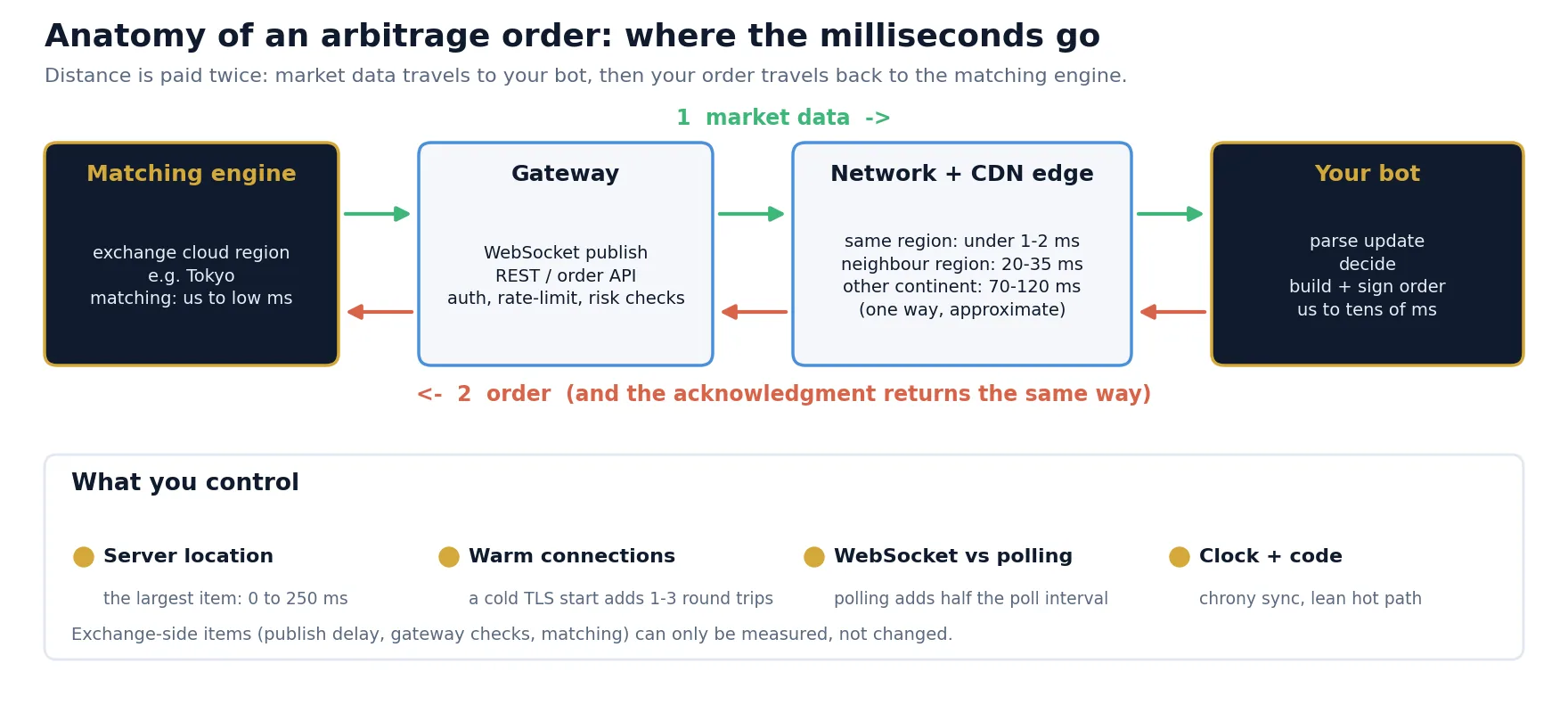
“Latency” is not one number. An order that reacts to a market move passes through a chain of steps, and each step adds time. Thinking in terms of a budget tells you which parts you can change and which you cannot.
| Component | Typical range (approximate) | Who controls it |
|---|---|---|
| Market data publish (engine to WebSocket gateway) | Sub-millisecond to several milliseconds; longer for aggregated or throttled streams | Exchange; you choose the stream type |
| Network, one way, same cloud region | Under 1 ms to about 2 ms | You, through hosting choice |
| Network, one way, neighbouring Asian regions (e.g. Tokyo to Hong Kong) | About 20 to 35 ms | You |
| Network, one way, across continents (e.g. Europe or North America to Tokyo) | About 70 to 120 ms | You |
| Connection setup (TCP and TLS handshakes) on a cold connection | One to three extra network round trips | You: keep connections warm |
| Your own decision code | Microseconds to tens of milliseconds | You |
| API gateway, authentication, rate-limit and risk checks | A few milliseconds to tens of milliseconds, with spikes in volatile markets | Exchange |
| Matching | Microseconds to low milliseconds | Exchange |
The pattern is clear: the two items you control that are measured in tens or hundreds of milliseconds are where your server is and whether your connections are warm. Everything else either belongs to the exchange or is small when the software is written sensibly. That is why the rest of this guide focuses on location and measurement.
Where crypto exchanges run their matching engines
Exchanges rarely publish the exact location of their matching engines, but most of them run on public cloud, and the region can be inferred from latency measurements made from many cloud regions. Independent measurements published by third parties in 2026 agree on most of the large venues. The table summarizes the publicly reported regions. Treat it as a starting point for your own tests, not as a guarantee: exchanges do migrate (BitMEX, for example, was reported to have moved its engine from Dublin to Tokyo in 2025).
| Exchange | Publicly reported engine region | Cloud region to test first | Confidence |
|---|---|---|---|
| Binance | Tokyo | AWS ap-northeast-1 | High: consistent across independent measurements |
| Bybit | Singapore | AWS ap-southeast-1 | High |
| OKX | Hong Kong | AWS ap-east-1 | High |
| Gate.io, KuCoin, Bitget, HTX | Tokyo | AWS ap-northeast-1 | Medium to high |
| Coinbase (spot) | United States, east coast | AWS us-east-1 | Medium: API fronted by a CDN, measure order acknowledgments |
| Kraken | Europe | Test London, Dublin and Frankfurt | Low: published sources disagree |
| Deribit | London area | AWS eu-west-2 | Medium to high |
Two practical conclusions follow. First, Tokyo is the closest thing crypto has to a central trading hub: a server there is within a few milliseconds of Binance and several other large venues, about 25 ms one way from Hong Kong and about 35 ms one way from Singapore. Second, any strategy that pairs an Asian exchange with Coinbase or a European venue has a physical floor of 70 to 120 ms one way between the two engines, whatever you do with your own server.
Hosting a server in a given country does not change which exchanges you are allowed to use. Follow each exchange’s terms of service and the rules of your own jurisdiction; never use servers or VPNs to get around geographic restrictions.
The CDN trap: why ping lies
The most common mistake is to measure latency with ping or with the time to open a TCP connection to the API host name. Almost every large exchange puts its public REST and WebSocket endpoints behind a CDN or a cloud load balancer with edge locations around the world. When you connect to api.binance.com from Europe or North America, the server that answers your TCP handshake is an edge node in a nearby city, not the matching engine in Tokyo. The handshake takes a few milliseconds; then the edge forwards your request over the provider’s backbone to the real origin, and that is where the time goes.
So a ping of 5 ms to an exchange host name can coexist with a real request time of 150 ms. The only numbers that mean anything are the ones that include the trip to the origin: the time to first byte of a real API response on an already open connection, the delay between an exchange’s own event timestamp and your receive time on the WebSocket, and the time from sending an order to receiving its acknowledgment.
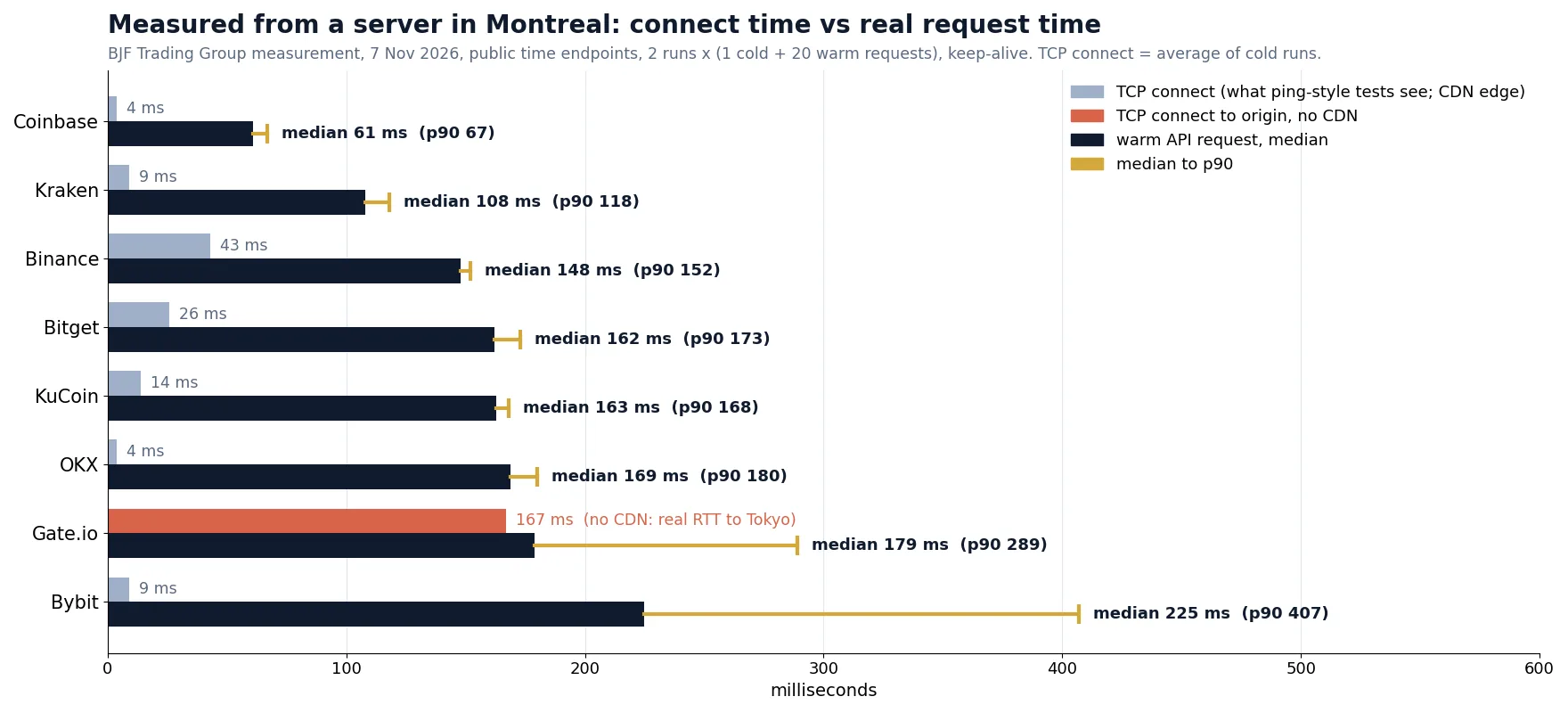
Measured by BJF Trading Group on 7 November 2026 from a web server in Montreal (Leaseweb), public time endpoints, two runs of one cold plus 20 warm requests per exchange.
What we measured from a server in Montreal
To show the effect with real numbers rather than vendor claims, we ran a small probe from the web server that hosts this site, in Montreal. For eight exchanges it opened one connection, sent one request (cold), then sent 20 more requests over the same keep-alive connection (warm), at four requests per second, and repeated the whole run twice. The endpoint was each exchange’s public server-time call, which does almost no work, so the result is close to pure transport plus gateway time.
| Exchange | Front end seen from Montreal | TCP connect, ms | Cold first request, ms | Warm request median, ms | Warm p90, ms |
|---|---|---|---|---|---|
| Coinbase | Cloudflare edge | 4 | 119 to 140 | 61 | 67 |
| Kraken | Cloudflare edge | 3 to 15 | 162 to 179 | 108 | 118 |
| Binance | CloudFront edge | 11 to 74 | 210 to 277 | 148 | 152 |
| Bitget | Cloudflare edge | 15 to 37 | 226 to 247 | 162 | 173 |
| KuCoin | Cloudflare edge | 6 to 23 | 220 to 244 | 163 | 168 |
| OKX | Cloudflare edge | 3 to 4 | 217 to 232 | 169 | 180 |
| Gate.io | Direct, AWS Tokyo address | 167 | 668 to 718 | 179 | 289 |
| Bybit | CloudFront edge | 8 to 10 | 278 to 281 | 225 | 407 |
Four lessons come out of this small test:
- Connect time is meaningless behind a CDN. OKX answered the TCP handshake in 3 to 4 ms, yet every real request took about 170 ms, because the work happens in Hong Kong.
- The ranking follows geography. Coinbase (US east coast) is fastest from Montreal, Kraken (Europe) second, and the Asian exchanges cluster at 150 to 225 ms. From Tokyo the order would be reversed.
- Cold connections are expensive. Without an edge nearby, every handshake round trip crosses the Pacific: the first request to Gate.io took about 0.7 seconds, the following ones about 0.18 seconds. A bot that opens a new connection when it sees a signal has already lost.
- Tails matter. Bybit’s median was 225 ms but one request in ten took more than 400 ms. An arbitrage leg is only as fast as its slow cases, so always look at p90 and p99, not only the median.
These numbers describe one web server on one afternoon, not a trading setup, and they include each exchange’s gateway processing. They are not a ranking of exchanges. Their purpose is to show the size of the effects: geography and connection handling account for more than 90% of the delay a distant bot experiences.
Step by step: measuring exchange latency correctly
You can reproduce a meaningful measurement from any server in an hour. The method below is what we recommend before choosing a hosting region or after any change to your infrastructure.
1
2
3
4
5
6
7
For step 2, plain curl is enough to get started. Repeating the URL makes curl reuse one connection; the first line is the cold request, the rest are warm:
curl -s –rate 4/s -w “%{num_connects} %{time_connect} %{time_starttransfer}\n” -o /dev/null URL -o /dev/null URL -o /dev/null URL
For steps 4 and 5 you need a few lines of code in the language your bot uses, because the measurement must go through the same client library, the same JSON parser and the same connection settings as live trading. A number produced by a different tool tells you about that tool.
WebSocket market data and clock synchronization
For anything time-sensitive, market data should come from WebSocket streams, not from REST polling. A polling loop that requests the order book every 200 ms adds on average 100 ms of waiting before it even sees a change, on top of the request time, and it burns rate-limit budget that you need for orders. A WebSocket stream pushes each update as soon as the exchange publishes it. The details of streams, local order books and sequence checks are covered in our guide to connecting to crypto exchange APIs for arbitrage; here we focus on timing.
Measuring feed lag
Most exchange WebSocket messages carry a timestamp set by the exchange: an event time, a trade time or a message time, usually in milliseconds. Subtract it from your local receive time and you get the feed lag, which includes the exchange’s internal publishing delay and the network trip. Record it per stream, not only as an average: depth snapshots, incremental book updates and trade streams can behave differently, and aggregated streams that publish every 100 ms will show a saw-tooth pattern.
Why the clock matters
One-way measurements are only as good as the agreement between your clock and the exchange’s. If your server clock is 15 ms behind, every feed lag will look 15 ms better than it is. On a cloud server, run chrony against the provider’s time service and check chronyc tracking: an offset within about a millisecond is a sound basis for comparing regions. Many exchanges also expose a server-time endpoint; comparing it with your clock while accounting for half of the measured round trip gives a rough cross-check. Order endpoints that accept a receive window (a maximum allowed age of the request timestamp) will also reject orders when your clock drifts, which is another reason to keep it synchronized.
Measure the order path separately
Feed lag tells you how old your view of the market is. The order round trip tells you how long it takes to act on it. The two often differ: order requests go through authentication, rate-limit accounting and risk checks that a market-data stream does not. Some exchanges, Binance among them, offer an order-test endpoint that validates a signed order without sending it to the matching engine; it measures the network and gateway part. Where the exchange offers order placement over a WebSocket or FIX session, measure that too, because a persistent session avoids per-request overhead.
Choosing a hosting region for two-exchange arbitrage
For a single exchange the answer is simple: rent a server in the same cloud region as its engine. Arbitrage between two exchanges is a geometry problem, because the engines are in different places and you can only be next to one of them.
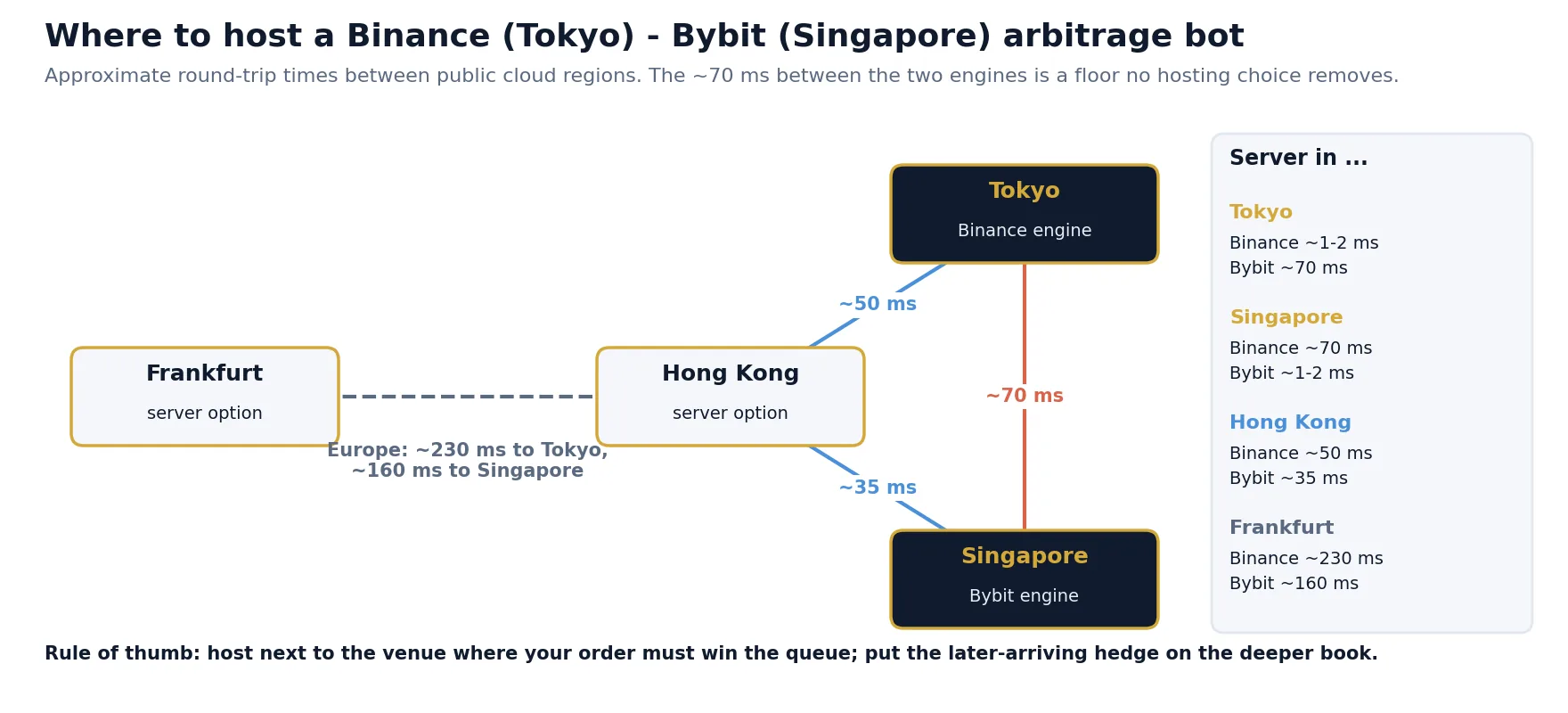
Take a hedge arbitrage between Binance (Tokyo) and Bybit (Singapore). The round trip between the two regions is about 70 ms, so roughly 35 ms one way. Consider the main options:
| Server location | Round trip to Binance | Round trip to Bybit | Assessment |
|---|---|---|---|
| Tokyo | About 1 to 2 ms | About 70 ms | Fast on Binance, the Bybit leg pays the full distance |
| Singapore | About 70 ms | About 1 to 2 ms | The mirror image |
| Hong Kong | About 50 ms | About 35 ms | Slow on both legs; rarely the best choice for two venues |
| Europe (e.g. Frankfurt) | About 230 ms | About 160 ms | Out of the race for any time-sensitive strategy |
Round trips are approximate typical values between public cloud regions; check your provider’s current inter-region figures and measure from your own servers.
The key observation is that the information always has to cross the distance between the two exchanges. If the price moves on Binance and the stale quote sits on Bybit, a server in Tokyo sees the move at once and its order travels 35 ms to Singapore; a server in Singapore receives the move 35 ms late and its order arrives at once. The total is the same. What changes is which part of the chain waits, and therefore which decision should guide the choice:
- Host next to the venue where the order must win. If your profit depends on hitting a quote before other traders on one exchange, compete where that queue is decided. Everybody’s information about the other exchange arrives at the same speed there, but your order does not have to travel.
- Put the hedge on the deeper book. The leg that reaches its exchange later should be the one that is least sensitive to a few milliseconds: the more liquid book, where the hedge price is unlikely to move much.
- Know the fill status quickly. Being next to the exchange where partial fills are common lets you size the hedge on accurate information, which reduces the unhedged risk.
- Split only when it pays. Two processes, one per region, can each keep a local order book and react locally, but they must coordinate over the same 70 ms link. This adds complexity and failure modes and is worth it mainly for professional setups.
For strategies across three or more Asian venues, Tokyo is usually the practical center because of the number of large exchanges there. For pairs that include a US or European venue, the cross-continent leg dominates and the strategy must tolerate 70 to 120 ms one way, which rules out pure speed competition and favours larger, longer-lasting gaps.
How latency turns into money
A price difference between two order books is not a fixed prize. Other traders see it too, market makers update their quotes, and the gap disappears within a time that depends on the asset and the venue. A simple way to think about it is to assume that each opportunity survives for a random time with an average lifetime, and to ask how likely it is to still be there when your order arrives.
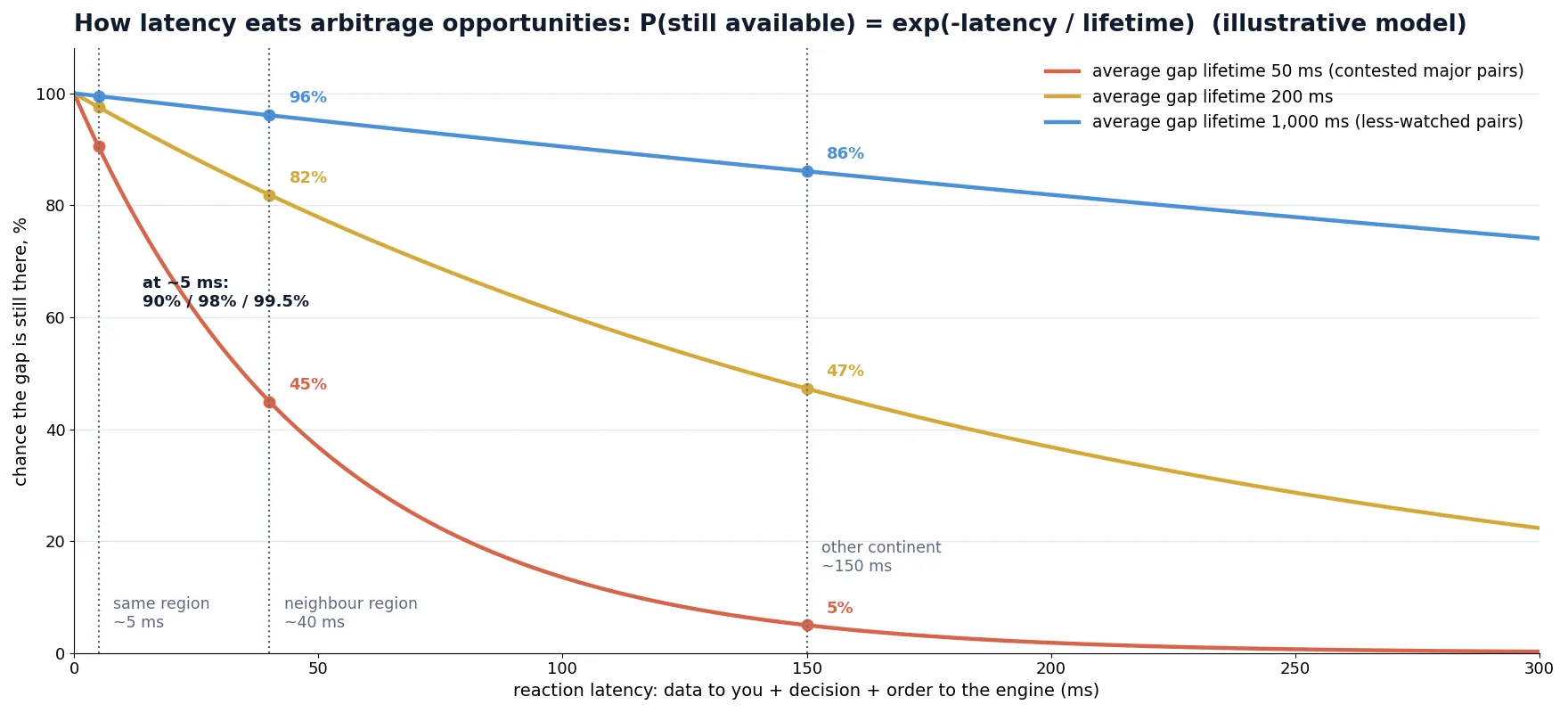
In this model the probability that a gap is still there after a reaction time of L milliseconds is exp(−L / τ), where τ is the average lifetime of the gap. The results for three reaction times, which correspond roughly to a server in the same region (5 ms), in a neighbouring region (40 ms) and on another continent (150 ms):
| Average gap lifetime | Reaction 5 ms | Reaction 40 ms | Reaction 150 ms |
|---|---|---|---|
| 50 ms (contested gaps on major pairs) | 90% | 45% | 5% |
| 200 ms | 98% | 82% | 47% |
| 1,000 ms (less-watched pairs) | 99.5% | 96% | 86% |
Now attach money to it. Suppose a strategy finds 200 signals a day with a net edge of 0.10% on a 5,000 USDT trade, or 5 USDT per captured signal, and that a missed signal costs 1.5 USDT on average, because one leg filled and has to be unwound. For gaps with a 200 ms lifetime:
| Server location | Captured | Expected per signal | Per day (200 signals) |
|---|---|---|---|
| Same region (5 ms) | 98% | 0.98 × 5 − 0.02 × 1.5 = 4.87 USDT | About 974 USDT |
| Neighbouring region (40 ms) | 82% | 0.82 × 5 − 0.18 × 1.5 = 3.83 USDT | About 766 USDT |
| Another continent (150 ms) | 47% | 0.47 × 5 − 0.53 × 1.5 = 1.56 USDT | About 311 USDT |
The numbers are hypothetical, but the conclusion is robust: moving a bot from another continent into the right region can multiply the result of the same strategy, while moving from a neighbouring region into the same region adds a smaller but still meaningful improvement. It also shows the limit: for gaps that live for a second or more, latency barely matters and fees, slippage and inventory decide the outcome. Before spending on infrastructure, check how long the gaps you trade actually last; the free crypto arbitrage scanner lets you watch real price differences between exchanges live.
Colocation, VPS and what is realistic for independent traders
In forex and equities, colocation means renting rack space in the same data center as the exchange or the broker’s servers, and the main hubs are well known (see our guide to forex arbitrage VPS and colocation hubs). In crypto, the equivalent for most traders is simply a virtual server in the same cloud region as the exchange. Because the engine itself runs in that cloud, a server in the same region is already within a millisecond or two of it, for a cost of tens of dollars a month.
| Option | Typical latency to engine | Cost | Who it is for |
|---|---|---|---|
| Home PC or office connection | Tens to hundreds of ms, unstable | None | Monitoring, slow strategies, testing |
| VPS in another region or continent | 70 to 250 ms | Low | Funding, basis and transfer-based arbitrage |
| Cloud server in the exchange’s region | About 1 to 2 ms round trip on the network | Low to moderate | Hedge arbitrage and most latency-sensitive retail strategies |
| Same availability zone, tuned instances | Sub-millisecond network gains | Moderate | Professional teams that have already optimized everything else |
| Dedicated connectivity or market-maker programs | Lowest available | High, usually tied to volume tiers | Market makers and institutions |
Within a region, the availability zone can make a further difference of a fraction of a millisecond. This matters only when you compete with professional market makers on the most liquid pairs, and it is worth testing only after you have fixed the larger items: region, warm connections, WebSocket data and your own code. The general principles of how fast a server needs to be, and why low latency matters more than high specifications, are covered in how fast your VPS needs to be for arbitrage.
Latency inside your own software
Once the server is in the right place, the remaining delays are mostly self-inflicted. The usual offenders, in the order we see them:
- Opening connections on demand. Keep REST connections alive with a connection pool, send a light request periodically so idle connections are not closed, and reconnect WebSockets proactively before the exchange’s maximum session time.
- Polling instead of streaming. Use WebSocket market data and, where available, WebSocket or FIX order entry.
- Heavy work on the hot path. Writing logs to disk, parsing large JSON messages field by field, or recalculating the whole order book on every update all add milliseconds. Do the minimum before sending the order and defer the rest.
- Rate-limit penalties. A bot that exceeds the request weight limit gets rejected or temporarily banned, which is infinite latency. Budget requests per exchange and back off before the limit, not after.
- Garbage collection and CPU contention. On a small shared VPS, other tenants and memory clean-up pauses can add tens of milliseconds at random moments. That shows up in p99, not in averages.
- Sequential leg submission. If both legs of a hedge are independent, send them in parallel rather than waiting for the first acknowledgment.
BJF Trading Group’s VIP Crypto Arbitrage software connects to centralized spot and futures exchanges through their native APIs and runs on a server that you choose, so the location principles in this guide apply to it directly. For the logic of latency-driven strategies themselves, see our latency arbitrage guide, and for the overall picture of cross-exchange strategies, the crypto arbitrage overview.
Risks and limitations
- Latency is not an edge on its own. Being fast only helps if the strategy is profitable after fees, slippage and inventory costs. A fast bot with a negative edge loses money faster.
- Locations change. Exchanges migrate engines and change CDN providers. A region that was right last year may not be right today; re-measure regularly.
- Measurements are local. Our Montreal numbers, and any published table, describe one place and one moment. Only measurements from your own server, through your own software, are valid for your decisions.
- Exchange-side delays dominate in stress. In violent markets, gateways queue requests and acknowledgments slow down for everyone. Your strategy must tolerate this, for example by limiting position size when acknowledgment times rise.
- The arms race has no end. On the most liquid pairs, professional firms invest far more in speed than an independent trader can. Look for gaps that last long enough for your setup instead of competing on the shortest ones.
- Compliance. Server location does not change your legal position. Use only exchanges and products that are available to you, and respect API terms and rate limits.
Check how long real gaps last before you optimize
Watch real price differences between centralized exchanges, how large they are and how quickly they close. Then decide how much latency your strategy can tolerate.
Get the free Crypto Arbitrage ScannerVIP Crypto Arbitrage software
Free arbitrage scanner + short email course
Get the free scanner link and a few short, practical emails from Boris: what a price gap really means after costs, how to test a strategy before risking real money, and which tools fit your market. No hype.
FAQ
What is low-latency crypto trading?
It is trading with the shortest possible delay between a market event on an exchange and your order reaching that exchange’s matching engine. In practice it means hosting the trading server in the same cloud region as the exchange, using WebSocket data and warm connections, and keeping your own code fast.
Where are Binance’s servers located?
Independent latency measurements consistently place Binance’s matching engine in Tokyo, in the AWS ap-northeast-1 region. Its public API is fronted by a CDN, so the server that answers a ping is usually an edge node near you; measure real request and order times to confirm.
Is ping a good way to measure exchange latency?
No. Most exchange APIs sit behind CDNs, so ping and TCP connect times only measure the distance to the nearest edge. In our test from Montreal, OKX answered the TCP handshake in 3 to 4 ms but each real request took about 170 ms. Measure time to first byte on a warm connection, feed lag and order acknowledgment time instead.
Do I need colocation for crypto arbitrage?
For most independent traders, no. Because the major exchanges run in public cloud regions, a server in the same region is already within one or two milliseconds of the engine. Dedicated connectivity programs exist for market makers and high-volume accounts, but they matter only after everything else is optimized.
What latency is good enough for crypto arbitrage?
It depends on how long the gaps last. Funding rate, basis and transfer-based strategies work with seconds of delay. Hedge arbitrage with balances on both exchanges usually needs tens of milliseconds to each venue. Competing for the shortest gaps on major pairs requires single-digit milliseconds from the same region.
Which region is best for trading on several crypto exchanges?
Tokyo is usually the best single location for Asian exchanges, because Binance and several other large venues are there and Hong Kong and Singapore are about 25 to 35 ms away one way. If your exchanges are spread across continents, choose the location of the venue where your orders must be fastest.
Is WebSocket faster than REST for crypto market data?
Yes, for practical purposes. A WebSocket stream pushes each update when the exchange publishes it, while REST polling adds waiting time between requests plus a full request for each check, and it uses up rate limits. Use REST mainly for snapshots, account queries and recovery.
This article is educational and does not constitute financial advice. Latency figures in the Montreal table were measured by BJF Trading Group on 7 November 2026 from one server and are not a ranking of exchanges; region information is based on publicly reported third-party measurements and may change. Figures and charts marked as illustrative or approximate are models and typical values, not measurements of any specific exchange or trader.
