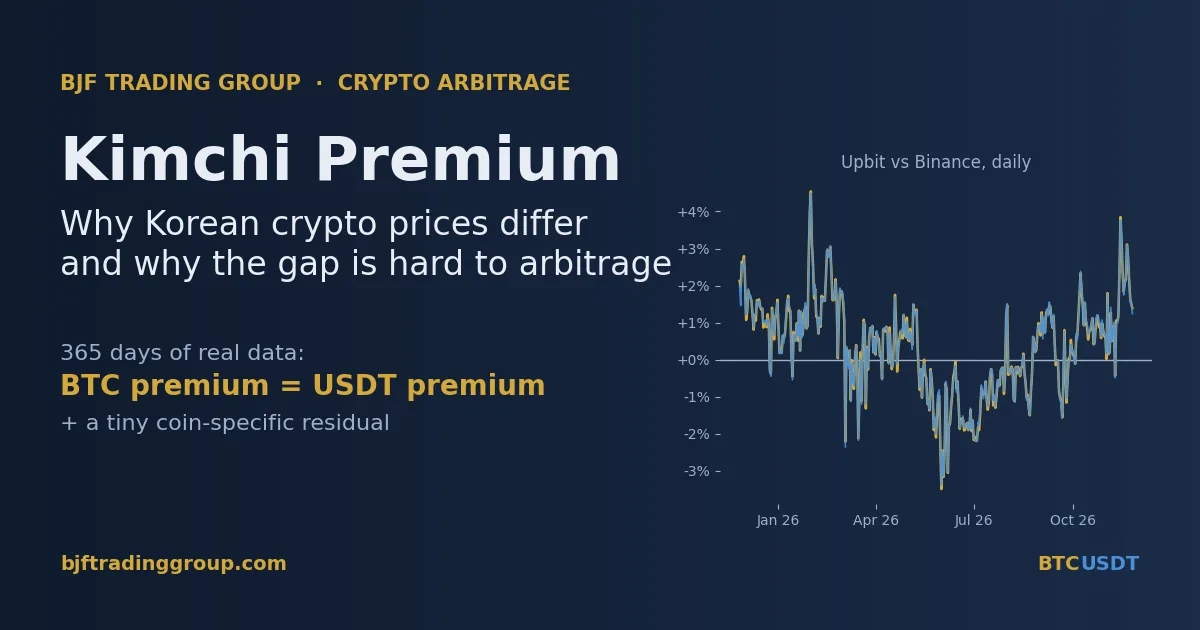
Kimchi Premium: Why Korean Crypto Prices Differ and Why the Gap Is Hard to Arbitrage Wednesday November 25th, 2026 – Posted in: Arbitrage Software, cryptoarbitrage software
Kimchi Premium: Why Korean Crypto Prices Differ and Why the Gap Is Hard to Arbitrage
The “kimchi premium” is the difference between the price of bitcoin and other coins on South Korean exchanges and the price on global exchanges. It has reached tens of percent in past bull markets and turned into a discount in quiet ones. This guide shows how to calculate it correctly, what a full year of real Upbit, Bithumb and Binance data looks like, why almost the whole gap is a premium on the dollar rather than on bitcoin, and why the obvious “buy abroad, sell in Korea” loop breaks at the step that matters.
- Kimchi premium: the short answer
- How to calculate the kimchi premium
- Why Korean prices can differ at all
- One year of real data: Upbit vs Binance
- A premium on the dollar, not on bitcoin
- How large the premium has been
- The arbitrage loop and where it breaks
- Worked example: the premium on paper vs what you can capture
- Legal and compliance limits
- Other regional price gaps
- What traders and bots can actually do with it
- Step by step: measuring the premium correctly
- Risks and limitations
- FAQ
Kimchi premium: the short answer
Short answer: the kimchi premium is how much more (or less) a cryptocurrency costs on South Korean won (KRW) exchanges such as Upbit and Bithumb than on global exchanges, after converting the Korean price into dollars. It exists because the Korean market is partly closed: KRW trading requires a Korean real-name bank account, foreign money cannot freely flow in, and won cannot freely flow out. Our year of daily data shows that the premium on bitcoin is almost exactly the same as the premium on USDT in Korea, so it is really a premium on dollar access. That is why it cannot be captured by moving coins alone: the profit only appears when won is converted back into dollars, and that step is regulated.
The term became famous in 2017 and 2018, when bitcoin traded in Seoul at a premium of tens of percent over US exchanges. Since then it has become a standard sentiment indicator for Korean retail demand and a classic example in every discussion of cross-exchange crypto arbitrage. It is also one of the most misunderstood: a large premium on a chart is not the same as a profit that an arbitrageur can lock in.
All values in the cards are measured from public exchange data and a public USD/KRW quote (method below). They describe the past and are not a forecast.
How to calculate the kimchi premium
The premium compares one coin in two currencies, so one price must be converted. The standard definition uses the market exchange rate of the won against the US dollar:
premium = KRW price / (global USD price x USD/KRW rate) – 1
With the snapshot from 25 November 2026 at 14:54 UTC:
| Input | Value | Source |
|---|---|---|
| BTC/KRW on Upbit (last trade) | 78,770,000 KRW | Upbit public ticker |
| BTC/USDT on Binance (last trade) | 57,686.01 USDT | Binance public ticker |
| USD/KRW market rate | 1,347.47 | Public FX quote |
| Global price in KRW | 57,686.01 x 1,347.47 = 77,730,170 KRW | Calculated |
| Kimchi premium | 78,770,000 / 77,730,170 – 1 = +1.34% | Calculated |
Three details change the number more than most people expect:
- Which dollar. Global exchanges quote bitcoin in USDT, not in US dollars. On the day of our snapshot USDT was close to one dollar on global venues, so the difference was negligible, but during stablecoin stress it is not. Our guide to stablecoin arbitrage and quote-currency gaps explains how to normalize such quotes.
- Which exchange rate. The interbank USD/KRW rate, a bank’s retail rate and the rate implied by USDT on a Korean exchange can differ by more than one percent. The premium is only meaningful if you state which one you used.
- Which prices. Last trades, mid prices and executable bid/ask prices give different answers. For a trading decision use the bid where you would sell and the ask where you would buy, at the size you intend to trade.
There is also a second, very useful version of the formula, which converts at the USDT price on the Korean exchange itself instead of the official rate:
coin-specific premium = KRW price / (global USDT price x USDT/KRW on the Korean exchange) – 1
On the same snapshot that is 78,770,000 / (57,686.01 x 1,364) – 1 = +0.11%. The difference between +1.34% and +0.11% is the core of this article: most of the premium belongs to the dollar, not to bitcoin.
Why Korean prices can differ at all
In an open market, any persistent price difference between two exchanges is closed by arbitrageurs who buy on the cheap venue and sell on the expensive one. The kimchi premium survives because several of the usual arbitrage channels into and out of Korea are restricted:
- Real-name accounts. KRW trading on Korean exchanges is linked to verified real-name bank accounts at partner banks. In practice this limits KRW markets to people who can open such accounts, mainly Korean residents, so foreign capital cannot simply sell coins into the Korean market.
- Foreign-exchange rules on the won. Moving won abroad and converting it into dollars is governed by Korea’s foreign-exchange regulation. Larger or repeated outward transfers require documentation and a legitimate purpose, which makes the “convert the profit back into dollars” step slow, limited and closely watched.
- Controls on crypto transfers. Korean exchanges apply the Travel Rule to transfers and restrict withdrawals to verified wallets and approved foreign exchanges. Moving coins in and out is possible for verified users, but not anonymous or instant.
- Concentrated domestic demand. Korea has one of the largest retail crypto markets in the world, trading almost entirely against KRW on a few domestic venues. When local enthusiasm rises faster than global demand, prices in won rise faster too.
- The won itself. The won is not a freely traded offshore currency in the way the euro or yen are. When demand for dollars in Korea rises, the USDT price in won can drift away from the official rate, and every coin priced in won follows.
None of these channels is fully closed, which is why the premium is usually small. But they are narrow enough that during demand spikes the price in Korea can move away from the rest of the world for days or weeks.
One year of real data: Upbit vs Binance
To see how the premium behaves outside the headlines, we downloaded daily closing prices for 365 days (26 November 2025 to 25 November 2026) from public APIs: BTC/KRW and USDT/KRW on Upbit, BTC/USDT on Binance, and the USD/KRW market rate from a public FX quote. For each day we calculated the bitcoin premium against the official rate and the USDT premium against the same rate.
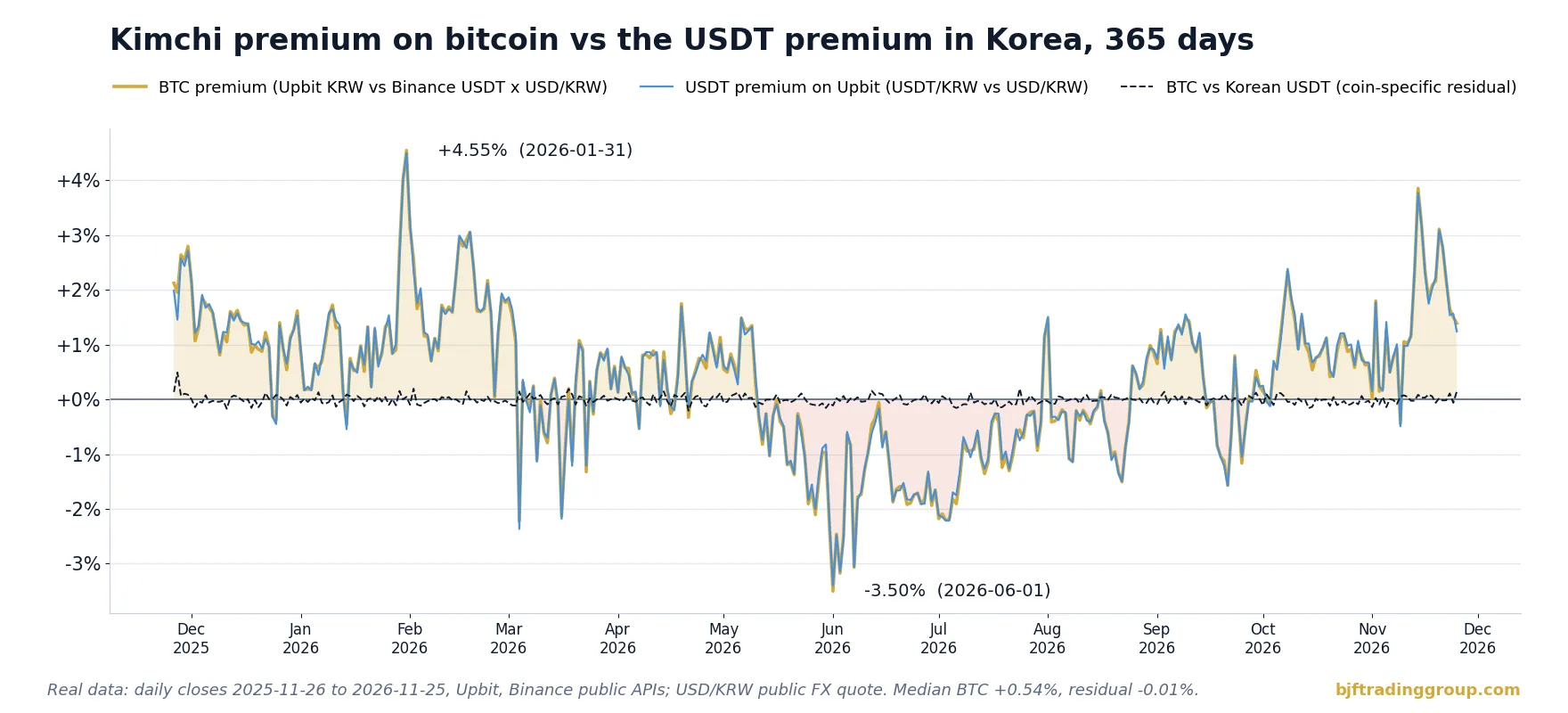
| Statistic (365 days) | BTC premium | USDT premium | BTC vs Korean USDT |
|---|---|---|---|
| Median | +0.54% | +0.54% | -0.01% |
| 10th to 90th percentile | -1.36% to +1.77% | -1.32% to +1.74% | -0.10% to +0.09% |
| Highest day | +4.55% (31 Jan 2026) | +4.50% (31 Jan 2026) | +0.49% |
| Lowest day | -3.50% (1 Jun 2026) | -3.39% (1 Jun 2026) | -0.21% |
| Days above 0% / above 2% / above 5% | 62% / 7% / 0% | – | – |
What the year shows:
- The premium is small most of the time. The median was about half a percent, and on only 7% of days did it exceed 2%. It never reached 5% in this period.
- It can be negative. From mid-May to the end of July 2026 bitcoin was cheaper in Korea than abroad on most days; the monthly median for June was -1.68%. A “kimchi discount” is as real as a premium.
- It moves in waves. Short spikes around late January and mid-November 2026 coincided with sharp price moves, when local demand reacts faster than capital can flow.
- Bitcoin and USDT move together. On almost every day the BTC premium and the USDT premium were within a few hundredths of a percent of each other.
Method: daily closes at 00:00 UTC for the crypto pairs; the FX rate is the latest daily close available for that date, so part of the day-to-day noise comes from the different timing of the FX quote. The series describes one year and one exchange pair; it is not a forecast.
A premium on the dollar, not on bitcoin
The third column of the table is the most important number in this article. When the Korean bitcoin price is converted at the price of USDT on the same Korean exchange, the premium almost disappears: a median of -0.01%, and 80% of days between -0.10% and +0.09%. In other words, inside Korea bitcoin is already priced correctly against the “Korean dollar”. What is expensive is the dollar itself.
This happens because arbitrage inside the crypto system works well. Anyone who can move USDT and bitcoin between Upbit and a global exchange can trade the BTC/USDT ratio, so that ratio stays aligned within fees. What crypto transfers cannot do is move won out of Korea. So the whole closed-market effect collects in a single place: the price of USDT (and of every coin) in won relative to the official exchange rate.
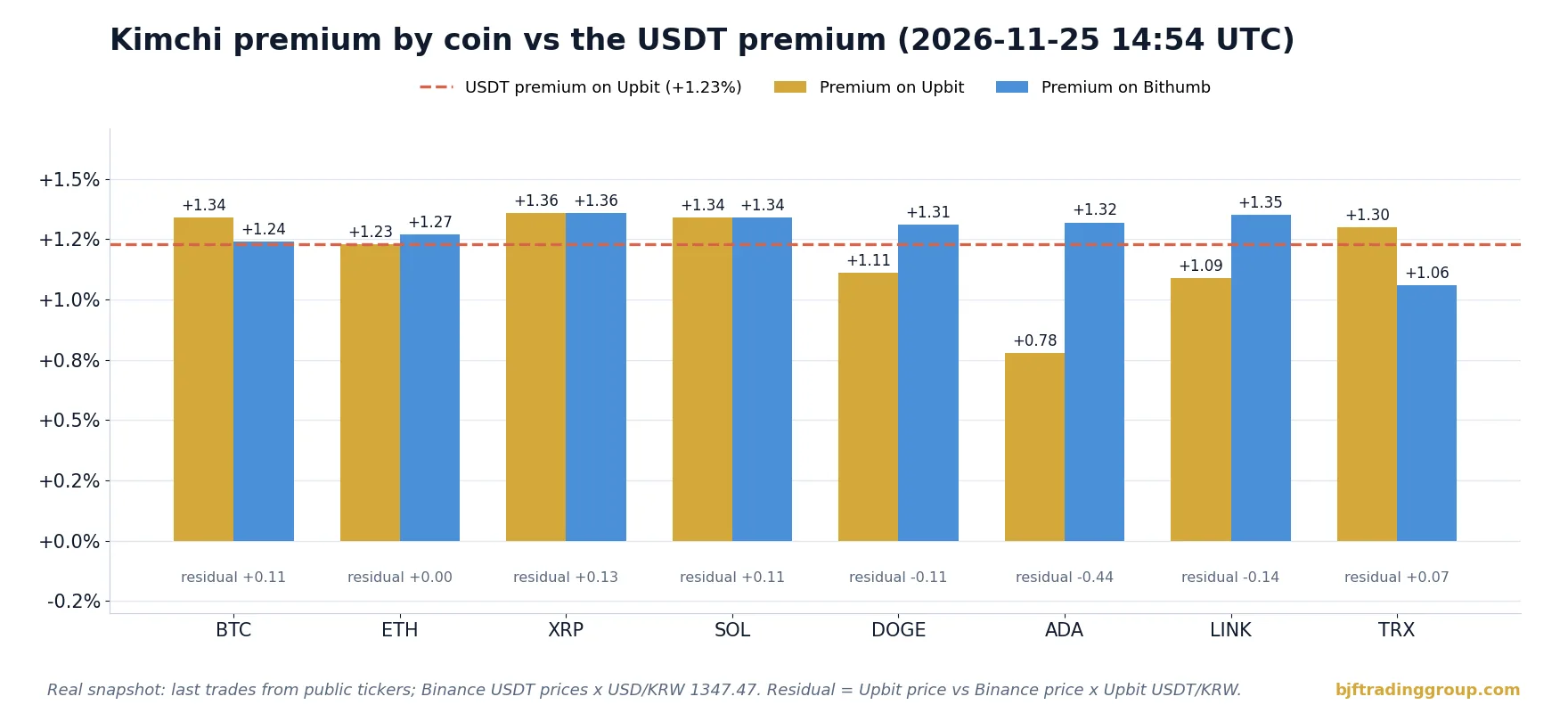
| Coin | Premium on Upbit | Premium on Bithumb | Upbit vs Korean USDT |
|---|---|---|---|
| BTC | +1.34% | +1.24% | +0.11% |
| ETH | +1.23% | +1.27% | 0.00% |
| XRP | +1.36% | +1.36% | +0.13% |
| SOL | +1.34% | +1.34% | +0.11% |
| DOGE | +1.11% | +1.31% | -0.11% |
| ADA | +0.78% | +1.32% | -0.44% |
| LINK | +1.09% | +1.35% | -0.14% |
| TRX | +1.30% | +1.06% | +0.07% |
The snapshot confirms the pattern across coins. With USDT at +1.23%, most coins sat between +1.1% and +1.4%. The coin-specific part (last column) was within about ±0.15% for most coins; the larger values, such as ADA on Upbit, come mainly from low-priced coins with coarse price steps in won and from the fact that last trades on two venues are never simultaneous. Coin-specific gaps of this size are ordinary cross-exchange spreads, and they are subject to the same fee and transfer arithmetic as any other pair of venues.
How large the premium has been
The quiet year in our data is not typical of every period. Press reports and research put the historical peaks much higher:
| Period | Approximate premium on bitcoin | Context |
|---|---|---|
| Late 2017 to January 2018 | tens of percent, peaks near 50% | Retail boom, before the real-name account system was in place |
| April 2021 | around 20% | Bull market; Korean authorities announced checks on illegal foreign-exchange transfers |
| March 2024 | around 10% | Bitcoin at new highs, strong local demand |
| Nov 2025 to Nov 2026 (our data) | -3.5% to +4.5%, median +0.5% | Calmer market, falling prices for much of the period |
Historical values are approximate figures from public reporting and depend on the exchange, the time of day and the exchange rate used. The last row is our own measurement.
The large premiums appeared when Korean retail demand surged during bull markets and capital could not flow in fast enough. Each time, the premium shrank later as demand cooled and as more participants found legal ways to bring coins into Korea. The general lesson: the premium is a function of the gap between local and global demand and of the width of the legal channels between them.
The arbitrage loop and where it breaks
The textbook kimchi arbitrage looks simple: buy bitcoin with dollars abroad, send it to a Korean exchange, sell it for won, and bring the won back as dollars. Each round should earn the premium. In practice every step has a cost or a limit, and the last step is the one that decides everything.
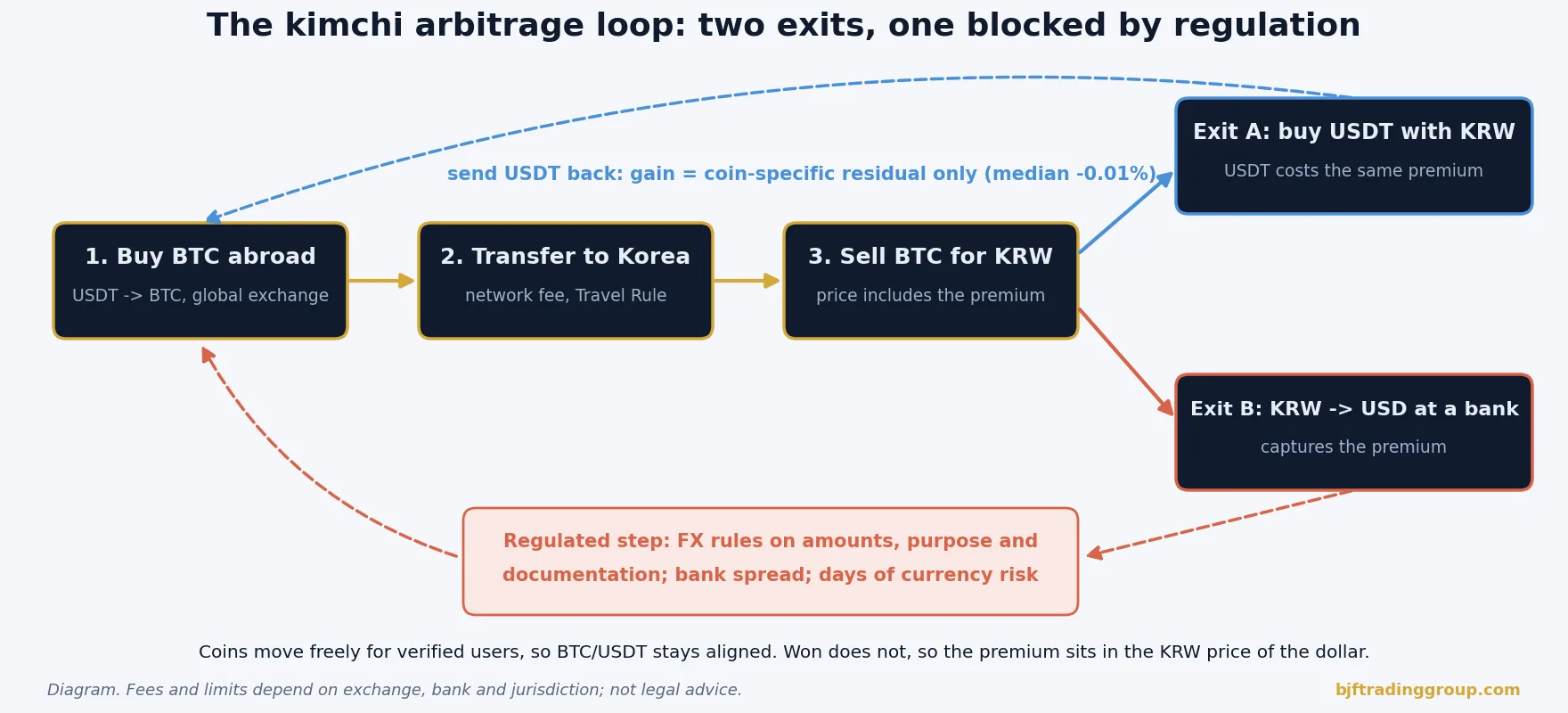
Step by step:
- Buy abroad. Buy BTC with USDT on a global exchange. Cost: the taker fee and the spread.
- Transfer to Korea. Withdraw to a Korean exchange where you hold a verified account. Cost: the network fee and the price risk while the coin is in transit; Travel Rule checks may add delay. The withdrawal side of this step is covered in detail in our guide to withdrawal fees and transfer times.
- Sell for won. Sell BTC for KRW on the Korean exchange. You now hold won worth the global price plus the premium.
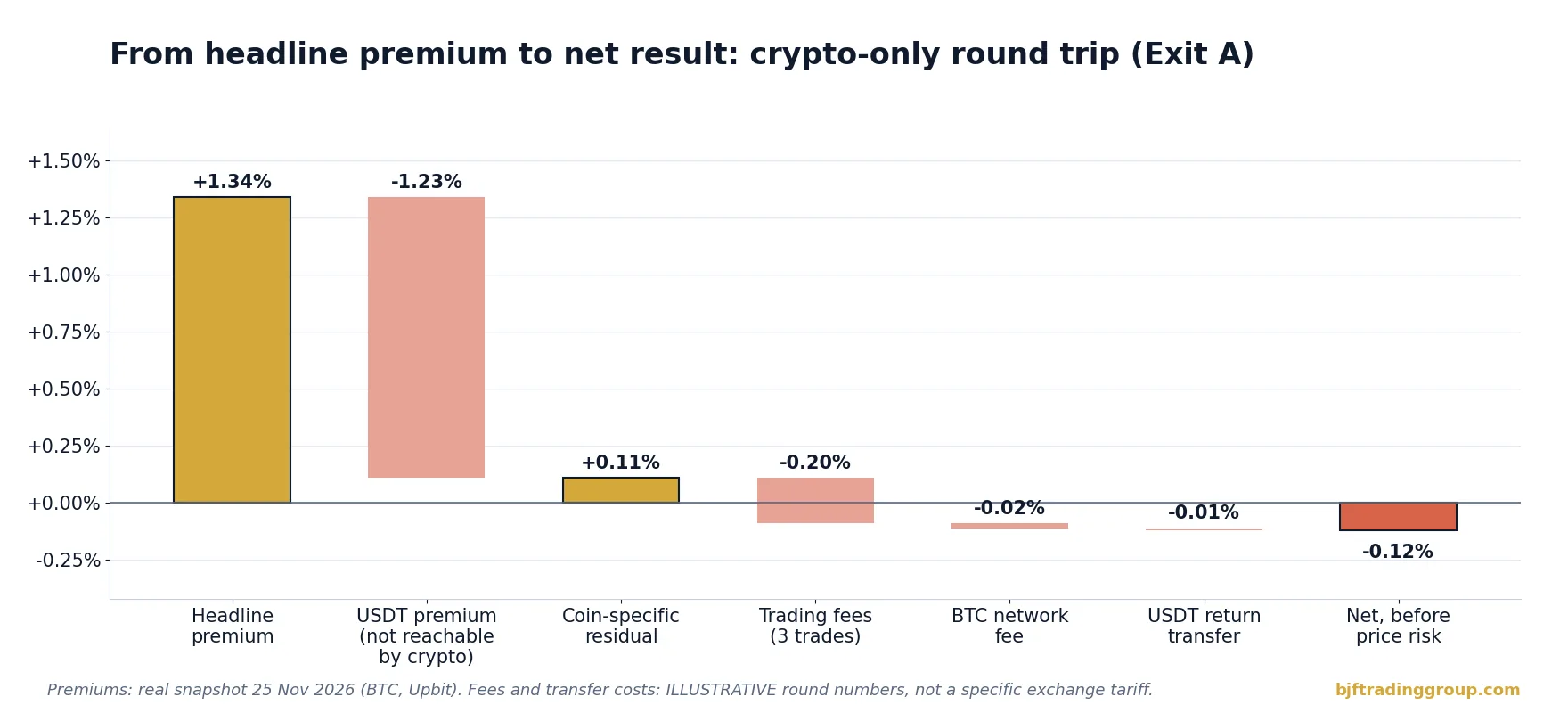
- Exit A: stay in crypto. Buy USDT (or another coin) with the won and send it back abroad. This is easy for a verified user, but USDT costs the same premium in won. You receive roughly the residual from the previous section, a few hundredths of a percent either way, before fees.
- Exit B: convert won into dollars. Withdraw won to a Korean bank account and convert it into dollars at the bank rate, then transfer the dollars abroad. This captures the premium, but it costs a bank FX spread, takes time, and is subject to foreign-exchange rules on purpose, amounts and documentation.
Exit A is the one that crypto traders can automate, and our data shows why it rarely pays: the market has already arbitraged it. Exit B is the one that would earn the premium, and it is exactly the channel that capital controls restrict. This is why the kimchi premium is often described as an arbitrage that only exists on paper.
Worked example: the premium on paper vs what you can capture
Take the snapshot prices and a trade of 1 BTC. The fee levels below are illustrative round numbers for a standard account, not the tariff of a specific exchange; check your own fees before using the numbers.
| Step | Exit A: buy USDT in Korea | Exit B: convert KRW via a bank |
|---|---|---|
| Buy 1 BTC abroad | -57,686 USDT | -57,686 USDT |
| Sell 1 BTC on Upbit | +78,770,000 KRW | +78,770,000 KRW |
| Convert KRW | at 1,364 KRW/USDT = 57,749 USDT | at 1,347.47 KRW/USD = 58,458 USD |
| Gross result | +63 (+0.11%) | +772 (+1.34%) |
| Trading fees (illustrative: 0.10% abroad, 0.05% per trade in Korea) | -0.20% | -0.15% |
| BTC network fee and transit risk (illustrative) | -0.02% plus price risk | -0.02% plus price risk |
| Bank FX spread and transfer fees (illustrative) | – | -0.30% to -1.00% |
| USDT return transfer (illustrative) | -0.01% | – |
| Net before price risk | about -0.12% | about +0.2% to +0.9% |
| Time per round | minutes to an hour | days, plus documentation |
With a premium of 1.34%, Exit A loses money and Exit B leaves a thin margin that depends heavily on the bank rate. Exit B also ties up capital for days, carries currency risk on the won and is permitted only within the limits and purposes that foreign-exchange rules allow. At a premium of 5% or 10% the arithmetic of Exit B looks better, but those are exactly the periods when regulators and banks scrutinize transfers most closely.
The fee side of this comparison follows the same logic as any two-venue trade. Our article on maker and taker fees in crypto arbitrage shows how to turn fee tiers into a break-even spread, and the same calculation applies to the coin-specific residual.
Legal and compliance limits
The restrictions that create the premium are law, not inefficiencies. Anyone considering a trade that touches the Korean market should understand them and get professional advice where needed. In general terms:
- Account eligibility. KRW trading on Korean exchanges is tied to verified real-name accounts. Using another person’s account or identity to access the market is not an arbitrage technique; it is a violation of the exchange’s rules and potentially of the law.
- Foreign-exchange regulation. Converting won into foreign currency and sending it abroad must follow Korean foreign-exchange rules on amounts, purpose and reporting. Splitting transfers, misdeclaring their purpose or using informal channels to avoid these rules is illegal. Korean authorities have investigated and prosecuted schemes that moved money abroad to profit from the premium, including probes in 2022 into abnormal foreign-exchange remittances worth several billion dollars that were linked to crypto trading.
- Crypto transfer rules. Travel Rule data, wallet verification and the exchange’s list of approved counterparties apply to every transfer. Transfers can be delayed or refused.
- Tax. Gains, foreign-exchange conversions and cross-border transfers may be taxable or reportable in Korea and in your country of residence.
We do not describe ways to get around any of these rules, and this article is not legal, tax or financial advice. The practical conclusion for most traders outside Korea is simple: the kimchi premium is something to measure and understand, not something you can legally trade as an arbitrage.
Other regional price gaps
Korea is the best known case, but the same mechanism appears wherever a local currency market for crypto is separated from the global one:
- Countries with capital controls or currency stress. In markets where buying dollars is restricted or the local currency is weakening fast, USDT often trades above the official exchange rate on local exchanges and peer-to-peer platforms. As in Korea, this is mainly a premium on dollar access, and bitcoin follows the local USDT price.
- US exchanges vs offshore exchanges. The price difference between a US-dollar exchange and a global USDT exchange (often called the Coinbase premium) is watched as an indicator of US institutional demand. It is usually a few hundredths of a percent and is mostly arbitraged, because dollars and USDT move freely between the two worlds for eligible traders.
- Regional listings. A coin listed only on local exchanges, or with deposits suspended on one venue, can trade at a large gap. These gaps are usually caused by a blocked transfer path, so the “arbitrage” cannot be completed until the path reopens.
The common thread: a persistent regional gap tells you that something stops money or coins from moving. Before treating a gap as an opportunity, identify what that something is. If it is a legal restriction or a blocked network, the gap is not tradable for you.
What traders and bots can actually do with it
If the premium itself cannot be captured, why follow it? There are three practical uses.
- Sentiment indicator. A rising premium means Korean retail is buying more aggressively than the rest of the world; a falling premium or a discount means the opposite. Many traders watch it alongside funding rates and exchange flows. It describes current demand; it is not a reliable timing signal on its own.
- Correct spread measurement. Any scanner or bot that compares KRW prices with USDT prices must decide which exchange rate to use. If it uses the official rate, every Korean coin will appear “1% more expensive” during a premium, and the screen fills with false opportunities. Converting at the live USDT/KRW price on the same exchange shows the spreads that crypto transfers can actually trade.
- Trading the residual where you are eligible. For traders who legally hold verified accounts on both sides, the coin-specific residual is an ordinary cross-exchange spread: small, usually within fees, occasionally wider for individual coins during volatile moments. It follows the same rules as any other venue pair: pre-positioned inventory, both legs at once, and a threshold above all costs.
For general cross-exchange monitoring, the free crypto arbitrage scanner shows where prices of the same coin currently differ between exchanges; when one side is quoted in won, apply the normalization above before reading the spread. For automated trading on venues you are eligible to use, SharpTrader runs arbitrage strategies across crypto exchanges with thresholds you set per instrument. Low-latency hosting matters less here than legal access: our guide to exchange server locations and API latency explains when speed does decide the outcome.
Step by step: measuring the premium correctly
1
2
3
4
5
6
7
Risks and limitations
- Legal risk. The main barrier to the kimchi premium is regulation. Trades that rely on bending account or foreign-exchange rules can lead to frozen funds and prosecution.
- Price risk in transit. Coins in transit and won waiting for conversion are exposed to market moves that can exceed the premium within minutes.
- Premium collapse. The premium can shrink or turn into a discount quickly, as it did in May and June 2026, while capital is still tied up in the loop.
- Transfer interruptions. Exchanges can suspend deposits or withdrawals of a coin, delay transfers for compliance checks or remove a counterparty from their approved list.
- Measurement limits. Our series uses daily closes and a daily FX rate, and the snapshot uses last trades, not executable prices at size. Real executable premiums are lower after spreads and depth.
- Exchange and counterparty risk. Balances on any exchange are exposed to insolvency, hacks and account restrictions. This article is not financial advice.
Measure spreads that you can actually trade
BJF Trading Group builds arbitrage and high-frequency trading software for crypto and forex markets. Watch real price differences between exchanges with the free scanner, normalize every quote to the same currency, and automate only the spreads that still pay after every fee on venues you are allowed to use.
Free arbitrage scanner + short email course
Get the free scanner link and a few short, practical emails from Boris: what a price gap really means after costs, how to test a strategy before risking real money, and which tools fit your market. No hype.
FAQ
What is the kimchi premium?
It is the percentage by which a cryptocurrency trades higher on South Korean won exchanges than on global exchanges after converting the Korean price into dollars at the market exchange rate. When Korean prices are lower, the gap is called a kimchi discount.
Why does the kimchi premium exist?
Because the Korean crypto market is partly separated from the global one. KRW trading requires a verified Korean real-name bank account, foreign capital cannot freely enter the KRW market, and converting won into dollars and sending them abroad is governed by foreign-exchange rules. When local demand rises faster than these channels allow capital to flow, Korean prices rise above global prices.
How is the kimchi premium calculated?
Divide the coin’s price in won on a Korean exchange by its global price multiplied by the USD/KRW exchange rate, then subtract one. For example, 78,770,000 KRW divided by 57,686 USDT times 1,347.47 KRW per dollar gives a premium of about 1.34%.
How big is the kimchi premium now?
It changes every minute. In our data from November 2025 to November 2026 it ranged from about -3.5% to +4.5% for bitcoin on Upbit, with a median of about +0.5%. Historically it has been much higher in bull markets, with peaks near 50% in early 2018, around 20% in April 2021 and around 10% in March 2024.
Can you arbitrage the kimchi premium?
Not in the way the chart suggests. Moving coins into Korea and buying USDT with the won returns only a small coin-specific residual, because USDT in Korea carries the same premium. Capturing the full premium requires converting won into dollars through a bank, which is limited by Korean foreign-exchange rules and is not available to most foreign traders. Circumventing these rules is illegal.
Can foreigners trade on Upbit or Bithumb?
KRW trading on Korean exchanges requires identity verification linked to a Korean real-name bank account, which in practice limits access mainly to Korean residents. Check the current rules of each exchange; this article does not describe ways to bypass them.
Is the kimchi premium a good trading signal?
It is a useful indicator of Korean retail demand relative to the rest of the world. A rising premium shows strong local buying and a discount shows weak local demand. It is best used together with other data such as funding rates and volumes, not as a stand-alone buy or sell signal.
