Cash-and-Carry Arbitrage in Crypto: Spot–Futures Basis Trading Explained with Numbers Wednesday October 28th, 2026 – Posted in: Arbitrage Software, cryptoarbitrage software
Cash-and-Carry Arbitrage in Crypto: Spot–Futures Basis Trading Explained with Numbers
When a quarterly bitcoin future trades above the spot price, you can buy the coin, sell the future and lock in the difference. That is cash-and-carry arbitrage. It sounds risk-free, and the price risk really is hedged, but the real return depends on fees, margin structure, the cost of your capital and what happens to the short leg if the market rallies 30%. This guide walks through the full trade with numbers.
- What cash-and-carry arbitrage is
- Basis, contango and backwardation
- A worked BTC example
- Why the basis exists
- Dated futures vs perpetual funding
- Linear vs inverse contracts: the margin decision
- Costs, break-even and your hurdle rate
- Step by step: running the trade
- Early exit, holding to expiry and rolling
- Risks that remain after hedging
- Common mistakes
- Monitoring and automation
- FAQ
What cash-and-carry arbitrage is
Short answer: cash-and-carry arbitrage means buying an asset on the spot market and at the same time selling a futures contract on the same asset that trades at a higher price. The two positions cancel each other’s price risk. At expiry the futures price converges to the spot price, so the difference you locked in at entry (the basis) becomes your gross profit, whatever the coin did in between.
The name comes from traditional commodity markets: you pay cash for the physical good and carry it (store, insure, finance it) until the futures delivery date. In crypto there is no warehouse, but there is a cost of carry all the same: the capital tied up in the coin, the margin for the short position, trading fees and the risk of keeping funds on an exchange.
Cash-and-carry is a market-neutral, relative-value trade. It does not try to predict where bitcoin goes. It earns a yield that the market pays to whoever is willing to sell futures to leveraged buyers. That is why it is popular with funds and treasury desks, and why the yield shrinks when too much capital chases it.
If you are new to the instruments themselves, start with our explainer on how futures differ from the spot market. This guide assumes you know what a futures contract and margin are.
Basis, contango and backwardation
The basis is the difference between the futures price and the spot price. Traders quote it in three ways:
Simple (non-compounded) annualization, which is how most dashboards quote it. Compounded figures are slightly higher.
When futures trade above spot the market is in contango. This is the normal state for crypto, because most traders who use futures want leveraged long exposure. Cash-and-carry needs contango.
When futures trade below spot the market is in backwardation. It happens after crashes, during forced deleveraging or when borrowing the coin is expensive. In theory you can run the trade in reverse (short spot, buy the future), but shorting spot crypto requires borrowing the coin on margin, which is often limited and expensive. Most practitioners simply wait for contango to return.
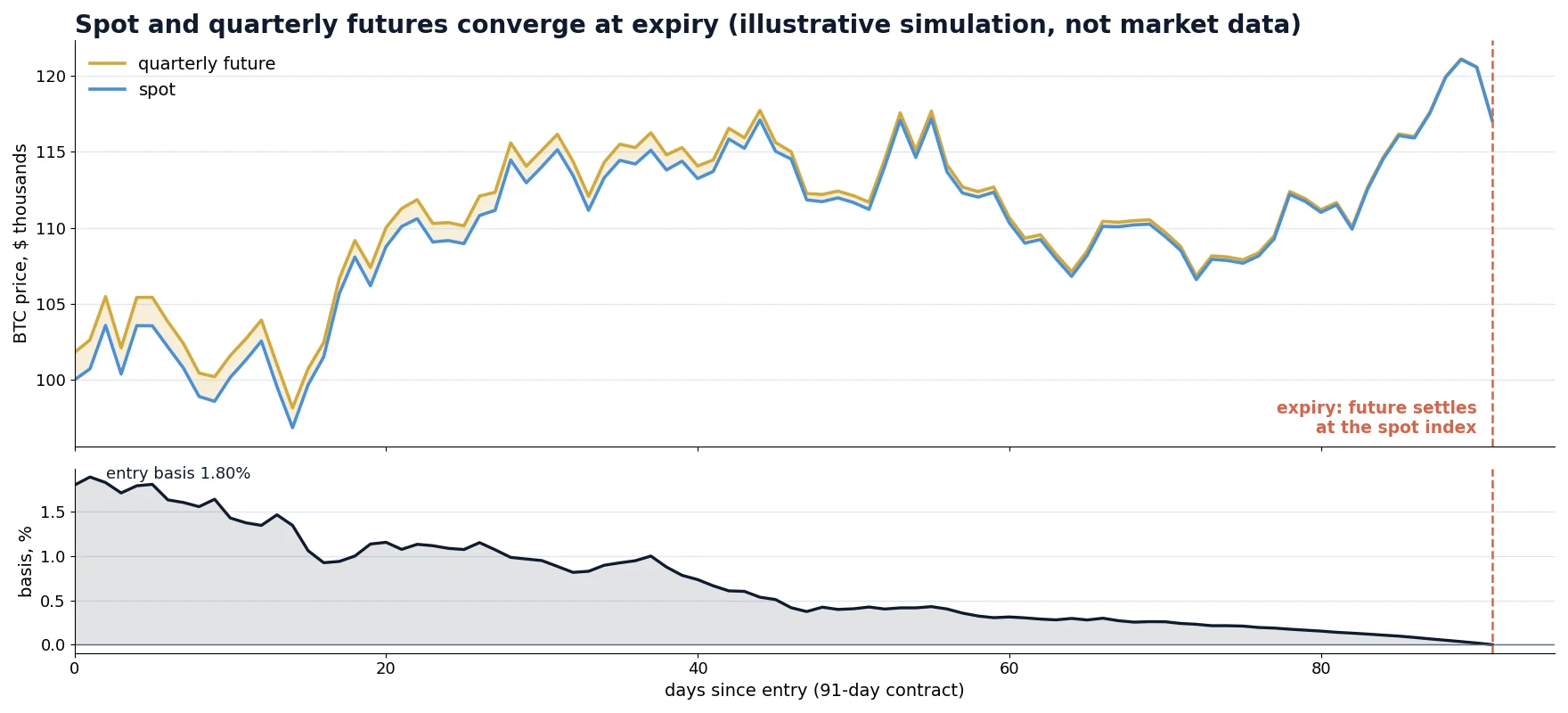
The key property is convergence: a dated future settles against the spot index at expiry, so the basis must fall to zero on the expiry date. Before that the basis moves freely: it can widen, narrow or briefly turn negative. Convergence is the only point where the outcome is fixed.
A worked BTC example
All prices below are illustrative round numbers chosen to make the arithmetic easy to follow, not a quote from a specific day.
- BTC spot price: $100,000
- Quarterly BTC future, 91 days to expiry: $101,800
- Basis: $1,800 = 1.80%, annualized 7.22%
- Trade size: 1 BTC long spot, 1 BTC short future (USDT-margined)
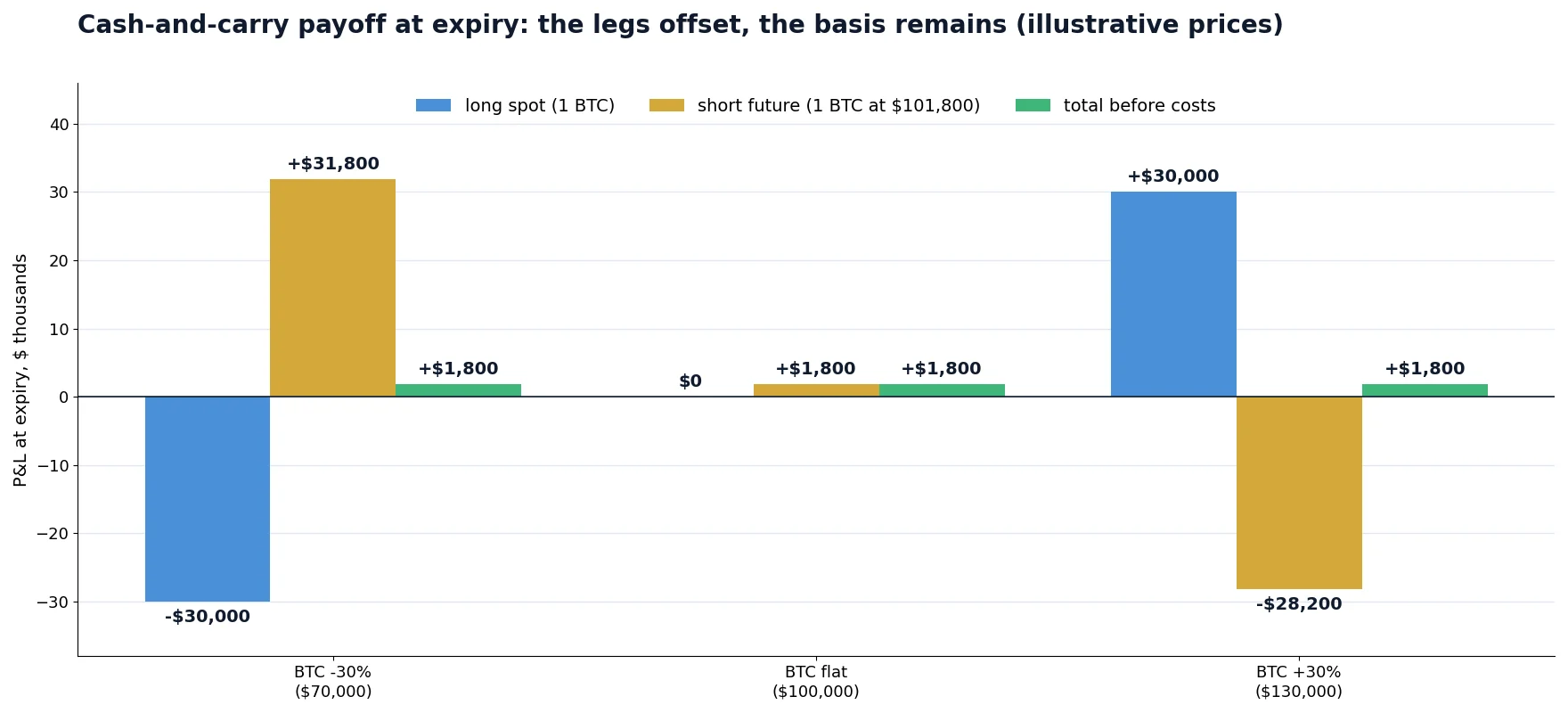
At expiry the future settles at the spot price, whatever it is. Here is what happens in three very different markets:
| BTC at expiry | Spot leg P&L | Short futures P&L | Total before costs |
|---|---|---|---|
| $70,000 (−30%) | −$30,000 | +$31,800 | +$1,800 |
| $100,000 (flat) | $0 | +$1,800 | +$1,800 |
| $130,000 (+30%) | +$30,000 | −$28,200 | +$1,800 |
Now the costs. Assume taker fees of 0.10% on spot and 0.05% on futures, paid on entry and on exit. Entry costs about $100 + $51, exit roughly the same, so the round trip is about $300 (0.30%). Net profit: about $1,500.
How much capital did that need? The spot coin costs $100,000. The short future needs margin; at 3x leverage that is about $33,900 of USDT. Total capital: about $133,900. The return is $1,500 / $133,900 = 1.12% for 91 days, or about 4.5% annualized. The headline basis was 7.22%; the realistic return on capital is closer to 4.5%. That gap between headline and net yield is the main thing most cash-and-carry guides skip.
The +30% row also hides a problem. The short future lost $28,200 against $33,900 of margin. At 3x, the liquidation price is roughly 33% above entry, so the position would have been close to liquidation, even though the overall trade was perfectly hedged. We come back to this in the margin section, because it decides whether cash-and-carry is a calm trade or a stressful one.
Why the basis exists
If the trade is hedged, why does the market pay for it? Because someone has to take the other side of leveraged demand, and that service has a price. The main drivers:
- Demand for leveraged longs. Buying a future needs only margin. In bullish phases speculators bid futures up, and the basis widens.
- Scarce arbitrage capital. To close the gap, arbitrageurs must fund the full spot purchase plus margin. When capital is scarce or expensive, the gap stays open.
- The cost of money. In traditional markets the fair basis is roughly the interest rate. In crypto the “interest rate” is what dollars and stablecoins earn elsewhere. When risk-free US dollar yields are high, the basis must be higher to attract capital.
- Exchange and custody risk. Both legs usually sit on exchanges. Part of the basis is compensation for that counterparty risk.
The result is a basis that moves with market sentiment. In strong bull phases annualized basis on major venues has repeatedly exceeded 15–20% for weeks; in quiet or bearish markets it falls to low single digits, sometimes below the risk-free rate, and occasionally into backwardation. The trade is therefore cyclical: the best entries come in euphoric markets, exactly when holding a hedged position feels least exciting.
Since US spot bitcoin ETFs launched in 2024, a large part of the regulated version of this trade runs on CME: funds buy ETF shares and short CME futures. That brought more capital to the trade and is one reason the basis on regulated venues has compressed compared with the early years of crypto.
Dated futures vs perpetual funding
Crypto has a second way to earn the same premium: perpetual futures. A perpetual never expires, so it cannot converge. Instead, exchanges keep it close to spot through periodic funding payments between longs and shorts. Long spot plus short perpetual is also called cash-and-carry, and it is covered in detail in our funding rate arbitrage guide. The two versions behave differently:
| Dated futures (basis) | Perpetual (funding) | |
|---|---|---|
| Yield known at entry? | Yes, if held to expiry | No, re-set every funding interval |
| How you are paid | Convergence at expiry (or earlier, when you close) | Funding payments every 8 h (1–4 h on some venues) |
| Can the yield turn negative? | Not if held to expiry; only mark-to-market in between | Yes, negative funding means the short pays |
| Exit | Hold to expiry, close early or roll | Any time |
| Liquidity | Lower, concentrated in BTC and ETH | Deepest market in crypto, many altcoins |
| Best for | Locking a known yield for a quarter | Flexible, frequently rebalanced positions |
Many desks run both and move capital to whichever pays more for the risk. A rule of thumb: when the annualized basis on the next quarterly contract is clearly higher than the average funding rate you expect over the same period, the dated future is the better short leg, because it locks the yield. To estimate funding returns in the same units, use our funding rate APR and break-even calculator.
Linear vs inverse contracts: the margin decision
Crypto exchanges list two kinds of dated futures, and the choice changes the economics of cash-and-carry more than any fee discount.
Linear (USDT- or USDC-margined) futures
Margin and profit are in a stablecoin. Easy to understand, but the spot coin and the margin are separate pots. If BTC rallies, the short future loses stablecoins while the gain sits in your spot coin. The position can be liquidated even though the hedge as a whole is profitable. To avoid that you either use low leverage (more idle capital, lower return) or move profits from the spot side to the futures margin during a rally.
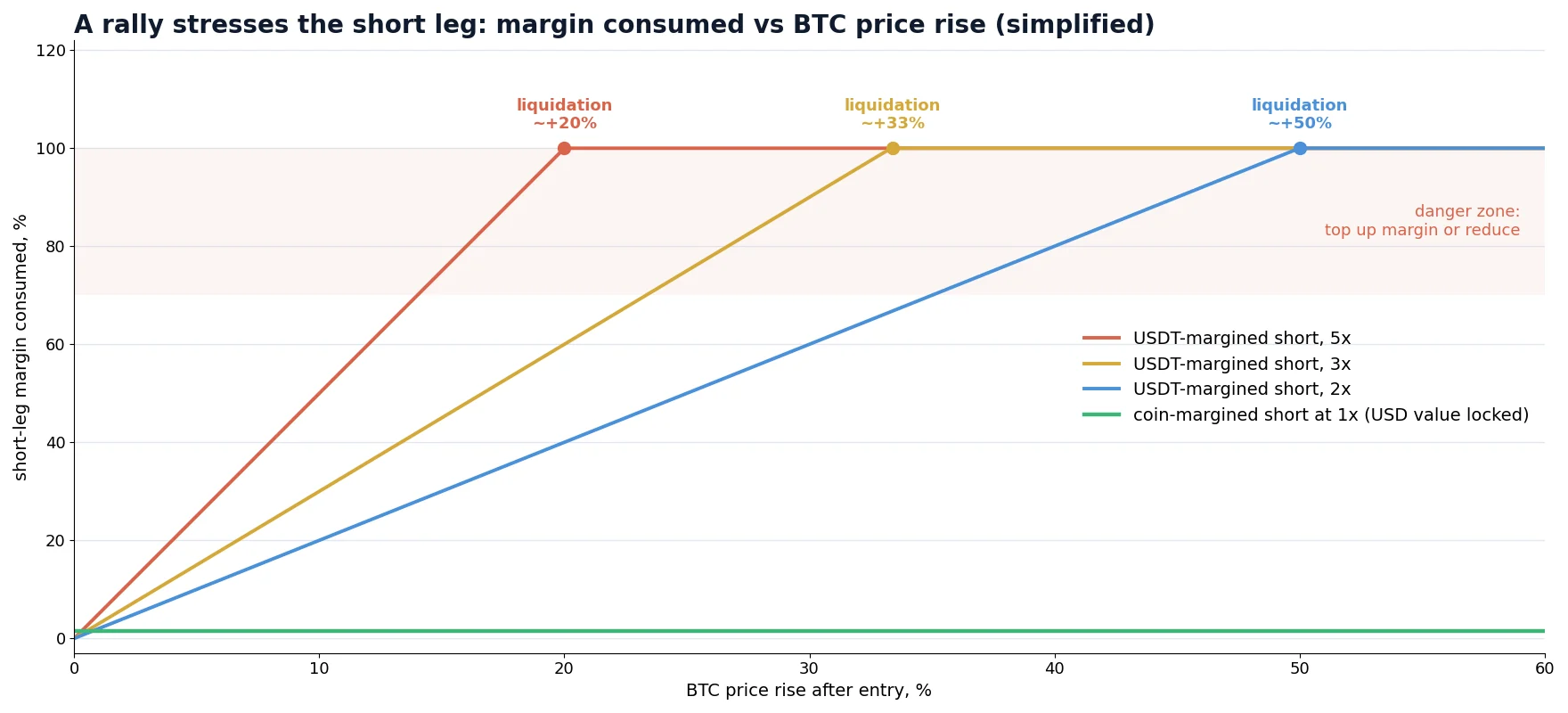
Approximate liquidation distance for an isolated short at different leverage, before maintenance margin details:
| Short leverage | Margin for 1 BTC at $101,800 | Liquidation roughly at | Total capital (spot + margin) |
|---|---|---|---|
| 1x | $101,800 | far away (price must about double) | ~$201,800 |
| 2x | $50,900 | ~+49% | ~$150,900 |
| 3x | $33,900 | ~+33% | ~$133,900 |
| 5x | $20,400 | ~+19% | ~$120,400 |
Inverse (coin-margined) futures
Here the contract is quoted in dollars but margined and settled in the coin itself. That allows an elegant version of the trade: deposit the BTC you bought as collateral and short the inverse future for a dollar value equal to the futures price (in our example $101,800 of contracts per 1 BTC).
Something useful happens. When BTC rises, the short loses BTC but each remaining BTC is worth more dollars; when BTC falls, the short gains BTC. The dollar value of the account stays fixed at about $101,800 and the effective leverage stays close to 1x. There is no separate margin pot and no realistic liquidation price. At expiry you hold $101,800 / ST BTC, worth $101,800 at whatever price ST is.
Capital needed: only the $100,000 for the coin. Same $1,800 basis, same $300 costs, so the return is $1,500 / $100,000 = 1.5% for 91 days, about 6.0% annualized instead of 4.5% with the linear 3x setup.
Costs, break-even and your hurdle rate
A basis is only worth taking if it beats three things: trading costs, the risks you keep, and what the same capital earns with no work at all. List every cost before you enter:
- Trading fees on four executions (spot buy, futures sell, and both exits). Maker orders cut this sharply but add the risk of one leg filling without the other.
- Slippage on the less liquid leg, usually the dated future. Check order book depth for your size, not the top of book.
- Settlement or delivery fee if you hold to expiry (venue-specific, often small).
- Transfer costs if spot and futures are on different exchanges: withdrawal fees, network fees and time. See our breakdown of crypto withdrawal fees and transfer times.
- Opportunity cost: what your dollars would earn in short-term government bills or another low-risk place. This is your hurdle rate.
Break-even in annualized terms is simple: round-trip costs in % × 365 / days. With 0.30% costs on a 91-day contract that is about 1.2% per year. A quarter with 7.22% basis therefore nets about 6.0% on the inverse setup and 4.5% on the linear 3x setup. If your hurdle rate is, say, 4% per year, the linear trade barely pays for its risk and work, while the inverse trade leaves a margin of about two percentage points.
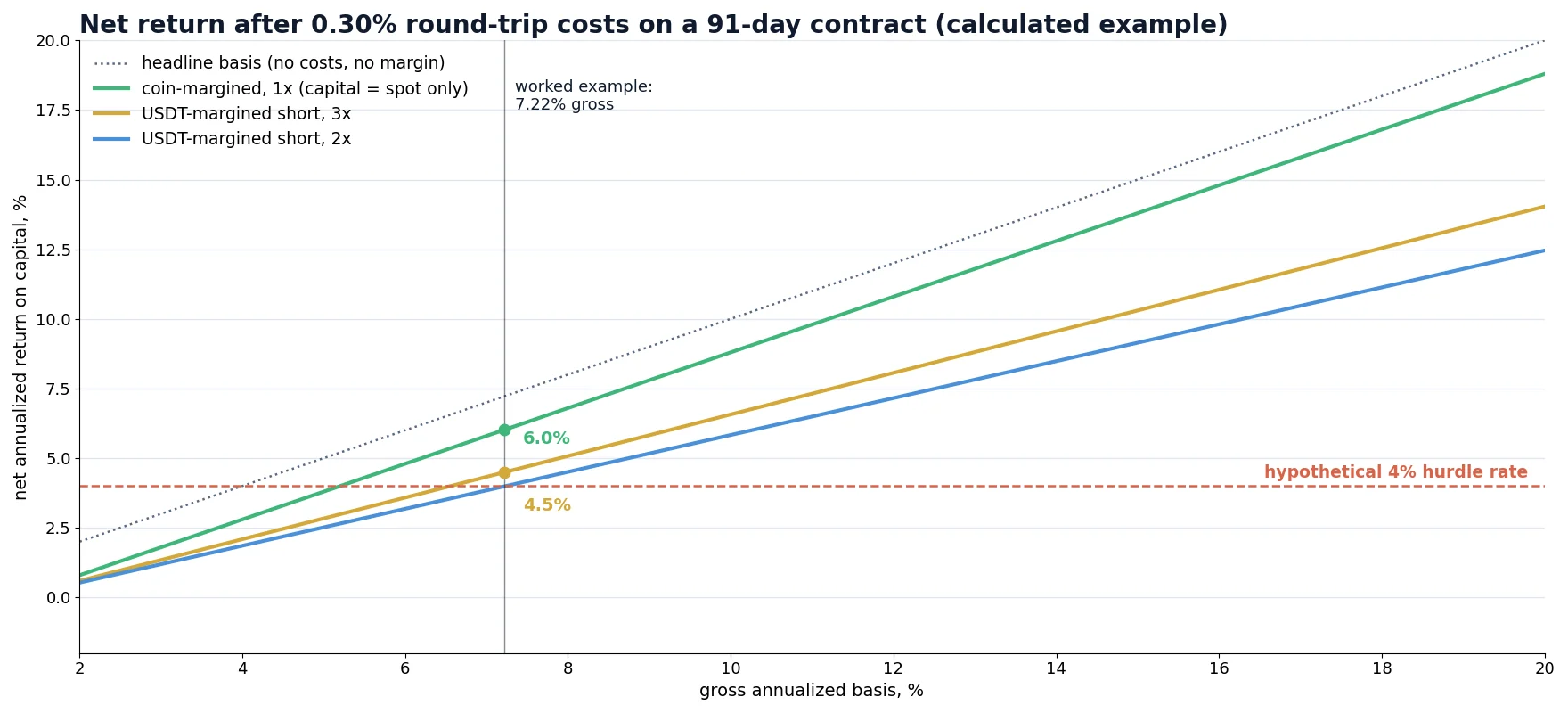
The chart shows why so many traders get disappointed: below about 6.5% gross annualized basis, a USDT-margined trade with sensible leverage hardly beats a risk-free deposit at that hurdle. The trade becomes attractive when the basis is well above the hurdle, which in practice means bullish, leveraged markets.
Step by step: running the trade
1
2
3
4
5
6
7
Early exit, holding to expiry and rolling
Holding to expiry is not the only choice, and often not the best one.
Closing early when the basis collapses
Say you entered at 1.80% basis with 91 days left. Forty-five days later the market has cooled and the basis is only 0.40% with 46 days left. If you close both legs now, you have captured 1.40% in 45 days, about 11.4% annualized before costs. Holding to expiry would earn the remaining 0.40% over 46 days, about 3.2% annualized, which is likely below your hurdle rate. Close, and keep the capital ready for the next opportunity. The extra exit fees are the price of that option, so include them.
Living with a temporary widening
The opposite also happens: the basis widens from 1.80% to 3% after entry. Your position shows a mark-to-market loss, because the future you are short rose faster than spot. Nothing is broken. If you hold to expiry, convergence still delivers the original 1.80%. The danger is only a margin problem on a linear short, which is another reason to keep leverage low.
Rolling to the next quarter
Before expiry you can close the expiring short and open a short on the next quarterly contract, keeping the spot coin. This is a calendar roll. Do it only if the next contract’s annualized basis still clears your hurdle; otherwise let the position settle and stay in cash.
Risks that remain after hedging
Cash-and-carry removes price risk, not all risk. These are the ones that actually hurt people:
| Risk | What happens | How to limit it |
|---|---|---|
| Liquidation of the short | A rally wipes the futures margin while the gain sits on the spot side; the hedge breaks at the worst moment | Coin-margined 1x, or low leverage plus alerts and a top-up plan |
| Exchange / counterparty | Insolvency, frozen withdrawals or a hack; the hedge is worthless if you cannot get your money out | Large, established venues; spread capital; do not chase a slightly higher basis on a weak exchange |
| Auto-deleveraging (ADL) | In extreme moves an exchange can force-close profitable positions, for example your short in a crash, leaving the spot coin unhedged | Watch ADL indicators; re-hedge immediately if closed |
| Settlement mismatch | The future settles at an averaged index price; you sell spot at a different price | Sell spot in slices during the settlement window |
| Leg risk at entry and exit | One leg fills, the other does not, and the price moves | Simultaneous orders, small slices, size limited by the thinner book |
| Stablecoin risk | A USDT- or USDC-margined leg is exposed to a depeg | Use reputable stablecoins; consider coin-margined contracts |
| Access and tax | Some venues are not available in your country; spot and futures gains may be taxed differently | Check eligibility on every venue; ask a tax advisor before scaling up |
Common mistakes
- Quoting the basis as the return. The return is on all capital used, including margin, after all fees. Most of the time it is well below the headline basis.
- Using high leverage on the short to “improve” the yield. It improves the return on paper and turns a hedged trade into a liquidation risk.
- Comparing the yield with zero instead of a hurdle rate. A 5% hedged yield is not attractive if cash earns 4% with no exchange risk.
- Ignoring settlement mechanics. Selling spot hours before or after the settlement window re-opens price risk on the final day.
- Mixing up the coin quantity and the dollar notional on inverse contracts. Size the inverse short in dollars at the futures price, not in coins.
- Forgetting that both legs are on exchanges. Price risk is hedged; the risk of the venue failing is not.
Monitoring and automation
A single cash-and-carry position needs only a spreadsheet: spot and futures prices, days to expiry, costs, margin. It becomes an operational job once you compare several venues and contracts, react to basis collapses, or combine dated futures with perpetual and cross-exchange opportunities. Exchange APIs give you everything needed; our guide to crypto exchange APIs for arbitrage covers rate limits, WebSocket feeds and order handling.
The same premium shows up in several places, and BJF tools cover the related parts of it. The Funding Rate scanner compares perpetual funding across exchanges, so you can see whether the perpetual or the dated future pays more for the same risk. The free Crypto Arbitrage Scanner tracks cross-exchange price differences. For an overview of the strategies, start with the crypto arbitrage guide.
Compare the premium before you lock it in
Before you lock a quarterly basis, check what perpetual funding pays on the same coin across exchanges. If funding is higher and stable, the perpetual may be the better short leg; if it is lower or erratic, the dated future locks a known yield.
Free arbitrage scanner + short email course
Get the free scanner link and a few short, practical emails from Boris: what a price gap really means after costs, how to test a strategy before risking real money, and which tools fit your market. No hype.
FAQ
Is cash-and-carry arbitrage in crypto risk-free?
No. It removes the price risk of the coin, because the long spot and short futures positions offset each other, but you still carry exchange and counterparty risk, liquidation risk on the short leg, stablecoin risk on USDT-margined contracts, execution risk when opening and closing, and the opportunity cost of the capital.
What is a good annualized basis for BTC cash-and-carry?
There is no fixed number. Compare the net return on all capital, after fees, with your risk-free rate. With 0.30% round-trip costs on a 91-day contract, costs alone take about 1.2% per year; a USDT-margined setup at 3x needs a gross basis of about 6.5% to earn roughly 4% on capital, while a coin-margined setup needs less.
What is the difference between cash-and-carry and funding rate arbitrage?
Both hold spot and short a derivative. Cash-and-carry with dated futures locks a known basis that is realized through convergence at expiry. Funding rate arbitrage uses perpetual futures that never expire and earns periodic funding payments, which change every interval and can turn negative.
Can you do cash-and-carry with perpetual futures?
Yes. Long spot plus short perpetual is often called cash-and-carry too, but the income comes from funding payments instead of convergence, so the yield is not known in advance. Many desks compare both and use whichever pays more for the same risk.
What happens if the price of bitcoin rises sharply during the trade?
The spot leg gains and the short futures leg loses about the same amount, so the hedge holds. The danger is margin: on a USDT-margined short the loss reduces your futures margin and can lead to liquidation if leverage is too high. A coin-margined short sized at the futures price keeps effective leverage close to 1x.
Do I have to hold the position until expiry?
No. If the basis collapses early you can close both legs and keep most of the profit in less time. Holding to expiry only guarantees convergence; it is not always the most efficient use of the capital.
This article is educational and does not constitute financial advice. All prices, fees and returns in the examples are illustrative; fees, contract specifications and settlement rules differ between exchanges and change over time.
