Withdrawal Fees, Networks and Transfer Times: the Hidden Cost of Cross-Exchange Crypto Arbitrage Thursday October 22nd, 2026 – Posted in: Arbitrage Software, cryptoarbitrage software
Withdrawal Fees, Networks and Transfer Times: the Hidden Cost of Cross-Exchange Crypto Arbitrage
A scanner shows a 0.6% gap between two exchanges. Whether that gap is money or a trap depends on things the scanner does not show: the withdrawal fee, the network you can use, how many confirmations the receiving exchange wants, and how far the price moves while your coins are travelling. This guide puts numbers on each of them and shows how professional arbitrage avoids most of them.
- The short answer
- The full cost stack of a cross-exchange trade
- What happens during a transfer
- Networks compared: fees, confirmations and credit times
- Worked example: how a 0.60% gap shrinks
- Break-even spread and trade size
- Price risk while coins are in transit
- How to calculate the true cost, step by step
- Pre-funded arbitrage and rebalancing
- Three ways to run cross-exchange arbitrage
- Spreads that exist because nobody can close them
- Practical rules to cut transfer costs
- FAQ
The short answer
Short answer: a crypto withdrawal fee is a fixed amount of the coin that an exchange deducts when you move funds out. Together with the network you choose and the confirmations the receiving exchange requires, it decides how much a transfer costs and how long it takes. For cross-exchange arbitrage these costs are usually larger than the visible spread on small trades, and the waiting time adds price risk. That is why serious arbitrage keeps balances on both exchanges in advance and moves coins only in planned, batched rebalances.
Most explanations of how crypto arbitrage works start with “buy where it is cheap, sell where it is expensive”. That sentence hides a transfer in the middle. On paper the transfer is a detail; in a real trade log it is where most of the edge disappears. The rest of this article is about that middle step.
The full cost stack of a cross-exchange trade
A simple “buy on A, move, sell on B” trade has more cost lines than most people write down. Some are percentages of the trade size, some are fixed amounts, and one is not a fee at all but a risk.
| Cost line | Type | Typical size | Who sets it |
|---|---|---|---|
| Trading fee on exchange A (buy) | % of trade | 0.02%–0.10% taker on major venues, higher on small ones | Exchange A, your fee tier |
| Trading fee on exchange B (sell) | % of trade | 0.02%–0.10% taker | Exchange B, your fee tier |
| Slippage on both order books | % of trade | Near zero on deep pairs, 0.1%+ on thin ones | Order book depth vs your size |
| Withdrawal fee on A | Fixed, in coin units | From cents to several dollars per transfer | Exchange A, per coin and network |
| Network fee (gas) | Fixed, variable with congestion | Usually included in the exchange withdrawal fee | The blockchain |
| Deposit fee on B | Fixed | Usually zero; exists on some venues and coins | Exchange B |
| Return leg (moving the quote currency back) | Fixed | A second withdrawal fee | Exchange B |
| Price change during transit | Risk, not a fee | Grows with time and volatility | The market |
Written as a formula, the net result of one transfer-based cycle is:
Net = Q × (Spread − FeeA − FeeB − Slippage) − Withdrawalcoin − Withdrawalreturn ± Q × Price move in transit
Q is the trade size in dollars. The important detail is that the percentage lines scale with Q while the withdrawal lines do not. That single fact explains why the same spread can be a loss at $500 and a profit at $20,000, and why small accounts are hit hardest. If you are still sizing your account, our guide on how much capital arbitrage needs covers the other side of that question.
Card values come from the worked examples in this article. Fees differ by exchange, coin, network and date.
What happens during a transfer
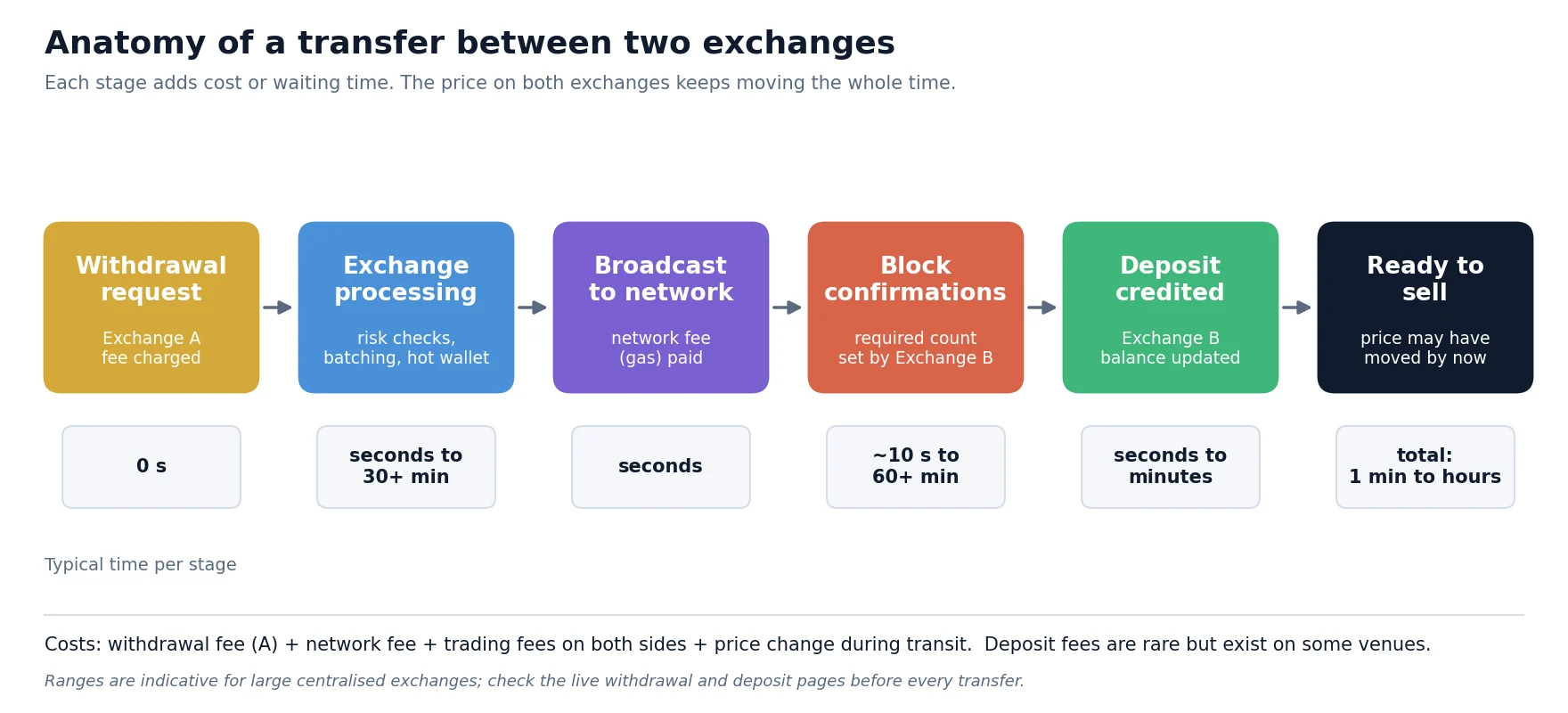
A withdrawal is not one event. It is a chain of steps run by two different companies and a blockchain, and each step can add time.
1. Withdrawal request and exchange processing
When you request a withdrawal, exchange A deducts the withdrawal fee at once, then runs its own checks: risk scoring, address whitelist rules, daily limits for your verification level, and sometimes manual review for larger amounts. Many exchanges also batch withdrawals from a hot wallet. On a quiet day this takes seconds; on a busy day or for a flagged transaction it can take 30 minutes or more. This part is invisible on the blockchain and impossible to speed up from your side.
2. Broadcast and network fee
The exchange signs and broadcasts the transaction and pays the network fee (gas). That is why the withdrawal fee you see is usually higher than the raw network fee: the exchange sets a fixed price that covers gas in busy periods, wallet operations and a margin. Exchanges review these fixed fees from time to time, so a number you wrote down last month may be out of date.
3. Confirmations required by exchange B
The receiving exchange will not credit your deposit until the transaction has a certain number of confirmations, which it sets per network. The count reflects how the exchange sees the risk of a block reorganisation on that chain. Multiplied by the block time, it gives the minimum waiting time even when everything else is instant.
4. Deposit credit, then the trade
Only after the credit can you sell on exchange B. If the gap has closed in the meantime, you now hold a coin you did not want, on an exchange where you did not want it.
Networks compared: fees, confirmations and credit times
The same token often exists on several networks. USDT, the most common way to move value between exchanges, is a good example: the coin is the same, but the cost and speed of moving it are very different depending on the chain you pick. Both exchanges must support the same network, and you must select it on both sides.
| Network | Typical exchange withdrawal fee (USDT) | Block time | Confirmations commonly required | Typical credit time* |
|---|---|---|---|---|
| Ethereum (ERC-20) | ~1–5 USDT, moves with gas | 12 s | 12–64 | 3–15 min |
| Tron (TRC-20) | ~1–1.5 USDT | 3 s | 19–30 | 1–3 min |
| BNB Smart Chain (BEP-20) | ~0.1–0.3 USDT | a few seconds or less | ~15 | about 1 min |
| Solana (SPL) | ~0.1–1 USDT | ~0.4 s | finalized slot | under 1 min |
| Arbitrum, Optimism, Base | ~0.1–0.5 USDT | 0.25–2 s | exchange-specific | 1–5 min |
| Polygon | ~0.1–1 USDT | ~2 s | often 100–200 blocks | 2–10 min |
| Bitcoin on-chain (for BTC) | ~0.00001–0.0005 BTC | ~10 min | 1–3 (some venues more) | 10–60 min |
*After the exchange has broadcast the transaction; exchange-side processing comes on top. Ranges summarise publicly listed fees and confirmation rules of large exchanges in 2026; they change often. Always read the live withdrawal and deposit pages before a transfer.
Three practical conclusions follow from the table. First, the cheapest and fastest rails for moving dollars are usually stablecoins on low-fee chains, provided both of your exchanges support the same one. Second, Ethereum mainnet and Bitcoin on-chain are slow and expensive for frequent moves, even if they are the most widely supported. Third, the coin you are arbitraging may only exist on one chain, so the coin leg of a transfer can be much slower and more expensive than the stablecoin leg.
Worked example: how a 0.60% gap shrinks
A mid-cap coin trades 0.60% higher on exchange B than on exchange A. You have $2,000 in USDT on exchange A and decide to buy, transfer and sell. All numbers are illustrative but realistic for 2026 fee levels.
| Step | Cost or result | In dollars |
|---|---|---|
| Gross spread on $2,000 | 0.60% | +$12.00 |
| Buy on A, taker fee 0.10% | −0.10% | −$2.00 |
| Withdraw the coin from A (fixed fee in coin units) | fixed | −$1.60 |
| Sell on B, taker fee 0.10% | −0.10% | −$2.00 |
| Send USDT back to A on TRC-20 for the next trade | fixed | −$1.00 |
| Net if the price does not move | 0.27% | +$5.40 |
| Transit: 10 min processing + 15 min confirmations | 1-sigma move at 80% volatility ≈ 0.55% | ±$11.00 |
| Realistic outcome range | about −$5.60 to +$16.40 |
On paper the trade earns $5.40. In practice the result is dominated by the price move during the 25 minutes the coins spend travelling, and the expected value of that move is not zero: price gaps between exchanges tend to close, so by the time you can sell on B a good part of the 0.60% is often gone. If the full gap closes during transit, the trade loses the $6.60 of costs, plus or minus whatever the market did.
Break-even spread and trade size
Because withdrawal fees are fixed amounts, the spread needed to break even falls quickly as the trade size grows. The chart below uses 0.20% round-trip trading fees and four levels of fixed transfer cost per cycle.
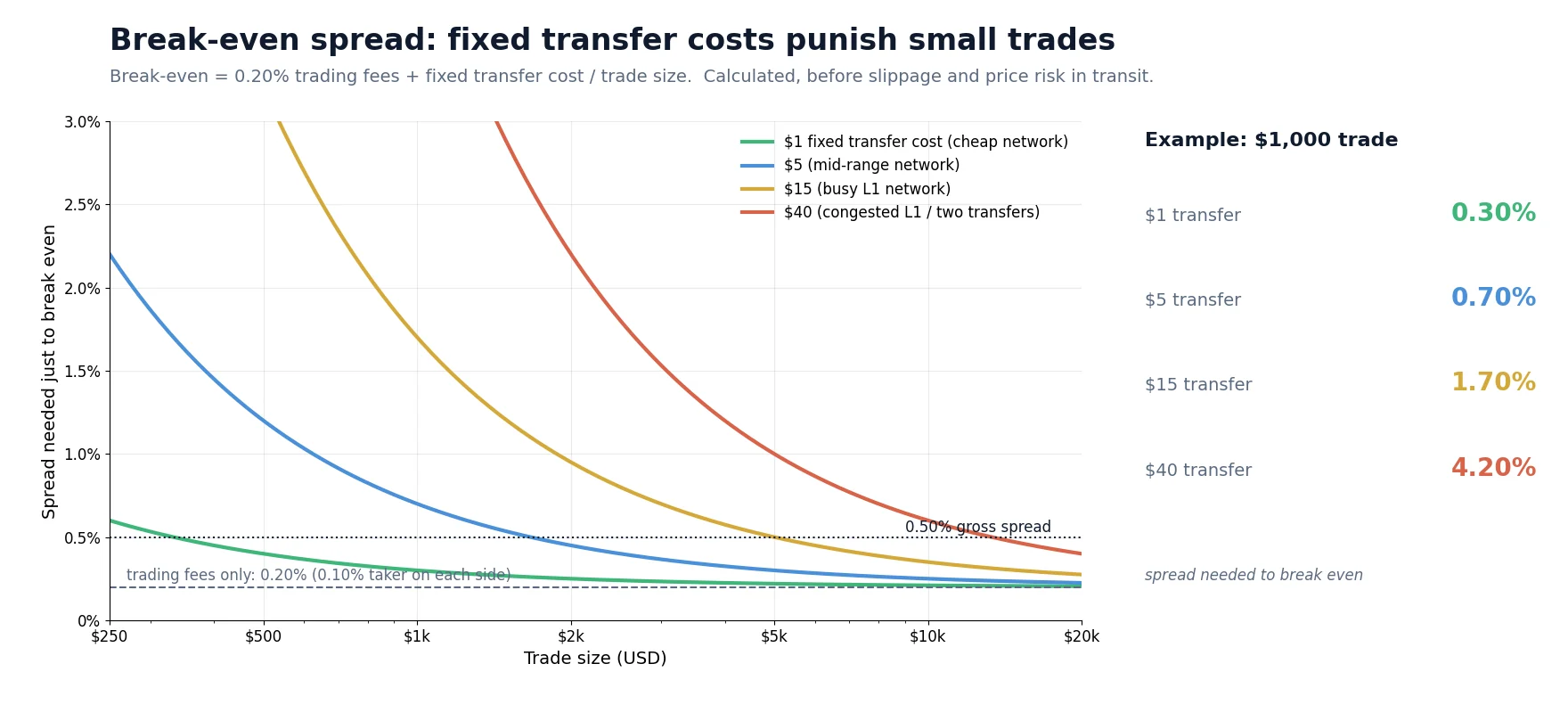
At $1,000 a $5 transfer cost already needs a 0.70% spread just to break even, and a $15 transfer needs 1.70%. Gaps of that size between liquid exchanges are rare and short-lived. At $20,000 the same $15 transfer adds only 0.075%, but at that size two other limits appear: order book depth on the thinner exchange and withdrawal limits of your account level.
Price risk while coins are in transit
A transfer turns an arbitrage into a short directional trade: from the moment you buy on A until you sell on B, you own the coin. A simple way to estimate how far it can move is to scale annual volatility by the square root of time:
Typical move ≈ annual volatility × √(minutes ÷ 525,600)
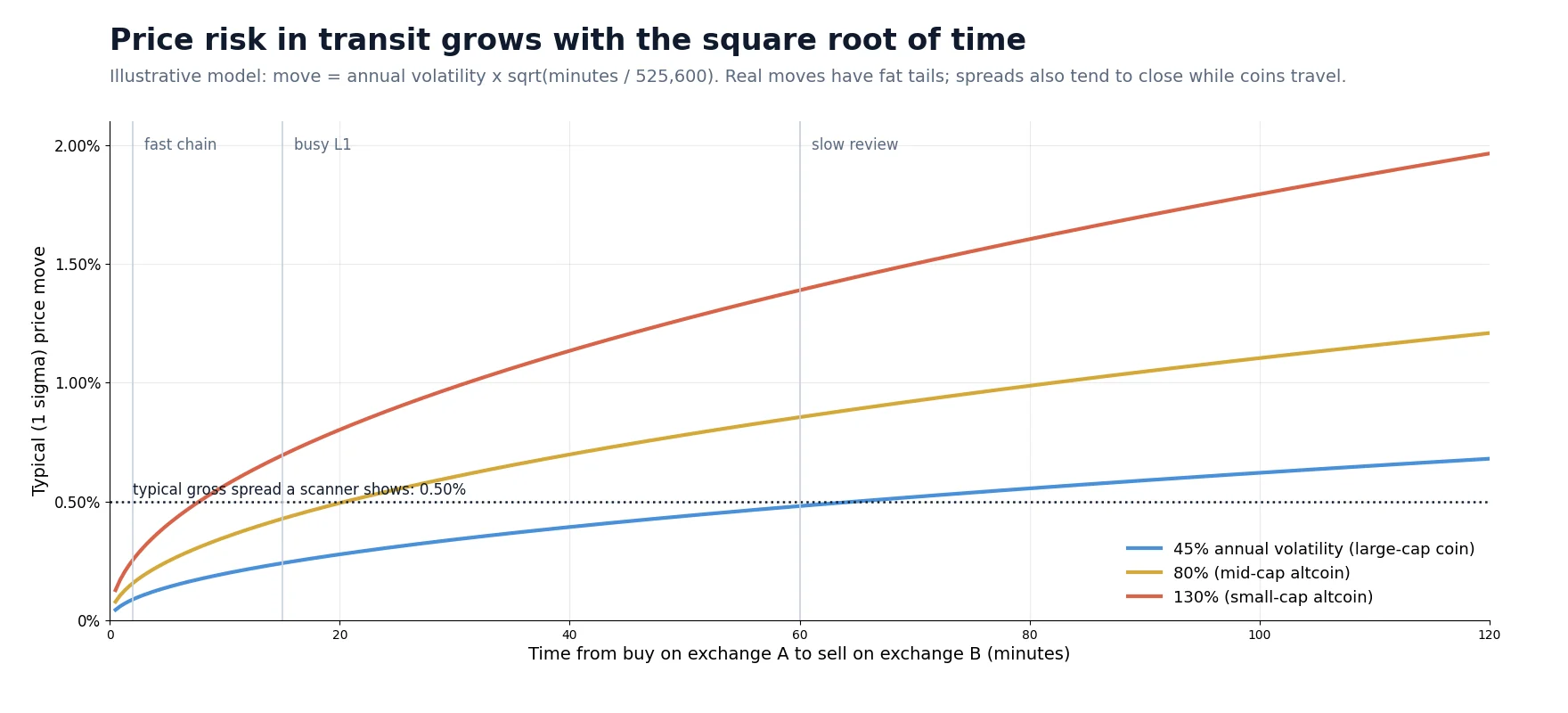
For a large-cap coin with 45% annual volatility, 15 minutes in transit already means a typical move of about 0.24%, half of a 0.50% spread. For a small-cap altcoin with 130% volatility, the typical move over the same 15 minutes is about 0.69%, larger than the whole spread. You can hedge the coin with a short position on a perpetual future during transit, but that adds its own fees and funding payments; our funding rate arbitrage guide explains how those payments work.
How to calculate the true cost, step by step
Before trusting any cross-exchange spread that needs a transfer, run these six checks. They take a few minutes by hand and can be automated.
1
2
3
4
5
6
If a spread survives all six checks, it is a candidate. If it fails step 1, it is not an opportunity at all, however large it looks.
Pre-funded arbitrage and rebalancing
The way around both fixed fees and transit risk is not to transfer on every trade. Instead you keep balances on both exchanges in advance: quote currency (for example USDT) on the exchange where you buy, and the coin on the exchange where you sell. When a gap appears, both legs are executed at the same time, within seconds, so there is no transit and no directional exposure. This is how hedge arbitrage across exchanges is normally run, and it is the model used by VIP Crypto Arbitrage for its hedge strategy.
The cost does not disappear; it moves. After a series of trades in the same direction, exchange A runs low on USDT and exchange B runs low on the coin. At some point you must rebalance: move coin from A to B and USDT from B to A. The difference is that a rebalance happens a few times per many trades, in larger amounts, at a time you choose.
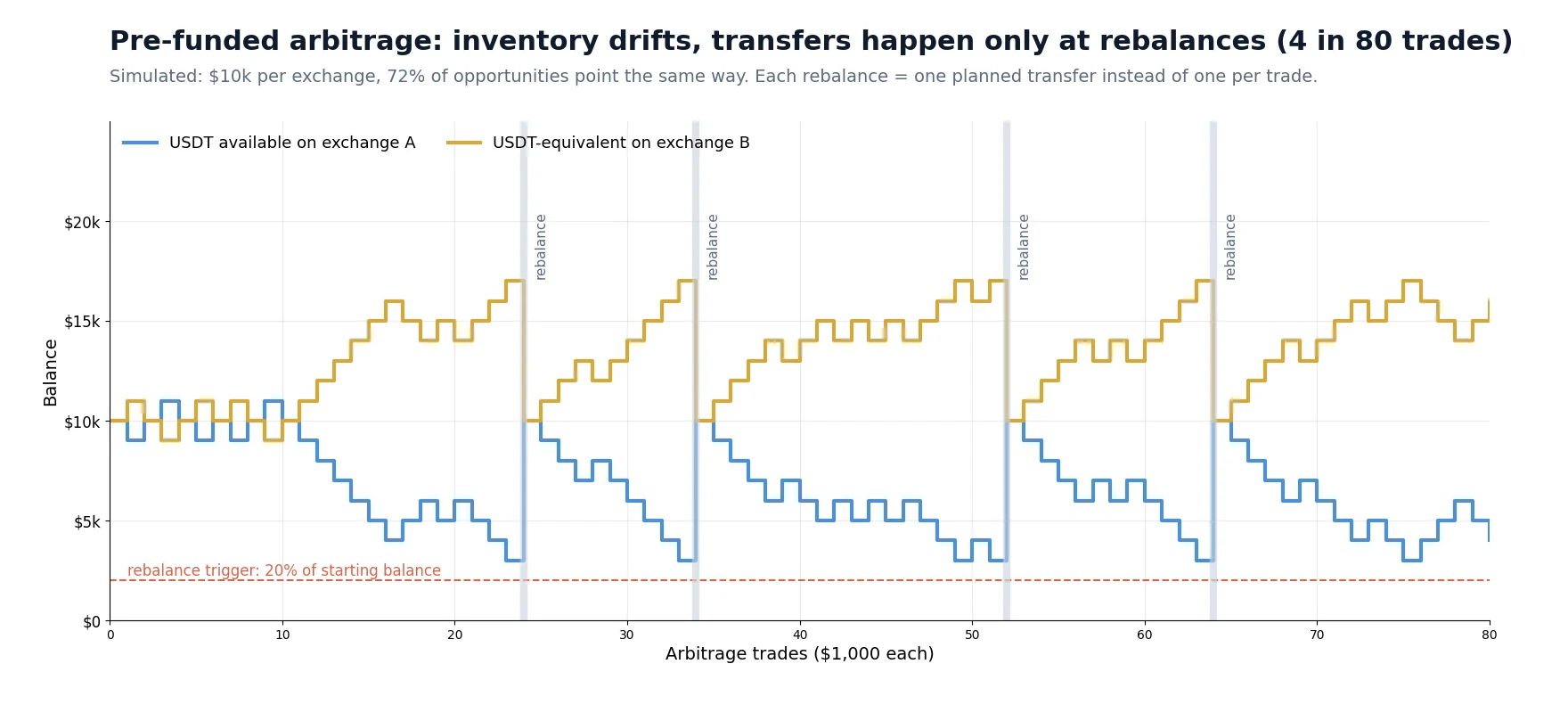
Rebalancing cost in numbers
Take the same simulation: 80 trades of $1,000, each with a 0.45% gross spread and 0.20% trading fees, so $2.50 net per trade before transfers, $200 in total. The balances needed 4 rebalances.
| Model | Transfers | Cost per transfer pair | Total transfer cost | Share of $200 net edge |
|---|---|---|---|---|
| Move coins on every trade, cheap networks | 80 pairs | $2.50 | $200 | ~100% |
| Pre-funded, rebalance on cheap networks | 4 pairs | $2.50 | $10 | ~5% |
| Pre-funded, rebalance on Ethereum mainnet | 4 pairs | $10.00 | $40 | ~20% |
Calculated from the simulation above; transit risk is not included in the first row, which makes that model look better than it is.
Pre-funding has its own costs. Capital is split across exchanges and partly idle, and you carry counterparty risk on every venue that holds your funds. The coin balance also changes in value with the market unless you hedge it. These are the reasons to keep the number of exchanges small and to choose venues carefully; the list of supported exchanges is a good starting point for planning which pairs of venues to fund.
Three ways to run cross-exchange arbitrage
| Transfer-based | Pre-funded (inventory) | Pre-funded with perp hedge | |
|---|---|---|---|
| Transfers | Every trade | Occasional, batched | Occasional, batched |
| Transit price risk | High | None during trades | None; coin inventory hedged |
| Speed of execution | Minutes to hours | Seconds | Seconds |
| Capital needed | One balance | Balances on each exchange | Balances plus futures margin |
| Main extra cost | Withdrawal fees on each trade | Rebalancing, idle capital | Funding payments, futures fees |
| Realistic for | Rare, large and persistent gaps | Regular hedge arbitrage | Larger books, volatile coins |
Transfers can be avoided entirely by staying on one exchange, for example with triangular arbitrage across three pairs on the same venue, or by trading the gap between spot and perpetual futures. Each of those has its own cost structure, but none of them pays withdrawal fees per trade. For the order-routing and data side of multi-exchange setups, see our guide to exchange APIs for arbitrage.
Spreads that exist because nobody can close them
The largest gaps on any scanner are often not opportunities. A price difference between two exchanges stays open when arbitrageurs cannot move coins to close it. Typical reasons:
- Deposits or withdrawals suspended on one exchange for wallet maintenance, a network upgrade or a security incident. The gap can be several percent and last for days.
- Same ticker, different token. A bridged version of a token on one chain and the native version on another can carry the same symbol but not be interchangeable on a given exchange.
- Network not supported on both sides. Exchange A offers the coin only on one chain, exchange B only on another.
- Delisting or trading halt announced on one venue, where the remaining holders sell into a thin book.
- Thin order book. The quoted price is valid for a few dollars only; your size would move it.
A free crypto arbitrage scanner is very useful for seeing where gaps appear and how long they last. Treat the very largest gaps as a question (“why is nobody closing this?”) rather than as a signal, and check wallet status before anything else.
Practical rules to cut transfer costs
- Use stablecoins on a low-fee network as your main rail for moving dollars between exchanges, and confirm both venues support the same one.
- Rebalance in fewer, larger transfers. A fixed fee on $8,000 costs a tenth of the same fee spent on ten $800 transfers.
- Size balances on each exchange for typical daily flow, so rebalances are needed days apart, not hours apart.
- Remember that withdrawal fees are fixed in coin units: when the coin price doubles, the fee in dollars doubles too.
- Whitelist withdrawal addresses well before you need them; many exchanges lock withdrawals to a newly added address for a period.
- Know your withdrawal limits for your verification level before you scale up; they cap how fast you can rebalance.
- Always send a small test amount when you use a new address, network or memo for the first time. Funds sent on the wrong network or without a required memo or tag can be lost or take weeks to recover.
- Write down fees and credit times you actually experience; your own log is more reliable than any published table.
Arbitrage without moving coins on every trade
VIP Crypto Arbitrage runs one-leg and hedge strategies across 50+ spot and futures exchanges using the balances already on your accounts, so transfers become planned rebalances instead of a cost on every trade. Start with the free scanner to see which gaps on your exchanges survive real costs, or use SharpTrader if you also trade forex.
VIP Crypto ArbitrageFree crypto arbitrage scannerSharpTrader
Free arbitrage scanner + short email course
Get the free scanner link and a few short, practical emails from Boris: what a price gap really means after costs, how to test a strategy before risking real money, and which tools fit your market. No hype.
FAQ
What are crypto withdrawal fees?
They are fixed amounts, charged in the coin you withdraw, that an exchange deducts when you send funds to an external address. They cover the network fee the exchange pays to broadcast the transaction plus its own costs, and they differ by coin and by network.
Which network is cheapest for moving USDT between exchanges?
Low-fee chains such as Solana, BNB Smart Chain and Ethereum layer-2 networks usually cost from a few cents to under a dollar per withdrawal, Tron about one dollar, and Ethereum mainnet several dollars. The cheapest usable option is the cheapest network that both of your exchanges support.
How long does a crypto transfer between exchanges take?
From about a minute on fast chains to an hour or more on Bitcoin or during busy periods. The total is exchange processing time plus the number of confirmations the receiving exchange requires multiplied by the block time.
Why is the withdrawal fee higher than the network fee?
Exchanges set a fixed fee that has to cover network fees in busy periods, their wallet operations and a margin. They review these fees periodically, so the live withdrawal screen is the only reliable source.
Can you do crypto arbitrage without transferring coins?
Yes. With balances kept on both exchanges in advance, both legs are executed at the same time and coins are moved only in occasional rebalances. Triangular arbitrage on one exchange and spot-futures strategies also avoid per-trade transfers.
Why does a large spread often mean the wallet is suspended?
Large gaps between liquid exchanges are normally closed within seconds by arbitrageurs. A gap that stays open usually means deposits or withdrawals of that coin are closed on one side, the token versions differ, or the order book is too thin to trade.
What happens if I send crypto on the wrong network?
If the receiving exchange does not support that network for the coin, the deposit is usually not credited. Some exchanges can recover such deposits for a fee after a long process, others cannot. Sending a small test amount first avoids most of these losses.
