Mesma estratégia, duas contas: arbitragem de latência otimizada vs. padrão no XAUUSD Segunda-feira, 22 de Junho de 2026 – Posted in: Arbitrage Software
BJF TRADING GROUP · SHARPTRADER OPTIMIZER
Mesma estratégia, duas contas: o que os parâmetros otimizados de arbitragem de latência realmente mudaram no XAUUSD
Rodamos a mesma lógica de arbitragem de latência em duas contas reais ao mesmo tempo, com o mesmo tamanho de 0,1 lote, o mesmo par de ouro e o mesmo saldo inicial. Uma conta usou parâmetros ajustados no SharpTrader Optimizer. A outra rodou com os padrões. Ao longo de aproximadamente 5.700 operações, a conta otimizada não apenas ganhou mais. Ela reduziu a perda média em dois terços e dobrou o profit factor. Veja a análise completa.
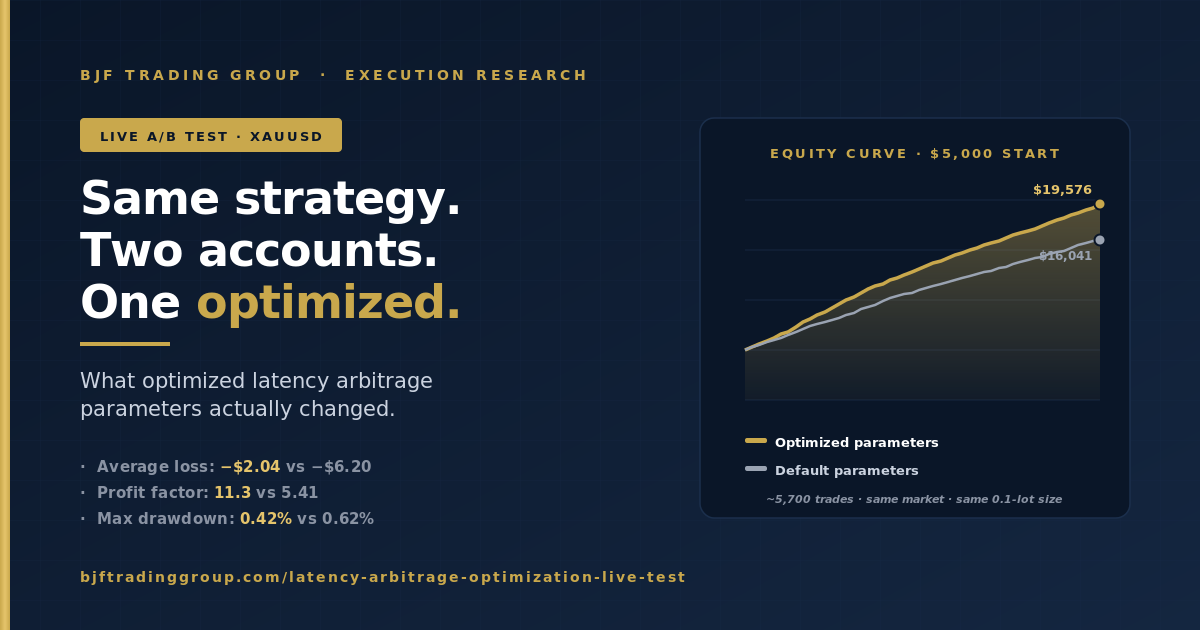
Resposta curta: otimizar os parâmetros de arbitragem de latência não buscou um lucro maior por operação. Reduziu o custo das operações perdedoras. A perda média da conta otimizada caiu de −$6,20 para −$2,04, sua operação perdedora média caiu de −6,2 pips para −2,0 pips e seu profit factor subiu de 5,41 para 11,3. Resultado líquido do teste: $14.576 vs. $11.041 em lucro realizado sobre uma base de $5.000, com drawdown máximo menor.
O resultado em uma linha
As duas contas começaram com $5.000 e operaram a mesma lógica de entrada de arbitragem de latência no ouro. A única diferença foi o conjunto de parâmetros: um saiu de uma grade de otimização no SharpTrader Optimizer, o outro usou os padrões de fábrica. Esta é a diferença principal.
A diferença de lucro é real, mas é o número menos interessante da página. Um total líquido 32% maior em três sessões pode ser ruído. O que não é ruído é como a conta otimizada chegou lá, e essa é a parte que vale a pena ler.
Duas curvas de patrimônio, lado a lado
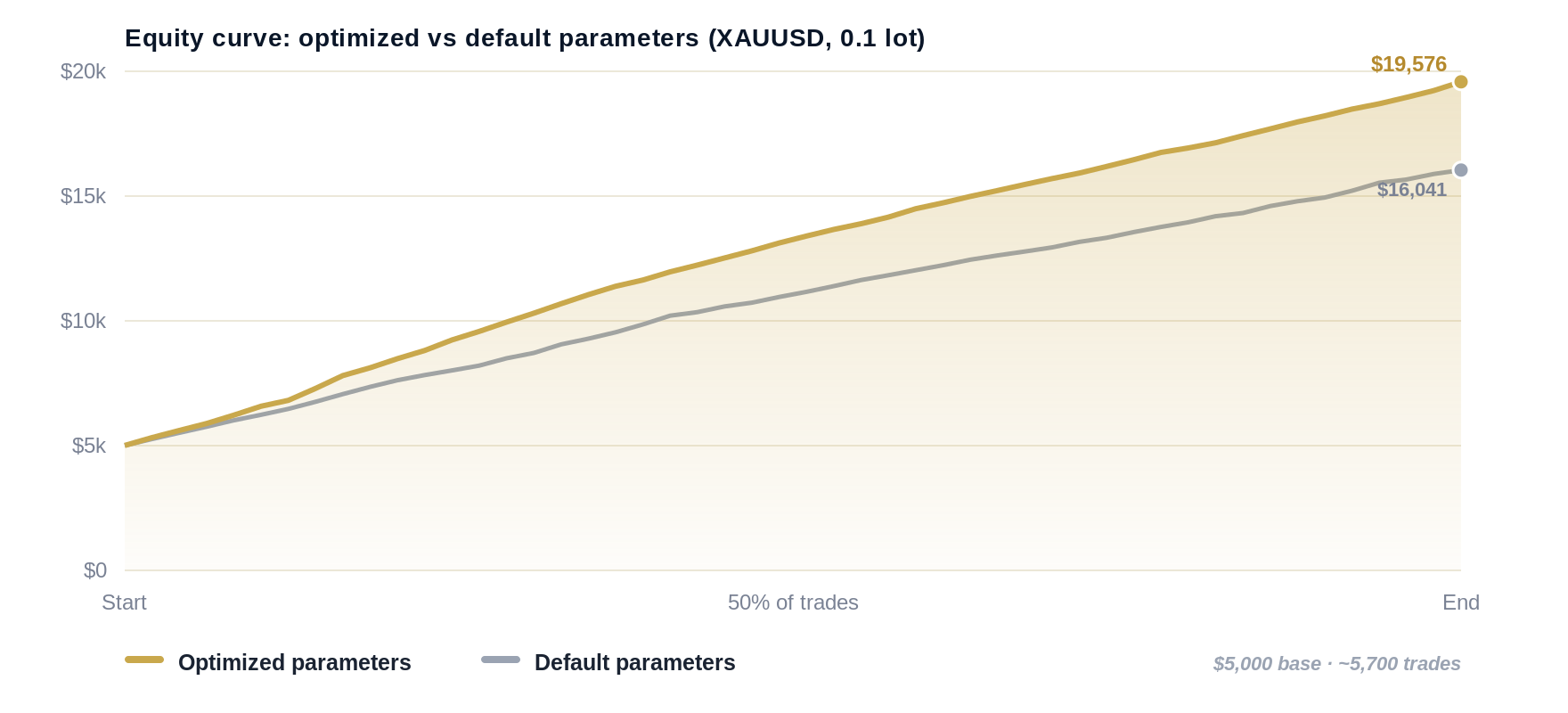
Plotadas em relação ao progresso do teste (0 a 100% das operações fechadas), as duas curvas sobem de forma constante, como se espera de uma vantagem de arbitragem que funciona. A linha otimizada se adianta gradualmente e termina mais alta, com quedas menores e menos frequentes ao longo do caminho.
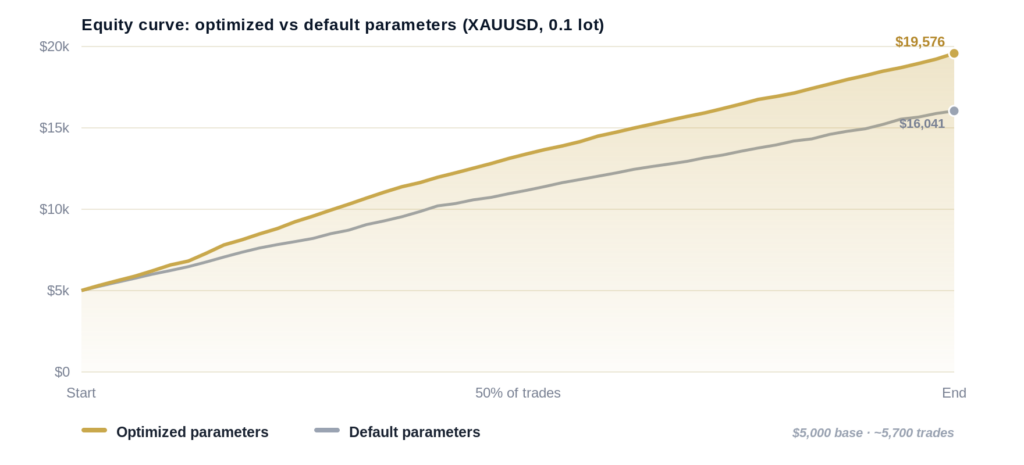
Patrimônio das operações fechadas a partir de uma base de $5.000, normalizado pelo progresso do teste para que as duas quantidades de operações (3.588 vs. 2.149) fiquem alinhadas para comparação.
Os números completos
Leia esta tabela de cima para baixo. A história não está na linha do lucro. Está nas linhas das perdas.
| Métrica | Otimizada | Padrão |
|---|---|---|
| Posições fechadas | 3,588 | 2,149 |
| Lucro líquido realizado | +$14,576 | +$11,041 |
| Taxa de acerto | 79.4% | 81.2% |
| Profit factor | 11.3 | 5.41 |
| Ganho médio | +$5.61 | +$7.76 |
| Perda média | −$2.04 | −$6.20 |
| Operação perdedora média (pips) | −2.0 | −6.2 |
| Drawdown máximo | 0.42% | 0.62% |
| Máximo de perdas consecutivas | 4 | 5 |
| Desvio-padrão do lucro líquido por operação | $5.83 | $7.12 |
| Duração média da operação | 1,4 s | 3,7 s |
A parte contraintuitiva
A conta otimizada teve uma taxa de acerto menor (79,4% vs. 81,2%) e um ganho médio menor ($5,61 vs. $7,76). Em uma avaliação ingênua, ela parece pior. Mesmo assim, ganhou mais dinheiro com menos risco. Por quê? Porque suas perdas foram três vezes mais baratas. Na arbitragem de latência, sua vantagem por operação é minúscula e o seu inimigo é a execução ruim. Aperte a cauda de perdas e tudo o que vem depois melhora.
Por que a cauda de perdas é o que decide tudo na arbitragem de latência
Um sinal de arbitragem de latência dura milissegundos. Você age com base em um preço para o qual um mercado já se moveu e que outro ainda não acompanhou. Quando a execução é limpa, você embolsa alguns pips. Quando a execução atrasa, o preço que você queria já se foi e agora você está do lado errado de um movimento que já aconteceu. Isso é uma entrada com slippage, e é por essas entradas que o dinheiro vaza.
Veja a operação perdedora média da conta padrão: −6,2 pips. Isso não é a estratégia errando a direção. A taxa de acerto prova que a leitura de direção está correta: 81% das operações foram vencedoras. Os −6,2 pips são custo de execução: a diferença entre o preço em que o sinal foi disparado e o preço que a conta realmente obteve, mais o spread variável pago ao cruzar o livro. A conta otimizada pagou apenas −2,0 pips pelo mesmo tipo de operação perdedora. Mesma vantagem, um terço do vazamento.
O que “otimização” significou aqui
- Orçamento de latência de entrada mais apertado. O conjunto otimizado só age quando o tempo de execução de ida e volta modelado cabe na janela em que a arbitragem ainda está viva. Sinais defasados são ignorados em vez de executados com atraso.
- Acionamento sensível ao spread. As entradas são filtradas pelo spread variável em tempo real, e não por uma premissa fixa, de modo que a conta deixa de pagar para cruzar um livro temporariamente largo.
- Tratamento de saída mais rápido. A duração média das operações caiu de 3,7 para 1,4 segundos. As posições são fechadas enquanto a distorção ainda está a seu favor, em vez de mantidas um instante a mais.
- Mais seletividade, não mais agressividade. A conta otimizada fez mais operações no total, mas cada uma passou por um critério mais rígido de qualidade de execução. A quantidade aumentou porque sinais baratos e limpos são abundantes quando você para de aceitar os caros.
Como o teste foi realizado
Desenho: duas contas reais, rodando em paralelo nas mesmas sessões de mercado, de modo que ambas viram a mesma ação de preço e as mesmas condições de liquidez.
Variáveis controladas: mesmo instrumento (XAUUSD), mesmo tamanho de lote fixo (0,1), mesmo saldo inicial ($5.000), mesmas condições da corretora, mesma lógica central de arbitragem de latência.
A única variável alterada: o conjunto de parâmetros. A conta A usou valores selecionados em uma grade de parâmetros no SharpTrader Optimizer. A conta B usou os padrões de fábrica.
Janela: 19 a 22 de junho de 2026. 3.588 posições fechadas na conta otimizada, 2.149 na conta padrão.
Rodar as duas contas ao mesmo tempo é o que torna a comparação justa. Se você otimiza na segunda-feira e roda os padrões na terça, qualquer diferença pode ser apenas segunda contra terça. Lado a lado, o mercado é constante e os parâmetros são a única coisa que pode explicar a diferença.
Como o otimizador encontrou esses parâmetros
Os parâmetros não vieram de palpites nem de ajuste de curva para obter uma linha de patrimônio bonita. Vieram de uma busca em grade no SharpTrader Optimizer, que foi construído para avaliar estratégias sensíveis à execução da forma como o mercado real as trata. Quatro fatores tornam essa busca confiável para uma estratégia de latência:
Dados de tick reais
A busca roda sobre fluxos históricos reais de ticks, e não sobre aproximações por barras. Para uma estratégia que vive dentro de uma distorção do tamanho de um único tick, os dados de barras escondem exatamente o que você está tentando capturar.
Modelagem do tempo de execução
Você define uma latência realista de execução das ordens em milissegundos e o otimizador mostra como ela altera os resultados. Os backtesters comuns pressupõem execuções com latência zero, e é justamente essa premissa que faz as estratégias de latência parecerem melhores no papel do que em produção.
Spread variável por tick
O spread histórico é aplicado tick a tick, e não como um padrão fixo da corretora. Entrada e saída pagam, cada uma, o spread que realmente existia naquele momento, de modo que a diferença de −6,2 vs. −2,0 pips aparece no teste antes de custar dinheiro em conta real.
Slippage nas duas pernas
Abertura e fechamento são modelados de forma independente quanto ao slippage. Uma estratégia de latência pode sofrer slippage ao entrar ou ao sair, e o otimizador precifica ambos, em vez de presumir que a saída é gratuita.
Além disso, a grade roda em todos os núcleos da CPU com alta utilização, de modo que uma busca com mais de 100.000 combinações de parâmetros termina em horas, e não em dias, e um mapa de calor de desempenho de 24 horas mostra quais horários de negociação realmente concentram a vantagem no ouro. Os parâmetros deste teste são simplesmente o conjunto com melhor pontuação depois que o tempo de execução, o spread variável e o slippage nas duas pernas foram cobrados de forma honesta.
O que levar disso se você opera arbitragem de latência
- Pare de otimizar pela taxa de acerto. A conta com pior aparência na taxa de acerto ganhou mais dinheiro. Otimize pelo profit factor e pelo tamanho da perda média.
- Suas perdas são uma métrica de execução, não de direção. Quando 80% das operações ganham, uma perda média de −6 pips está falando sobre execuções e spread, não sobre o seu sinal. Corrija isso na camada de execução.
- Os padrões são um ponto de partida, nunca a linha de chegada. O conjunto padrão foi lucrativo. Mas também deixava cerca de um terço do resultado líquido na mesa e carregava mais drawdown para isso.
- Teste com latência e spread variável ativados. Qualquer backtest que pressuponha execuções com latência zero e spread fixo vai superestimar uma estratégia de latência e esconder justamente o parâmetro que mais importa.
Perguntas frequentes
Não. Neste teste, a conta otimizada fez mais operações (3.588 vs. 2.149) e ainda assim registrou o maior profit factor (11,3 vs. 5,41). A melhora veio de operações perdedoras mais baratas, e não de operar menos.
Porque o lucro é a taxa de acerto multiplicada pelo ganho médio, menos a taxa de perda multiplicada pela perda média. Reduzir a perda média de −$6,20 para −$2,04 compensou com folga uma taxa de acerto um pouco menor e um ganho médio menor. A matemática recompensa mais o controle das perdas do que uma alta taxa de acerto.
Três dias é pouco para julgar retornos absolutos, e é por isso que destacamos as métricas estruturais, e não o total em dólares. Em aproximadamente 5.700 operações, as diferenças de perda média, profit factor e custo em pips por operação perdedora são muito mais estáveis do que o número líquido principal. A diferença em dólares pode diminuir. A diferença na cauda de perdas é uma propriedade dos parâmetros.
O método se transfere, mas os parâmetros não. Cada instrumento tem seu próprio comportamento de spread, volatilidade e perfil de execução, então a busca em grade deve ser refeita para cada instrumento. O ouro foi escolhido aqui porque seu comportamento de spread e de ticks torna o custo de execução fácil de ver.
Os limites de latência e de spread que filtram entradas e saídas, ajustados em uma grade de parâmetros avaliada com dados de tick reais, tempo de execução modelado, spread variável por tick e slippage nas duas pernas. A lógica central da estratégia era idêntica nas duas contas.
Assine as pesquisas de trading da BJF
Novos estudos de execução, tutoriais do otimizador e lançamentos de produtos – enviados assim que publicamos.
Faça o mesmo teste com os seus parâmetros
O SharpTrader Optimizer avalia estratégias de latência com dados de tick reais, tempo de execução modelado, spread variável e slippage nas duas pernas, e então entrega o conjunto de parâmetros que resiste aos quatro fatores. Encontre a versão da sua estratégia que se sustenta em produção, e não apenas no papel.
Scanner de arbitragem grátis + curso curto por e-mail
Receba o link do scanner grátis e alguns e-mails curtos e práticos do Boris: o que uma diferença de preço realmente significa depois dos custos, como testar uma estratégia antes de arriscar dinheiro real e quais ferramentas combinam com o seu mercado. Sem exageros. Os e-mails são enviados em inglês.
