Protected: Does Retail Have a Chance in Arbitrage? Friday February 6th, 2026 – Posted in: Arbitrage Software, Forex trading
There is no excerpt because this is a protected post.
Continue readingThere is no excerpt because this is a protected post.
Continue readingOver the past few years, the stock market has become a primary domain for automation, ranging from simple indicator-based systems to complex algorithms that leverage machine learning and real-time news feeds. Institutional players have long relied on algorithms, but with the development of broker APIs, cloud platforms, and strategy builders, automated trading has become a mass-market tool for retail traders as well. In 2026, the key question is no longer “do we need trading robots…
Continue readingForex robots are typically classified into two broad categories: arbitrage and non-arbitrage.Arbitrage attempts to extract profit from market inefficiencies (price discrepancies, latency, different feeds, execution differences).Non-arbitrage robots generate profits differently: they look for recurring behavioral market patterns—trends, pullbacks, impulses, volatility cycles, and event-driven reactions. That is why such systems are easier to deploy with most brokers and on different platforms, but they depend much more strongly on market phases and on competent risk management. Below are the…
Continue readingWhy Forex Trading Isn’t “Easy Money,” but Discipline, Knowledge, and Mindset Introduction: Why We Avoided Writing This Article for So Long For a long time, we avoided the topic of Forex trading for beginners. Not because it isn’t important—on the contrary, it’s one of the most popular and widely searched topics in trading. The reason was different: the market is flooded with articles, videos, and courses that create a dangerous illusion—that you can trade Forex…
Continue readingIntroduction Economic news trading has traditionally attracted traders with its high volatility, fast price movements, and the potential to earn profits within seconds. However, in recent years the market has undergone a technological leap that has radically transformed the entire structure of order execution, broker behavior, and the reaction speed of major participants. In 2024–2025, banks, prop-trading firms, and systematic hedge funds deployed fully automated frameworks for processing economic releases, built on machine learning, predictive…
Continue readingIntroduction: 2026 as a Turning Point for the Arbitrage Industry The Forex and cryptocurrency markets are undergoing a profound technological transformation. In 2026, the main liquidity participants — banks, ECN pools, market makers, crypto exchanges, prime services providers — are increasingly deploying AI-based monitoring systems.These systems are built on: behavioral analysis of trading flows, detection of recurring order patterns, clustering clients by trading behavior, analysis of temporal correlations between different accounts. As a result, traditional…
Continue readingroadmap for an auxiliary strategy designed to mask latency arbitrage. In the initial phase, some modules and ideas will not be implemented. A simplified version will be released first and will make it according to the plan described here, as well as based on your feedback and suggestions. Key idea: this is not a primary profit-generating strategy; it is a tool for plausible masking of arbitrage activity. Its job is to produce a sequence of…
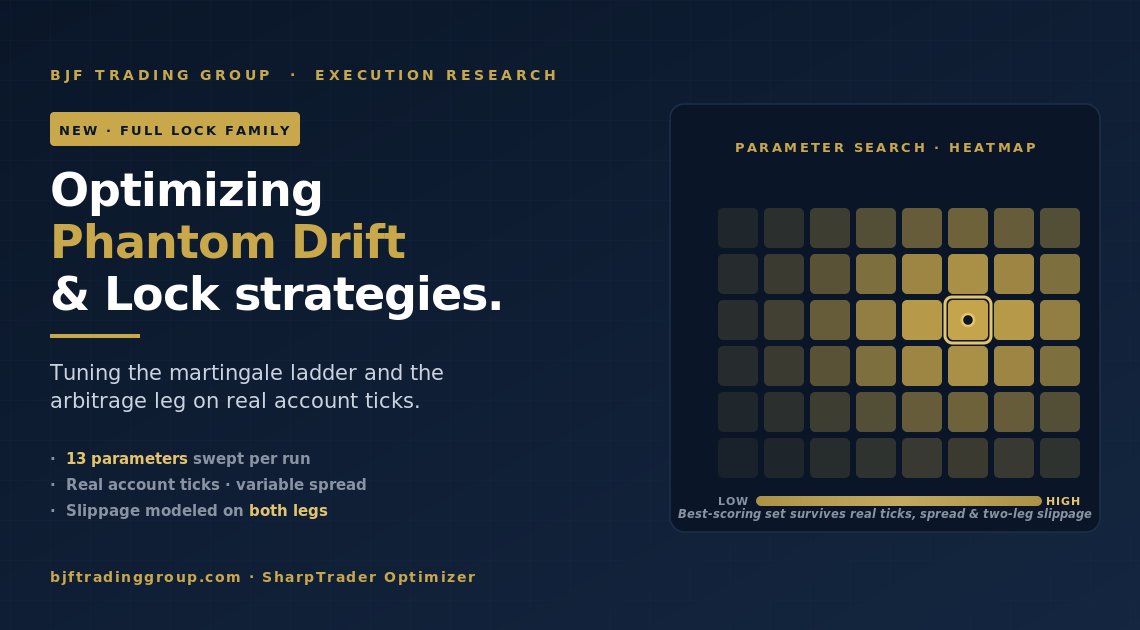
Continue readingIntroduction For the Phantom Drift arbitrage strategy, we use a hybrid approach that combines two distinct methods: latency arbitrage and a martingale system with a limited number of averaging steps. As we mentioned earlier, this combination enables us to disguise arbitrage activity and effectively confuse anti-arbitrage plugins. To make such a strategy work properly, it is essential to have optimized configurations for the martingale component. Previously, we provided ready-made templates for XAUUSD, GBPUSD, USDJPY, and…
Continue readingFrom modular filters to full strategies—how we structure indicator logic for an AI-driven workflow. Contents: Introduction 1. Indicator Groups & Filter Logic 2. Indicator → Group Mapping 3. Universal Filters 4. How to Assemble a Filter Builder Conclusion & Feedback Introduction Today, trading is entering a new wave of development: artificial intelligence is no longer just helping with routine tasks—it is becoming a full participant in the process. In our SharpTrader platform, we are preparing…
Continue readingIntroduction Latency arbitrage in the Forex market is one of the most profitable and at the same time one of the riskiest strategies in terms of broker detection. Its essence lies in exploiting quote delays between different brokers or liquidity providers. A trader opens trades in the direction where the price is “lagging” and profits from these millisecond discrepancies. The problem is that most brokers actively monitor and block such patterns because they result in…
Continue readingOur website uses cookies. By continuing to browse this website, you accept that cookies are used to help us analyze how the website is used and to offer you a better experience, such as enhanced navigation. If you do not agree to the use of cookies, you may disable them in your web browser as explained in our Privacy Policy.
Accept