 Deutsch
 日本語
日本語 العربية
 한국어
한국어 Español
 Português
 Indonesia
 Tiếng Việt
 中文
中文

Stock Trading Strategies: Time Horizons, Instruments, and Platforms Friday January 16th, 2026 – Posted in: stocks trading
Over the past few years, the stock market has become a primary domain for automation, ranging from simple indicator-based systems to complex algorithms that leverage machine learning and real-time news feeds. Institutional players have long relied on algorithms, but with the development of broker APIs, cloud platforms, and strategy builders, automated trading has become a mass-market tool for retail traders as well.
In 2026, the key question is no longer “do we need trading robots for stocks?”, but rather “which strategies and architectures deliver sustainable results with reasonable risk.”
This article systematizes the most popular approaches to automated stock trading—from classical trend-following and swing strategies to AI-driven systems, factor models, and portfolio robots. Each section analyzes the strategy logic, typical return/drawdown profile, data and infrastructure requirements, and practical implementation nuances — from historical backtesting to broker API integration and risk management.
This overview provides a clear map of available solutions and helps you choose the approaches that best match your time horizon, risk tolerance, and technical capabilities.
Short-Term Stock Trading: Day Trading and Scalping
Short-term stock trading is one of the most dynamic and competitive areas of the financial markets. Unlike long-term investors who hold positions for months or years, short-term traders operate on horizons ranging from a few seconds to one trading day. Their goal is to extract profit from intraday price fluctuations, liquidity, supply-and-demand imbalances, news events, and market participant behavior.
The most popular short-term trading styles are day trading and scalping. Both approaches require high concentration, discipline, an understanding of market microstructure, and strict risk management. At the same time, they differ fundamentally in pace, number of trades, tools used, and psychological load.
In this article, we will examine in detail:
- What day trading and scalping are,
- how they work in the stock market,
- which tools and strategies are used,
- what risks and requirements are imposed on the trader,
- who each trading style is suitable for.
-
Characteristics of Short-Term Stock Trading
1.1. Why Stocks
The stock market has a number of characteristics that make it attractive for short-term traders:
- High liquidity (especially in large-cap stocks),
- Transparency (centralized exchanges, order books),
- Regulation (less manipulation compared to OTC markets),
- Predictable trading sessions,
- Frequent news drivers (reports, earnings, macroeconomic data).
U.S. markets (NYSE, NASDAQ) are particularly popular, where thousands of stocks with high volatility are traded daily.
1.2. Key Factors of Intraday Price Movement
For a short-term trader, price is driven not by “fundamental value” but by:
- order imbalances in the order book,
- market maker activity,
- actions of algorithmic funds,
- news-driven impulses,
- crowd behavior (retail traders).
These factors underpin both day trading and scalping.
-
Day Trading: Intraday Stock Trading
2.1. Definition of Day Trading
Day trading is a trading style in which all positions are opened and closed within the same trading day. Holding positions overnight is excluded.
The main objectives of a day trader are:
- to profit from intraday price movements,
- to avoid overnight risk,
- to trade during the most liquid market hours.
2.2. Typical Timeframes
Day trading typically uses:
- M1–M5 — for entry points,
- M5–M15 — for structure analysis,
- H1 — to define the daily context.
2.3. Popular Day Trading Strategies
2.3.1. Opening Range Breakout (ORB)
Trading the breakout of the range formed during the first 15–30 minutes after market open.
- High volatility,
- Clear levels,
- Suitable for momentum stocks.
2.3.2. Trend Following (Intraday Trends)
Trading in the direction of the main movement of the day:
- Higher highs / higher lows,
- VWAP support,
- Volume confirmation.
2.3.3. Mean Reversion
Expecting price to return to its average value:
- Deviation from VWAP,
- Overbought / oversold conditions,
- False impulses.
2.3.4. News Trading
Trading based on news releases:
- earnings reports,
- FDA approvals,
- mergers & acquisitions,
- macroeconomic reports.
2.4. Day Trader Tools
- Charts (TradingView, DAS, Thinkorswim)
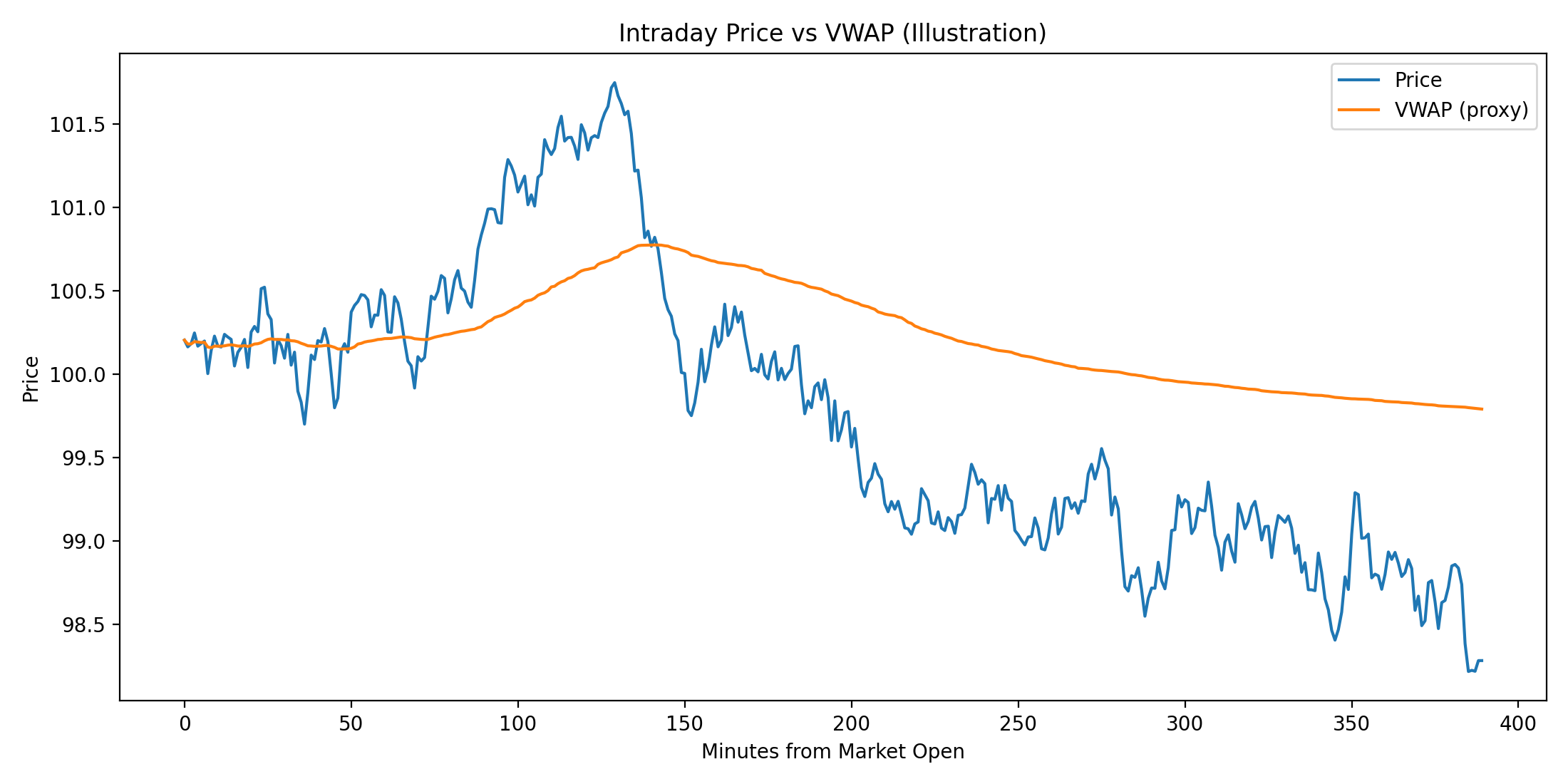
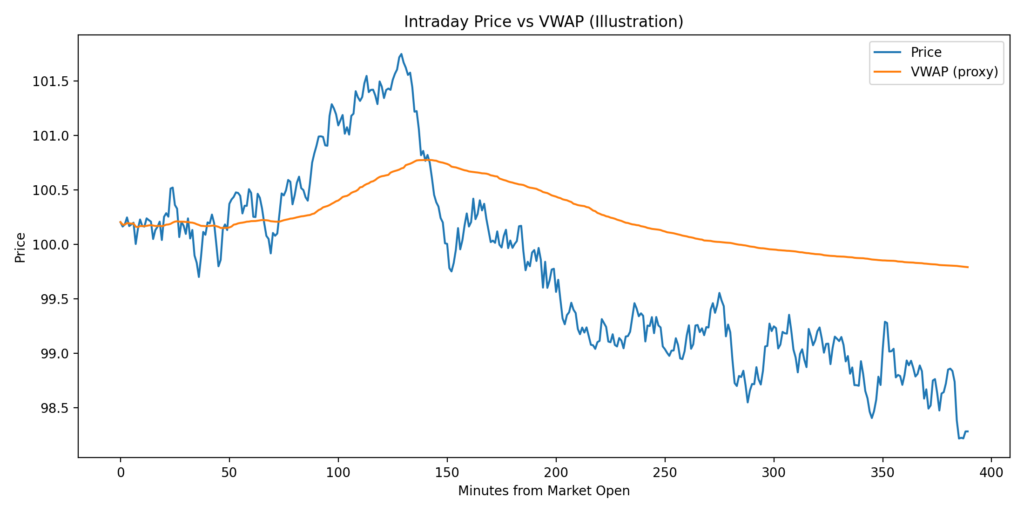
- VWAP — the key intraday benchmark
- Support and resistance levels
- Volume and Volume Profile
- Time & Sales (tape reading)
2.5. Risk Management in Day Trading
Core rules:
- risk per trade: 0.5–2% of account equity,
- fixed stop-loss,
- limit on the number of trades per day,
- maximum daily loss (daily loss limit).
Day trading without strict risk management almost guarantees capital loss.
-
Scalping: Ultra-Short-Term Trading
3.1. What Is Scalping
Scalping is a trading style in which the trader:
- holds positions from a few seconds to several minutes,
- executes dozens or even hundreds of trades per day,
- captures minimal price movements (1–10 cents).
A scalper does not work with trends, but with micro-movements and liquidity.
3.2. Key Characteristics of Scalping
- Extremely fast decision-making,
- Minimal take-profit targets,
- Frequent use of limit orders,
- Critical dependence on commissions and spreads.
3.3. Scalper’s Tools
Scalping is impossible without professional software:
- Level II (order book),
- Time & Sales,
- Direct Market Access (DMA),
- Hotkeys.
Technical indicators are secondary — the key role is played by order flow.
3.4. Core Scalping Strategies
3.4.1. Bid/Ask Bounce
Buying from a strong bid and selling into the ask:
- large limit orders,
- short-term level protection.
3.4.2. Liquidity Grab
Capturing liquidity before an impulse:
- sudden removal of limit orders,
- spike in prints,
- fast exit.
3.4.3. Spread Scalping
Trading inside the spread:
- buying at the bid,
- selling at the ask,
- minimal profit but very high frequency.
3.5. Risk Management in Scalping
Although stops are small, risks are enormous:
- high frequency of execution errors,
- slippage,
- technical failures.
Key principles:
- strict stop-losses,
- daily loss limits,
- perfect execution,
- emotional control.
-
Psychology of the Short-Term Trader
4.1. Emotional Load
Day trading, and especially scalping:
- create stress,
- intensify FOMO,
- provoke overtrading.
Without psychological stability, a trader loses discipline.
4.2. Typical Mistakes
- trading without a plan,
- revenge trading,
- increasing position size after a loss,
- ignoring stop-losses,
- trading while fatigued.
-
Comparison of Day Trading and Scalping
| Criterion | Day Trading | Scalping |
| Trade duration | minutes–hours | seconds–minutes |
| Number of trades | 1–10 | 20–200 |
| Speed requirements | moderate | extreme |
| Commissions | moderate | critically important |
| Psychological load | high | very high |
-
Who Short-Term Trading Is Suitable For
Day trading and scalping are not suitable for everyone.
They are suitable if:
- you are ready to study and train for months,
- you have discipline,
- you can work according to strict rules,
- you understand the risk of capital loss.
They are not suitable if:
- you are looking for “fast money,”
- you struggle to control emotions,
- you do not have time for daily trading.
Short-term stock trading is not gambling or a lottery, but a highly competitive professional activity. Day trading and scalping require different skills, but both are united by strict discipline, risk control, and a deep understanding of market dynamics.
For some traders, day trading becomes a stable source of income; for others, scalping turns into “manual labor” with the market. In both cases, success does not come quickly or for free — it is the result of experience, mistakes, and a systematic approach.
Medium-Term, Long-Term, and Advanced Stock Trading
Short-term styles — day trading and scalping — are not suitable for everyone. Many traders and investors prefer calmer approaches with lower stress, broader planning horizons, and different risk profiles. That is why stock trading is commonly divided into medium-term, long-term, and advanced strategies, each designed to solve specific tasks.
-
Medium-Term Stock Trading
Medium-term trading occupies a middle ground between active trading and investing. Positions are held from several days to several weeks, sometimes months. The main goal is to capture a meaningful phase of price movement rather than intraday noise.
7.1. Swing Trading
What Is Swing Trading
Swing trading is the trading of price “swings” (waves) that occur within a larger trend or range. The trader aims to:
- buy on pullbacks,
- sell on impulses,
- work with the technical structure of the market.
Unlike day trading, there is no need to monitor the market constantly throughout the day.
Swing Trader Timeframes
- Primary analysis: D1, H4
- Entries: H1, M30
Key Tools
- support and resistance levels,
- trendlines and channels,
- moving averages (EMA 20/50/200),
- RSI, MACD (as auxiliary filters),
- volume and VWAP on daily charts.
Example Trade Logic
- The daily trend is identified.
- Price enters a correction.
- A reversal pattern forms.
- Entry is made with the expectation of trend continuation.
Pros and Cons of Swing Trading
Advantages:
- less stress,
- fewer trades,
- lower commissions,
- suitable for combining with a full-time job.
Disadvantages:
- overnight risk,
- potential gaps,
- longer drawdowns.
7.2. Momentum Trading
Essence of the Momentum Approach
Momentum trading is the trading of stocks with strong price acceleration. The core idea is:
“What is strong becomes even stronger.”
The trader looks for stocks that:
- are rising sharply on volume,
- are in the market’s focus,
- have a fundamental or news-driven catalyst.
Typical Sources of Momentum
- earnings reports,
- analyst upgrades,
- IPOs,
- sector rotation,
- macroeconomic trends.
Momentum Trader Tools
- relative strength (RS),
- volume spikes,
- gap & go,
- high of day / low of day,
- stock scanners.
Momentum trading can be both intraday and medium-term, with positions held for several days.
-
Long-Term Trading and Investing
Long-term strategies are focused not on speculation, but on capital accumulation and participation in business growth. There are fewer trades, lower activity, but a much greater emphasis on fundamental analysis.
8.1. Position Trading
Position trading is the trading of large market cycles. Positions are held for months or even years.
Key characteristics:
- macroeconomic analysis,
- long-term trends,
- minimal number of entries,
- ignoring short-term noise.
A combination is used:
- fundamental analysis,
- weekly and monthly charts,
- interest rate and liquidity cycles.
8.2. DCA (Dollar Cost Averaging)
DCA is a strategy of regularly purchasing assets for a fixed amount regardless of price.
How it works:
- the investor buys stocks or ETFs, for example, once per month,
- does not try to time market bottoms or tops,
- smooths entry volatility.
DCA is especially popular:
- for index ETFs,
- for long-term capital accumulation,
- among passive investors.
Pros:
- minimal stress,
- discipline,
- suitable for any experience level.
Cons:
- does not optimize entry points,
- performs poorly in prolonged sideways markets.
8.3. Value Investing
Value investing is the search for undervalued companies.
This is the classic approach of Benjamin Graham and Warren Buffett.
Core criteria:
- low P/E and P/B ratios,
- stable earnings,
- strong balance sheet,
- dividends,
- temporary business problems.
A value investor buys “bad news” with the expectation of company recovery.
8.4. Growth Investing
Growth investing focuses on companies with high growth potential.
Typical characteristics:
- rapid revenue growth,
- scalable business model,
- often high valuations,
- reinvestment of profits.
Typical examples include technology companies, AI, biotech, and renewable energy.
Key risks:
- overestimation of expectations,
- sharp corrections,
- dependence on market cycles.
-
Advanced Trading Strategies
Advanced strategies require:
- experience,
- understanding of mathematics,
- risk control,
- often professional infrastructure.
9.1. Options Trading
Options allow traders to work not only with price direction, but also with:
- volatility,
- time,
- probabilities.
Basic strategies:
- Covered Call,
- Cash-Secured Put,
- Long Call / Put,
- Vertical Spreads.
Advanced strategies:
- Iron Condor,
- Calendar Spread,
- Straddle / Strangle.
Options are used:
- for hedging,
- for income generation,
- for directional trading with limited risk.
9.2. Pairs Trading
Pairs trading is a market-neutral strategy.
Core concept:
- buying one asset,
- selling another,
- trading price divergence/convergence.
Commonly used:
- stocks within the same sector,
- ETFs and individual stocks,
- statistical correlation.
Profit is generated not from overall market growth, but from relative price movement.
9.3. Arbitrage Strategies
Stock market arbitrage includes:
- statistical arbitrage,
- calendar arbitrage,
- ETF arbitrage,
- options arbitrage.
Key features:
- minimal market risk,
- strong dependence on infrastructure,
- low margins,
- need for automation.
Pure arbitrage today is primarily the domain of funds and professional teams; however, elements of arbitrage thinking are also used by retail traders.
-
How to Choose the Right Trading Style
The choice depends on:
- capital,
- time availability,
- psychology,
- goals.
| Goal | Approach |
| Active income | Scalping, Day Trading |
| Balance of time and income | Swing, Momentum |
| Capital accumulation | Position, DCA |
| Professional trading | Options, Pairs, Arbitrage |
The stock market offers a huge variety of trading styles — from second-based trades to multi-year investments. There is no “best” approach — only the one that fits you.
Understanding the differences between:
- short-term,
- medium-term,
- long-term,
- and advanced trading
allows you to build a strategy that matches your capabilities, personality, and financial goals.
-
Stock Trading Platforms
The choice of trading platform directly affects trading style, execution speed, available tools, and even which strategies are feasible. Day trading, scalping, swing trading, options, and arbitrage all impose very different infrastructure requirements.
Below are the most common stock trading platforms, with details on:
- which styles they support,
- whether an API is available,
- whether they are oriented toward retail or advanced traders.
11.1. Interactive Brokers (TWS / IBKR Desktop)
Type: broker + platform
Markets: stocks, options, futures, ETFs, bonds
API: ✅ available (one of the most powerful on the market)
Key features
Interactive Brokers is the de facto standard for:
- swing trading,
- position trading,
- options trading,
- algorithmic strategies.
The TWS platform has a steep learning curve but provides:
- access to global markets,
- low commissions,
- professional-grade tools.
API
The IBKR API supports:
- Python, Java, C++, C#, JavaScript,
- trading, data access, risk control,
- integration with proprietary algorithms and external systems.
Best suited for:
Swing, position, options, pairs trading, algo trading
Poorly suited for:
Ultra-fast manual scalping (due to interface latency)
11.2. Thinkorswim (Charles Schwab)
Type: retail trading platform
Markets: stocks, options, ETFs, futures
API: ⚠️ limited / not suitable for full automation
Key features
Thinkorswim is popular in the U.S. due to:
- powerful visualization,
- analytical convenience,
- strong options module.
API
- API available for data access and account management,
- no full-featured trading API for high-frequency automation.
Best suited for:
Day trading, swing trading, options (manual trading)
Not suited for:
HFT, arbitrage, systematic auto-trading
11.3. NinjaTrader
Type: trading platform
Markets: stocks, futures, options
API: ✅ available (C# / NinjaScript)
Key features
NinjaTrader is designed for:
- active traders,
- systematic traders,
- strategy developers.
The platform allows:
- custom indicator development,
- creation of trading robots,
- strategy backtesting.
API
- NinjaScript (C#-based),
- deep access to data and execution,
- suitable for semi-automated and automated strategies.
Best suited for:
Swing, momentum, algo trading
Less convenient for:
Manual high-speed stock scalping
11.4. TradingView (via Brokers)
Type: analytics platform + trading
Markets: stocks, ETFs, crypto, futures
API: ⚠️ limited (Pine Script ≠ full API)
Key features
TradingView is a leader in visual analysis:
- charts,
- indicators,
- screeners,
- social ideas.
API and automation
- Pine Script is used for indicators and signals,
- no direct trading API,
- live trading only via connected brokers.
Best suited for:
Swing, position, DCA, analysis
Not suited for:
Scalping, arbitrage, HFT
11.5. QuantConnect
Type: algorithmic trading platform
Markets: stocks, options, futures, FX, crypto
API: ✅ available (Python, C#)
Key features
QuantConnect is designed for:
- quantitative strategies,
- statistical arbitrage,
- pairs trading.
It allows:
- coding strategies,
- historical backtesting,
- broker connections (including IBKR).
API
- full trading and research API,
- cloud infrastructure,
- support for complex models.
Best suited for:
Pairs trading, arbitrage, systematic trading
Not suited for:
Manual trading
11.6. TradeStation
Type: broker + platform
Markets: stocks, options, futures
API: ✅ available
Key features
TradeStation combines:
- a retail-friendly interface,
- automation capabilities,
- its proprietary EasyLanguage.
API
- REST API for data and trading,
- support for systematic strategies,
- suitable for semi-automated solutions.
Best suited for:
Swing, momentum, options, systematic trading
11.7. Proprietary Trading Firm Platforms (Overview)
Many prop firms use:
- custom versions of DAS,
- Sterling Trader,
- proprietary terminals.
Key features
- high execution speed,
- direct market access,
- strict risk limits.
API
- usually absent or highly restricted,
- strong focus on manual trading.
Best suited for:
Day trading, scalping
Not suited for:
Retail algo trading
-
Summary Table of Platforms and APIs
| Platform | Trading Style | API |
| Interactive Brokers | Swing, Position, Options, Algo | ✅ |
| Thinkorswim | Day, Swing, Options | ⚠️ limited |
| SharpTrader | Arbitrage, Scalping | ✅ |
| NinjaTrader | Swing, Algo | ✅ |
| TradingView | Swing, DCA, Analysis | ⚠️ Pine Script |
| QuantConnect | Arbitrage, Pairs, Algo | ✅ |
| TradeStation | Swing, Options, Systematic | ✅ |
Conclusion of This Section
Modern stock trading is not only about choosing a strategy, but also about choosing the technological environment.
Some approaches are impossible without an API, whereas others require minimal latency and manual control.
Understanding:
- which platforms exist,
- which ones provide access to automation,
- and which ones are designed for manual trading
helps you avoid a key beginner mistake — trying to implement an unsuitable strategy on an unsuitable platform.
-
The SharpTrader Platform: Infrastructure Development and Professional Strategies
Modern stock trading increasingly goes beyond classic terminals and manual solutions. Traders and investors need a unified platform capable of combining execution, analytics, automation, and strategy management. This is exactly the direction in which the SharpTrader platform is evolving.
13.1. Current Connections and Integrations
At the moment, the SharpTrader platform already has active connections to the following trading solutions:
- NinjaTrader — for systematic and semi-automated trading, strategy testing, and working with algorithms
- TradeStation — for implementing medium-term, momentum, and options strategies, as well as integrating with API-oriented solutions
These connections make it possible to use SharpTrader as an overlay for managing strategies, analytics, and entry/exit logic, without being tied to a single terminal.
13.2. Plans to Integrate Interactive Brokers
In the near future, integration with Interactive Brokers (IBKR) is planned — one of the key brokers for trading stocks, options, and ETFs in global markets.
Connecting to IBKR will unlock capabilities such as:
- direct access to U.S. stocks and international markets,
- implementation of algorithmic strategies via API,
- building pairs and market-neutral models,
- scaling trading solutions across different account types.
13.3. Development of Professional Strategies
Within the SharpTrader platform, the development of several professional stock-market trading strategies is planned. These will include:
- strategies without the use of artificial intelligence
(classic systematic models, statistics, momentum, mean reversion, pairs trading); - strategies using AI and machine learning,
including adaptive models, market regime analysis, signal filtering, and working with large datasets; - integration with professional analytics,
including advanced market data, volume, volatility, correlations, and fundamental factors.
The goal is to create not universal “black boxes,” but transparent and controllable trading solutions adapted to real stock-market conditions.
13.4. Feedback and Community Participation
The development of the stock trading direction within SharpTrader directly depends on client interest and requests.
If you:
- are considering stock trading,
- are interested in systematic or algorithmic strategies,
- want to use ready-made solutions or participate in their development,
👉 Leave a comment under this post.
We will analyze our clients’ interest in stock trading and, if demand is sufficient, accelerate development in this area—including integrations, analytics, and strategy launches.
FAQ on Stock Trading Strategies and Robots
Q: Can a regular retail trader use trading robots for stocks?
A: Yes. Most brokers (including those that provide API access) allow retail traders to automate trades, as long as the robot does not violate the broker’s rules and market manipulation laws.
Q: Which strategies are most commonly automated for stock trading?
A: Most commonly, traders automate trend following, swing strategies (mean reversion), pairs trading, market making/scalping, and factor/portfolio models (value, momentum, quality).
Q: Which horizon is better for automated stock trading: intraday or medium-term?
A: Intraday trading requires more complex infrastructure (low latency, good execution, strict risk controls). For most retail traders, swing or position-based automated trading with fewer trades and wider stops tends to be more stable.
Q: Can one strategy cover both bull and bear markets?
A: In theory, you can build an adaptive system, but in practice a portfolio of strategies is more reliable: some trend strategies (for strong moves), some mean reversion strategies (for ranges), plus separate protective/hedging modules.
Q: How justified is the use of AI/ML in stock trading robots?
A: AI approaches provide an edge where there is a lot of data (tape, news, factor features), but they are sensitive to overfitting and structural market shifts. In most real systems, ML is an addition to classic rules rather than a pure “black box.”
Q: How should you evaluate a trading robot’s returns and risks?
A: At minimum: annual return, maximum drawdown, Sharpe/Sortino, drawdown duration (time under water), and robustness across different market phases (crises, ranges, trends). It’s essential to look not only at average returns but also at scenarios like “what happens if the market moves against the algorithm.”
Q: How much historical data is needed for an adequate stock strategy backtest?
A: Ideally, you want to cover at least one full market cycle (5–10 years), including crisis periods and high-volatility phases. For intraday robots, tick/minute data is important; for swing strategies, daily bars are often sufficient.
Q: Can you buy a ready-made commercial robot and immediately run it on a live account?
A: No. Any robot must be:
- backtested on historical data (if the code/logic is available),
- run on a demo/micro account,
- checked for behavior during news days and gaps,
- adapted to your broker, commissions, and spreads.
Q: What is the minimum capital that makes sense for automated stock trading?
A: It depends on the style. For high-frequency scalping, capital must be substantial to offset commissions and slippage. For swing or portfolio robots, you can start with smaller amounts, but you must consider margin requirements and risk of 1–2% per trade / portfolio risk.
Q: What is the main advantage of robots compared to manual trading?
A: A robot follows the algorithm strictly: it doesn’t get tired, doesn’t “hold and hope” due to emotions, and doesn’t jump between systems. This does not automatically make a strategy profitable, but it helps realize the mathematical expectancy embedded in the rules without human errors.
Q: Which sections of the article should a beginner read first?
A: To start, the introductory sections are enough: an overview of strategy types (trend, swing, pairs trading), basic risk management, and the part about choosing/testing a robot. Sections on AI/ML, market making, and complex portfolio models are more logical to leave “for dessert.”
